

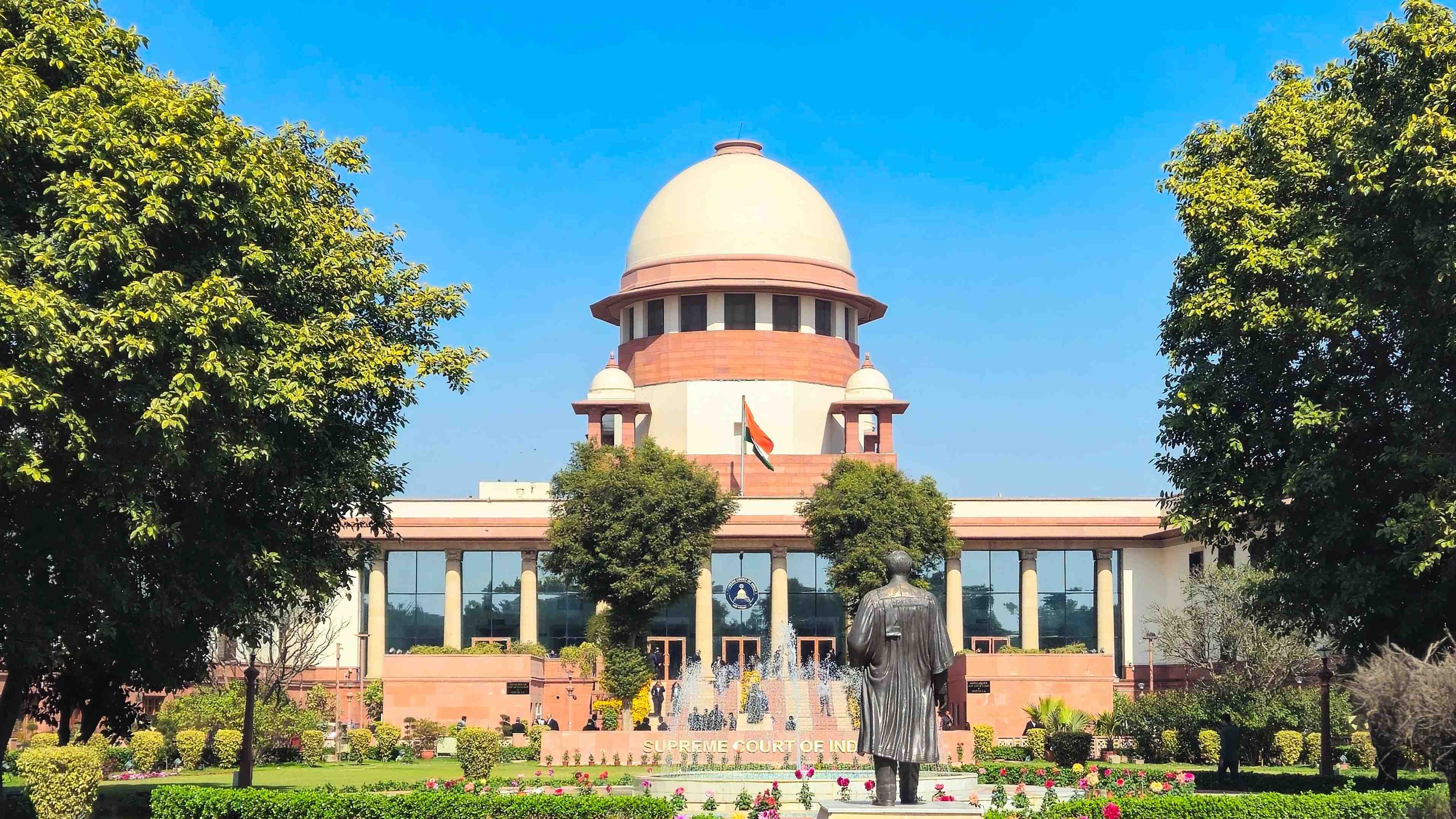
When the Supreme Court of India stepped in suo motu over a Class VIII Social Science textbook that cast aspersions on the judiciary, the action was immediate and emphatic. It ordered the withdrawal of the textbook and the assignment of responsibility. Whatever public perceptions may be — particularly under the present regime — institutional credibility, built over decades, could not be compromised in officially prescribed educational material. The National Council of Educational Research and Training (NCERT) conceded error. A corrective step followed. It was a swift demonstration of constitutional self-respect.
Yet the episode leaves a deeper and more disquieting question. If the court can intervene to protect its own institutional standing, what of the far more pervasive alterations across the broader spectrum of NCERT textbooks in recent years — alterations that affect millions of students and shape the intellectual quality of future generations?
What about the systematic deletions, compressions, reframings and selective emphases that cumulatively reshape historical consciousness along ideological lines? What of the academic climate in which these revisions occur — climate critics argue that it is heavily influenced by the ideological priorities of the Rashtriya Swayamsevak Sangh (RSS) and politically enabled by its governing affiliate, the Bharatiya Janata Party (BJP)?
Since the judiciary is vigilant about its institutional reputation, how does it explain the lack of comparable vigilance about the standing of knowledge itself, especially when the issue has been flagged repeatedly by academics, former textbook contributors and sections of the media, some of whom publicly contemplated legal recourse?
The controversies surrounding NCERT textbooks are not episodic. It is planned, structured, layered, cumulative and quite extensive. Successive editions — often justified as curriculum "rationalisations" — have introduced significant changes in history and political science textbooks. This includes: reduction of detailed discussion of the Mughal court and administration; removal of explicit references to the 2002 Gujarat riots; compression of analysis of communal politics and the demolition of the Babri Masjid; trimming of chapters on caste movements and structural inequality; and editing of references linking extremist ideologies to Mahatma Gandhi's assassination.
Sections analysing colonial economic exploitation have also been reduced. Discussions of social reform movements have been curtailed. Figures such as Vinayak Damodar Savarkar — whose historical record, including documented clemency petitions to the British, remains deeply contested among scholars — were elevated in celebratory terms without proportional contextual scrutiny.
Factually, the alterations represent narrative recalibration—not neutral streamlining—consistent with a sectarian socio-political worldview that prioritises civilisational glorification over critical inquiry and historical facts.
The treatment of the Mughal period, for instance, illustrates the shift. For decades, based on facts, NCERT textbooks described the Mughal Empire as a formative phase in India's administrative evolution, architectural innovation and composite cultural life. Syncretic practices, the opening of opportunities for lower castes, pluralism, and institutional sophistication were central to that narrative. Recent revisions have substantially altered it.
The removal of explicit references to the Gujarat riots from political science texts narrows engagement with contemporary communal violence. Democracies are strengthened not by selective amnesia but by confronting institutional breakdowns. Students denied rigorous engagements with such history are deprived of analytical tools essential to progressive constitutional citizenship.
Similarly, trimming sustained discussion of caste movements and structural inequality dilutes understanding of social hierarchies that continue to shape economic and political realities.
The same applies to instances of change in history and sociology textbooks. NCERT has defended these deletions, particularly in the context of pandemic-related reductions in academic load. Curriculum revision is legitimate. All education systems periodically condense material. The crucial question, however, is not whether trimming occurred but what was trimmed and why.
Largely, these shifts mirror positions long articulated by the RSS, which advocates reshaping national consciousness through education rooted in Hindu cultural nationalism. Through its extensive network of affiliated schools and institutions — some supported or facilitated by BJP-led state governments — curricula that emphasise ancient "Hindu" civilisation as the primary anchor have gained ground. Medieval history is frequently reframed as cultural subjugation, even though these are the indisputable ravages of time seen worldwide. Mythological narratives are foregrounded as civilisational proof-points. The inevitable consequence is the contraction of history and the minimisation of inconvenient complexities.
Importantly, if nearly six centuries of Muslim rule are reduced or reframed primarily through a lens of victimhood, what historical account replaces them? If the Muslim role is seen merely as subjugation while ignoring its contributions, and colonial rule is presented solely as exploitation without acknowledging legal reforms that abolished practices such as sati or introduced modern administrative frameworks, what explanatory continuity is offered? India, before colonial consolidation, was not a single nation-state but a mosaic of kingdoms, many hierarchical and internally exploitative. Simplifying that complexity in favour of civilisational mythology creates a historical vacuum. And vacuums invite distortion and ignorance.
The BJP, widely acknowledged as the political arm of the RSS, has governed during the period in which many of these curricular revisions occurred. This convergence of ideological ambition and political power has reshaped leadership across educational institutions, including curriculum committees and advisory boards. Appointments have increasingly reflected ideological alignment. Several scholars associated with earlier textbook committees have publicly expressed concern or resigned, alleging diminished academic autonomy.
Alongside deletion has come selective elevation. Textbooks now foreground certain regional rulers and revolutionaries whose narratives align closely with Hindu nationalist reinterpretations. Expanding representation is welcome when done proportionately. However, when framing consistently privileges a singular civilisational lens articulated in religious-cultural terms, addition becomes reinforcement rather than correction. Balanced historiography demands contextualisation, not hero construction.
This curricular recalibration also intersects with a parallel ecosystem often labelled "WhatsApp University." Digital platforms circulate simplified, frequently fabricated claims: ancient aviation technology, mythological episodes presented as empirically verified, uniformly negative portrayals of medieval centuries, and pseudo-scientific assertions devoid of scholarly grounding.
The boundary between mythology and historiography is foundational. India's epics and mythological traditions possess immense cultural value. They shape ethical imagination and collective memory. But historiography relies on archaeological evidence, textual criticism, comparative methodology and peer review. Collapsing these categories erodes intellectual clarity.
The proliferation of unverified historical claims among young minds is not accidental; it is nurtured by ill-founded ideological aspirations. In all of this, influence rarely announces itself. It operates through committee composition, prioritisation of themes and quiet editorial direction foregrounded by political and ideological rhetoric. Over time, such vagaries narrow critical academic debate. The implications extend beyond domestic politics.
Indian students, for example, increasingly enter global academic environments where South Asian history is taught through interdisciplinary scholarship grounded in documentation and archaeological research. Universities worldwide demand familiarity with historiographical debate, not civilisational assertion. If school-level education emphasises ideological narratives over methodological rigour, students face academic dislocation when they enter higher education.
They must relearn frameworks, recalibrate assumptions, and confront complexities that were omitted earlier, thereby burdening them. This produces a tangible disadvantage. Students accustomed to linear and celebratory narratives struggle with interpretive plurality. The divergence between domestic curricula and international scholarship undermines credibility and competitiveness.
Research excellence depends on early grounding in critical method and sound, universally accepted knowledge. With foundational education narrowing interpretive scope, intellectual agility suffers. At the school level, narratives may consolidate ideology; at the university level, disciplinary rigour is non-negotiable. Students are left straddling these worlds, compelled to unlearn simplifications before engaging in serious scholarship.
Moreover, when institutions of any sort mirror ideological consonance rather than diversity and educated footing, consequences are structurally social, economic and political and — as seen in the public statement of former ex-CJI DY Chandrachud of relying on religion for a ruling, and the extra-judicial statements of Justice GR Swaminathan invoking Sanatana Dharma and cultural traditions in his judicial life — can also impact judiciary, which is the guardian of the Constitution which precludes equity, criticism and inquiry for a vibrant democracy.
Presently, the judiciary's intervention demonstrates vigilance when institutional credibility is at stake, while systemic curricular transformation — shaping future politicians, lawyers, judges and policymakers — proceeds without comparable scrutiny.
Courts are not historians, nor should they dictate syllabi. But constitutional oversight includes safeguarding foundational values. When educational policy privileges a singular civilisational narrative over pluralist history, constitutional concerns arise.
Every government influences curriculum. The question is proportionality and national interest. National pride need not conflict with scholarship. Pride anchored in evidence is enduring. Pride anchored in mythic exaggeration is fragile and damaging. A confident civilisation confronts its complexities; it does not abridge them for political and indefensible ideological gain.
The larger danger lies not only in what is removed but in how omissions accumulate. A paragraph excised here, a chapter compressed there, a hero elevated without context leads to a shift in collective memory. Without a coherent, fact-based narration of the past, a constructive national vision is limited. Democracies thrive on debate and institutional self-critique, not sanitisation to suit politics and ideological pursuits.
Selective withdrawal of one textbook will not restore intellectual balance. The problem is much larger. Students must be presented with evidence, not unqualified affirmation. India's aspirations in science, technology and innovation demand education grounded in inquiry. Inquiry flourishes where questioning is encouraged and evidence respected. Ideological curation undercuts both.
The Supreme Court acted decisively when its integrity was questioned. The larger question persists: what about the integrity of India's knowledge system? What about the other NCERT textbooks, My Lords?
Education shapes citizens long after governments and judges change. Scrutiny of systemic curricular transformation when needed is not judicial overreach; it is constitutional prudence. The matter has been festering for too long. My Lords ought to address the insidious, unjustified and sustained shift in other textbooks with as much alacrity as they did for the court's reputation. Failing to do so risks its action on the class VIII textbook being perceived as self-protecting selectivity rather than a pervasive national interest. Reputations are earned, and manufactured knowledge remains entrenched through official dissemination.
.jpg)
.png) Cedric Prakash
Cedric Prakash
 ICPA
ICPA
 ICPA
ICPA
 ICPA
ICPA
 ICPA
ICPA
 ICPA
ICPA
 ICPA
ICPA
.jpg)
 A. J. Philip
.jpg)
.png) Jacob Peenikaparambil
Jacob Peenikaparambil
.jpg)
.png) John Dayal
John Dayal