

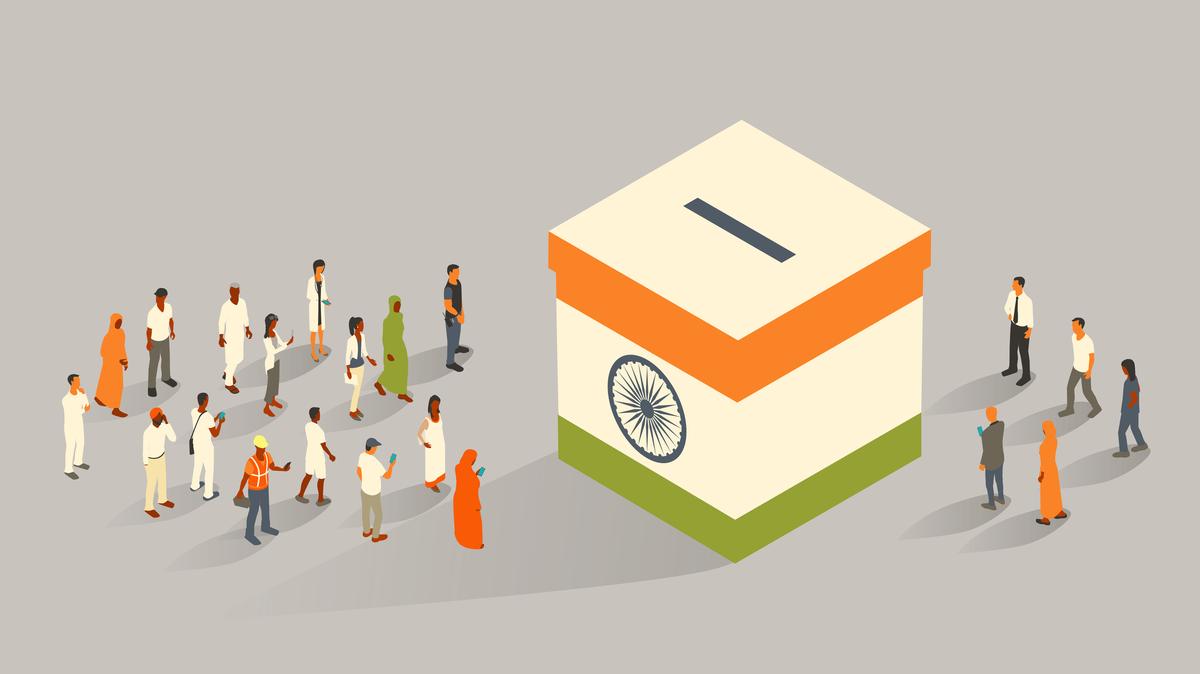
The failed delimitation exercise under the guise of Women's Reservation in the April 16–18, 2026, special session of Parliament is being projected by the ruling regime as a lost opportunity for women's empowerment. The opposition, in turn, is being cast as anti-women. Both claims collapse under scrutiny.
What was presented as a progressive reform was, in effect, a politically loaded restructuring of electoral power—one that made the bill's defeat both predictable and necessary in the interests of democracy and women's representation.
Women's reservation itself was never the issue. The Constitution (106th Amendment) Bill had already been passed in 2023 with broad political support. What remained was implementation.
Instead, the government chose to reintroduce it, binding it to delimitation—an exercise with far-reaching consequences for federal balance and electoral outcomes—without meaningful consultation with stakeholders across states. Given the long-standing opposition of southern states to delimitation, which would require a two-thirds majority, the bill's passage was unlikely despite anticipated political manoeuvring.
The bill's reintroduction reflected a calibrated political strategy with multiple objectives.
The first was political positioning. Statements in Parliament, coordinated protests, and amplification across media platforms and in campaigning in West Bengal and Tamil Nadu framed the opposition as anti-women.
This polarisation was also evident in the Prime Minister's address to the nation on April 18, 2026, with repeated references to the Congress—running into several dozen mentions, as noted in sections of the national media—while substantive commitments to women's representation remained minimal.
Political reactions reflected the sharp polarisation around the issue. At a press conference on April 19, 2026, in Delhi, Telangana Chief Minister A. Revanth Reddy described the move as a "political ploy" to secure a two-thirds majority in Parliament and enable constitutional changes. He further argued that linking women's reservation with delimitation could, over time, weaken existing reservation protections, including those for Scheduled Castes and Scheduled Tribes.
The apparent strategy was to place the opposition in a bind ahead of elections in West Bengal and Tamil Nadu, as well as subsequent contests leading up to 2029, in which women are expected to play a decisive role.
By tethering delimitation to women's reservation, the government constructed a powerful political shield—one now central to its electoral messaging, particularly in the wake of the significant consolidation of women voters in the 2025 Bihar Assembly elections.
In doing so, a contentious and far-reaching structural overhaul was embedded within a morally unassailable reform. To oppose the sequencing risked appearing opposed to women's empowerment. This is not legislative efficiency or concern for women's political representation—it is political engineering for electoral ascendancy.
A second, deeper objective is political entrenchment. Delimitation, in principle, rests on a simple democratic premise—equal representation proportionate to population. But in India of 2026 and beyond, a strictly population-based redistribution of parliamentary seats will inevitably tilt political power toward the Hindi belt states, where the BJP is strongly entrenched. This structural logic becomes clearer when viewed through electoral data.
Between 2014 and 2024, the five Hindi heartland states—Uttar Pradesh, Bihar, Madhya Pradesh, Rajasthan and Haryana—along with Gujarat, accounted for the bulk of the BJP's parliamentary strength. Non-Hindi states such as Karnataka, Assam, Odisha and Maharashtra supplemented this base but have not independently enabled government formation.
Notably, BJP seats in the five Hindi heartland states—excluding Gujarat—have declined from 152 in 2014 to 93 in 2024, reflecting electoral slippage in key states such as Uttar Pradesh, Rajasthan and Bihar. Post-2024 trends in Assam, Maharashtra and Karnataka also do not favour the party.
As shown in Chart 1, a linear projection based on the BJP's 2024 performance places the party at around 240 seats in a 543-member Lok Sabha in 2029. This model incorporates the party's recent 63-seat decline and treats opposition alliance consolidation as a structural shift rather than a temporary fluctuation. It does not account for anti-incumbency and emerging pressures—such as price rises, economic stress, foreign policy challenges, declining household savings, or potential fallout among women voters over the deferred women's reservation bill.
The broader environment adds further uncertainty. A potential El Niño cycle could weigh on agricultural output and rural incomes, while currency pressures and global volatility may affect inflation and purchasing power.
Questions persist around the sustainability and distribution of GDP growth, and shifts in global rankings have raised doubts about the durability of India's growth trajectory. Geopolitical developments in West Asia introduce additional risks.
Domestically, instability in Manipur, organisational challenges in Karnataka, limited presence in Tamil Nadu and Kerala, and continued contestation in West Bengal—including pushback against exercises such as the Special Intensive Revision (SIR)—all point to a more competitive landscape. Opposition consolidation in Maharashtra, including recent municipal elections, further reinforces this trend.
Taken together, these factors suggest a constrained and increasingly competitive path to power for the BJP under the existing 543-seat framework in 2029.
Chart 2, however, illustrates how this picture changes under an expanded Lok Sabha. Applying the BJP's 2024 state-wise success rates to a redistribution of seats based on the 2011 Census, the party's projected tally rises to around 410 seats in an 850-member House—before accounting for any change in vote shares.
This increase is not driven by improved performance, but by the structural effects of expansion itself, which disproportionately benefits northern states such as Uttar Pradesh and Bihar, where the BJP maintains its strongest organisational presence.
Uttar Pradesh, for instance, increases from 80 to 138 seats and Bihar from 40 to 72 under the population-based model (see Chart 4). Even with unchanged success rates, this translates into about 34 additional seats from these two states alone, illustrating how delimitation can amplify existing regional advantages.
These estimates are based on a linear application of 2024 electoral outcomes and are intended to illustrate directional impact rather than predict exact results.
Chart 3, on the other hand, highlights the corresponding redistribution elsewhere. The five southern states—Tamil Nadu, Karnataka, Andhra Pradesh, Telangana and Kerala—see their combined representation rise in absolute terms from 129 to around 172 seats, but their share of the Lok Sabha declines from approximately 23.8% to about 20.2%, underscoring the relative shift in political weight toward higher-population states.
Taken together, these projections illustrate a central point: even without an improvement in electoral performance, a population-driven expansion of the Lok Sabha would significantly enhance the BJP's parliamentary position by redistributing political weight toward regions where it is already structurally strong.
Delimitation also creates additional structural advantages. Few parties are likely to have the financial capacity to contest effectively across an expanded Lok Sabha, leaving many new constituencies open to those with the resources to compete widely. In such a scenario, the well-funded BJP would require only a fraction of additional seats beyond its projected base to consolidate a governing majority, with 425 as a halfway mark.
There is another factor at work as well: SIR (Special Intensive Revision), which has drawn criticism for disproportionately affecting opposition voters. Analysts have suggested that it may have played a role in shaping the outcomes of the 2025 Bihar Assembly elections.
Delimitation exercises in Jammu and Kashmir and in Assam have also drawn attention for their political implications, with critics arguing that such processes, if conducted without broad consensus and institutional safeguards, risk altering the electoral map in ways that favour the ruling establishment.
This is not a neutral institutional reform but a political agenda embedded within delimitation and linked to a Women's Reservation law already passed in 2023 but strategically left unimplemented.
The implications extend beyond electoral strategy to deeper questions of equality and federalism. With a strictly population-based delimitation using the 2011 census of 1.21 billion, Lok Sabha seats in the South fall from about 23.8% to approximately 20.2%, while the five Hindi heartland states and Gujarat – the BJP strongholds - would see their share rise significantly (see Chart 4). This is akin to punishing those states that controlled the population and fostered qualitative growth.
During the parliamentary debate, the Union Home Minister proposed a uniform 50% increase in seats across states. While this would have preserved regional balance, it was not incorporated into the bill and remains a political assurance rather than a constitutional framework.
Redrawing electoral boundaries is among the most consequential acts in a democracy—shaping representation, power distribution, and national policymaking influence for generations. Such decisions require transparency, consultation, and independent scrutiny. Instead, delimitation was advanced through an unrelated reform rather than as a standalone exercise.
This fits a broader governing pattern of pursuing high-impact policies through accelerated decision-making and limited consultation—but with a critical distinction: once constituency boundaries are redrawn, they cannot be undone.
The timing raises further questions. Delimitation depends on a fresh census, yet the census has been delayed without adequate explanation, creating an unusual situation in which the framework for restructuring is being politically advanced while implementation remains suspended. This bolsters the central question of whether the coupling of delimitation with women's reservation was driven by necessity—or by political design.
Opposition responses have begun to focus on delinking the two processes. On April 19, 2026, DMK Rajya Sabha MP P. Wilson introduced a Private Member's Bill proposing the immediate implementation of 33% women's reservation within the existing 543-seat Lok Sabha.
The defeat of the bill has also altered the political landscape more immediately. It creates the perception of a weakened Centre, potentially emboldening regional parties and reinforcing opposition consolidation ahead of 2029. Without the structural advantages of an expanded House, the BJP must now contest on a status quo map shaped by its 2024 performance.
The immediate consequence is clear: women's representation stands delayed once again. A reform intended to deepen democratic inclusion has been subsumed within a strategy of political entrenchment.
That trade-off, once made, rarely remains confined to one government. It reshapes the rules of the system itself.
(Projections are based on 2024 Lok Sabha performance levels using a linear trend model. Election data from ECI/TOI. Census 2011 from government publications. Delimitation proposals: 131st Amendment Bill. Analysis of trends in the article is based on these data.)
.jpg)
.png) Cedric Prakash
Cedric Prakash
 ICPA
ICPA
 ICPA
ICPA
 ICPA
ICPA
 ICPA
ICPA
 ICPA
ICPA
 ICPA
ICPA
.jpg)
 A. J. Philip
.jpg)
.png) Jacob Peenikaparambil
Jacob Peenikaparambil
.jpg)
.png) John Dayal
John Dayal