

.jpg) Jose Vattakuzhy
Jose Vattakuzhy
The new wave of labour unrest in India emerged in April 2026, beginning on April 3 in Manesar, Haryana, a major automotive hub. Initially centred on demands for higher wages, the movement quickly expanded beyond a single industry. A significant moment came on April 7, when women garment workers joined the protests, indicating a widening social base.
What started as a localised strike soon evolved into a broader agitation reflecting deeper concerns over wages, working conditions, and economic pressures affecting both organised and unorganised workers.
Rapid Expansion and Intensification of Protests
By April 13, the unrest had expanded significantly, encompassing approximately 45,000 workers across nearly 80 sites in Noida and spreading further to key industrial clusters in Rajasthan, including Bhiwadi, Neemrana, and Alwar. In Noida, the situation intensified, with demonstrations escalating into road blockades, confrontations with police forces, and instances of arson.
Law enforcement responded with measures such as the deployment of tear gas and the detention of workers, including arrests carried out at their residences. This trajectory suggests that the disturbances are not isolated incidents but rather part of a broader pattern of labour mobilisation unfolding across regions.
Continuity with Earlier Collective Actions
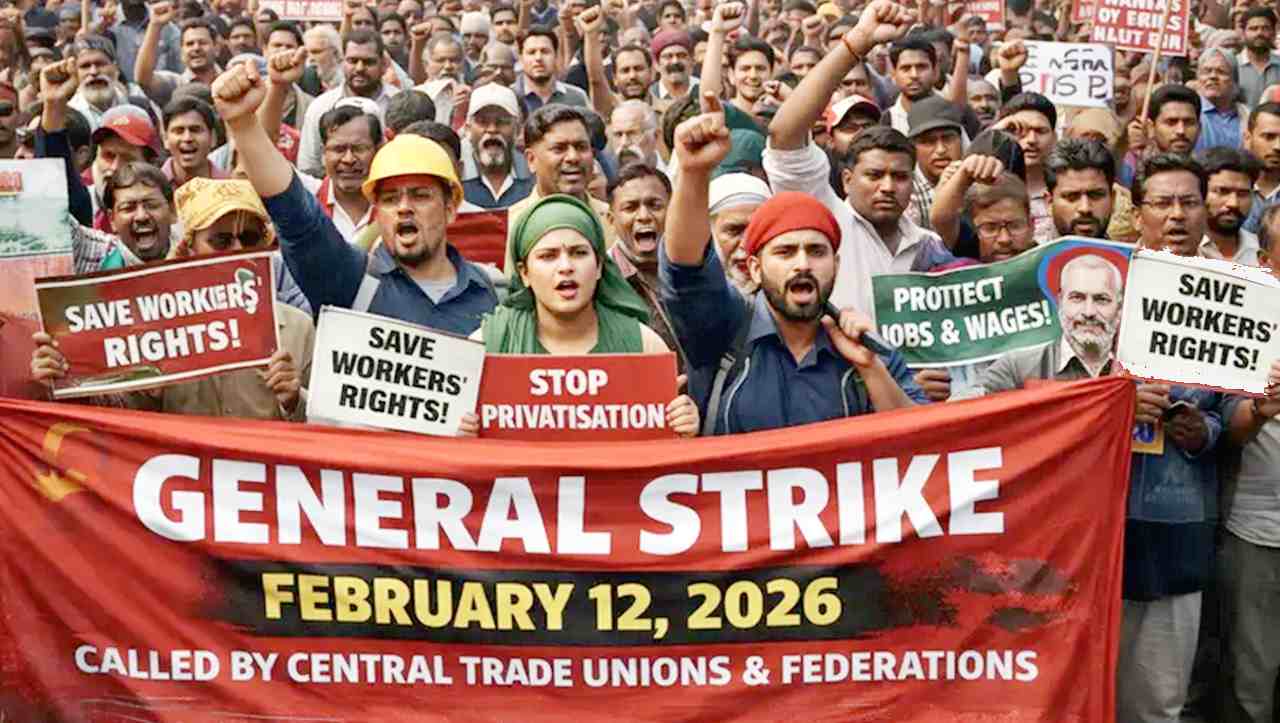
The developments also appear to build upon earlier collective actions, most notably the nationwide general strike of February 12, 2026, which witnessed the participation of millions of workers and farmers demanding enhanced labour protections and expanded social security measures.
In addition, an estimated 100,000 to 300,000 gig workers across India engaged in a coordinated nationwide protest on New Year's Eve 2026. Organised under the banner of the Indian Federation of App-based Transport Workers and the Gig and Platform Service Workers Union, this mobilisation reflects an emerging consolidation of collective identity and coordinated action among gig workers—groups historically marked by fragmentation and informality.
Profile and Conditions of the Workforce
The protests were largely driven by non-unionised contract workers employed in small-scale industries such as electronics, garments, and automobile components. Many are migrant workers from states like Uttar Pradesh and Bihar, living in overcrowded conditions on urban outskirts and struggling to meet basic living expenses. Their grievances are rooted primarily in economic hardship, particularly low and stagnant wages.
Most workers earn between ?10,000 and ?15,000 per month, with little improvement despite rising inflation. Even with extended working hours, earnings often remain around ?13,000, making it difficult to sustain a basic standard of living.
Deteriorating Working Conditions and Labour Insecurity
Working conditions further aggravate these challenges. Although the standard workday is officially eight hours, many workers report working 12 to 14 hours daily, often without adequate overtime compensation. Payslips frequently fail to reflect actual hours worked.
The contract labour system adds to insecurity by limiting access to formal benefits, weakening job protection, and restricting grievance redressal. Workers also report unsafe and overcrowded workplaces, inadequate ventilation and sanitation, and weak union representation, all of which reduce their ability to negotiate collectively.
Key Demands of the Workers
In response, workers have demanded a minimum monthly wage of ?18,000 to ?20,000, strict enforcement of the eight-hour workday, fair overtime pay, improved workplace conditions, and greater job security. These demands highlight both immediate concerns and long-standing structural issues in the labour system.
Immediate Triggers and Economic Pressures
Several immediate factors have intensified the protests. A sharp rise in the cost of living—especially food, rent, and transport—has widened the gap between wages and expenses. Delays in salary payments, particularly in export-oriented industries facing fluctuations in global demand, have added to financial stress.
Energy-related disruptions and rising input costs linked to global supply challenges have affected factory operations, leading to irregular work and reduced earnings. In this context, workplace incidents such as layoffs, wage disputes, or mistreatment have acted as triggers for collective action.
Regional Disparities and the Role of Digital Communication
Regional wage inequalities have further intensified worker dissatisfaction. While Haryana responded to similar unrest with substantial wage hikes, workers in Uttar Pradesh perceive the measures adopted locally as inadequate, reinforcing their demand for fair and uniform wage policies.
Meanwhile, the swift circulation of information through social media platforms such as WhatsApp and Facebook has facilitated rapid communication and coordination, enabling protests to spread quickly across multiple industrial units. This escalation was also underlined by reports of the arrest of an alleged "mastermind" accused of orchestrating the violence.
Structural Changes in the Labour Economy
The unrest also points to deeper structural shifts within India's labour economy. A growing dependence on contract and other precarious forms of employment has left many workers without adequate job security or social protection.
At the same time, the introduction of new labour codes has generated uncertainty and heightened concerns about the potential weakening of workers' rights. Long-standing problems—such as excessive working hours, unpaid overtime, and the poor enforcement of labour laws—continue to fuel discontent.
Challenges in Implementing Labour Codes
The implementation of India's four labour codes—the Code on Wages, 2019, Industrial Relations Code, 2020, Occupational Safety, Health and Working Conditions Code, 2020, and Code on Social Security, 2020—has also been delayed due to a combination of structural, political, and administrative constraints.
In addition, global economic pressures, including inflation and supply chain disruptions, have raised costs for workers and industries, further intensifying tensions over wages and employment conditions.
Changing Nature of Labour Unrest
Another notable aspect is the evolving character of labour unrest. Unlike earlier movements that were largely confined to the organised sector, contemporary protests are more diffuse, drawing in informal, migrant, and contract workers.
The rise of digital communication has further hastened mobilisation, enabling protests to spread rapidly and making them more difficult to control. Notably, external actors appear to have played a more significant role in these developments than the so-called trade unions, which are traditionally expected to represent and defend workers' interests.
Growth, Inequality, and the Future of Labour
Overall, this new wave of labour unrest highlights a growing tension between rapid industrial growth and the need for fair labour standards. It affects workers' livelihoods, disrupts production, and places increasing pressure on governments to respond through stronger policy measures and more effective enforcement.
The unrest is not driven by a single cause but by a convergence of stagnant wages, rising living costs, insecure employment, and evolving labour policies, underscoring the challenge of balancing economic growth with equity and stability.
Relevance of May Day in the Present Context
In this context, the significance of International Workers' Day becomes particularly relevant. Observed globally as a symbol of workers' rights and solidarity, May Day serves as a reminder of the historic struggles that secured basic labour protections and the continuing need to uphold them.
The present unrest echoes these enduring concerns, calling for renewed commitment from governments, employers, trade unions and society to ensure dignity, fair wages, and social security for all workers.
.jpg)
.png) Cedric Prakash
Cedric Prakash

 ICPA
ICPA
 ICPA
ICPA
 ICPA
ICPA
 ICPA
ICPA
 ICPA
ICPA
 ICPA
ICPA
.jpg)
 A. J. Philip
.jpg)
.png) Jacob Peenikaparambil
Jacob Peenikaparambil
.jpg)
.png) John Dayal
John Dayal