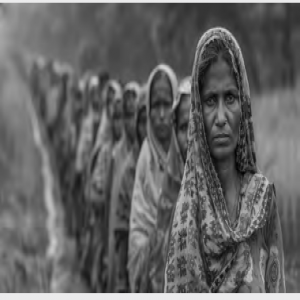


.png)
1. Discrimination:
The law of closed doors
Your third stage
Is discrimination,
The tightening of rules
Around the necks of the Dalit castes.
O Dr Gregory Stanton,
For us,
Discrimination is not a stage
It is the air-conditioner
Of the subcontinent:
Always on,
Invisible to those
Who kill my skin.
Temples and Mosques
Shut like fists
At our arrival,
Wells forget our thirst,
School benches
Shrink miraculously
When we sit down.
The Constitution
Wrote a promise
On paper:
"Equality,"
"Fraternity,"
"Justice."
But in the village,
But in the city,
But in the Hindu diaspora,
But in the Muslim world,
The ink dries differently.
We carry that book
Like a fragile god,
And every day
The policeman,
The landlord,
The judge
Scratch out one more line
From its heart.
My people clean your toilets,
Sweep your streets,
Clean your wounds,
Tie your shoelaces,
But are told
They are "unfit"
For your offices,
Your boardrooms,
Your sacred syllables.
My sisters clean your excreta
By day, by night
And are raped in your fields
By day, by night.
At dawn
Both labours
Go uncounted,
Unpaid,
Exploited,
Massacred.
You call this the third step
On the road to genocide.
We call it
"Dalit experience."
2. Dehumanisation:
When language becomes a weapon
Your fourth stage
Is when language
Cracks open
And spills out
The animal.
Here, we are called
Dog.
Pig.
Crow.
Fox.
Buffalo.
Impure.
Dalit.
Untouchable.
Pariah.
Madiga.
Dirt.
Words that stick to our bodies
Like dried blood on October 7.
The scripture says
Our very shadow
Can defile.
So we were made to walk
At noon
When shadows are shortest,
Our heads bowed
To keep our eyes
From contaminating the sun.
You study psychology
Of killers;
We study the grammar
Of butchers.
Manual scavenging,
You call it
In your reports
Such a gentle phrase
For a work
That tears the soul.
Imagine, Jurist,
Climbing each day
Into the throat of a nation
To scrape out its excreta
With your bare hands,
To breathe its rot,
And emerge
Only to be told
You are filthy.
Our bodies are used
Like tools
And then blamed
For being stained.
Dalit girls and women
Are stripped naked,
Paraded through the village
Their breasts become blackboards
Where caste writes its lesson
For the next generation:
"This is your place."
You warned the world
That dehumanisation
Makes murder easy.
Here, it has made
Life itself
A slow, permitted killing.
3. Organisation:
The invisible armies
Your fifth stage says
Genocide is always organised.
You search for militias,
Uniforms,
Chains of command.
Come walk our daylight roads.
The Hindus and the Muslims
Have no official insignia,
But their Sanatan-Sharias
Have learned
Our names.
The caste panchayat
Needs no letterhead,
Its verdicts
Are etched on our backs
With hot iron
And lynching strokes.
Bathani Tola.
Laxmanpur Bathe.
Kilvenmani.
Karamchedu.
Tsunduru.
Khairlanji.
Every Dalit body.
Every Dalit soul.
The villages fall from my mouth
Like milk teeth.
Each one
A lesson in logistics:
Who will block the exits?
Who will torch the huts?
Who will erase?
Who will maim?
Who will ensure
The police arrive
Late enough
To only count the ashes?
Organisation, you say,
Can be decentralised.
Here, it is woven
Into Hindus, Muslims,
Village councils,
State legislations,
Parliamentary houses,
Lawmaking bodies,
Neighbourhood whispers,
Caste associations,
Shudra,
Vaishya,
Kshatriya,
Brahmin,
Muslim Brotherhood,
Tribal,
That collect funds
For festivals
And for weapons
To erase my skin.
O Genocide Scholar,
The State,
Plays both tormentor
And spectator.
The police receive advance warning
Like wedding invitations:
Arrive after the bride
Is already a corpse
On the riverside of the Khairlanji.
FIRs misfiled,
Names misplaced,
Dalit witnesses lynched,
Evidence gassed,
An entire machinery
Perfectly calibrated
To do another massacre.
You look for genocidal plans
In cables and memos.
Ours are written
In the silences
Of government offices
And on the oral histories
Of untouchables.
.jpg)
.png) Cedric Prakash
Cedric Prakash
 ICPA
ICPA
 ICPA
ICPA
 ICPA
ICPA
 ICPA
ICPA
 ICPA
ICPA
 ICPA
ICPA
.jpg)
 A. J. Philip
.jpg)
.png) Jacob Peenikaparambil
Jacob Peenikaparambil
.jpg)
.png) John Dayal
John Dayal