

Shaping Young Minds in the Shadows
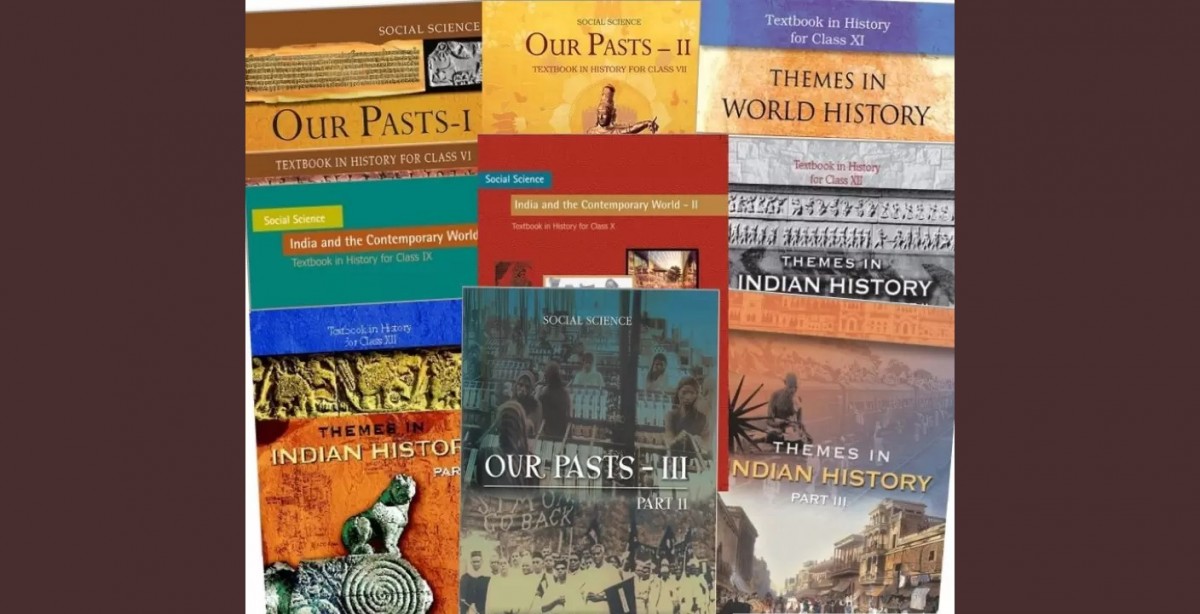
School textbooks should help children understand their country clearly and honestly. In India, NCERT books hold unusual authority because most states depend on them for teaching, examinations, and teacher training. When these books are delayed, divided, or quietly rewritten, the effect is felt in every classroom. Over the past few years, NCERT's shifting practices have unsettled teachers, parents, and researchers.
The problem is not only one of poor management. The pattern suggests a deeper project: to reshape how children imagine India's past and present. Key sections on the Mughals, Islamic rule, the RSS's role in Gandhi's assassination, caste discrimination, communal violence, and even scientific ideas have been trimmed or removed. They alter the story India tells its children about itself.
Fragmented Books, Fragmented Understanding
For decades, NCERT issued full textbooks in single volumes. Students and schools knew what to expect. Splitting books into two parts was once limited to higher classes. Over time, the practice has expanded sharply. Today, even Classes 7 and 8 receive multiple volumes for Social Science and Mathematics. Class 9 History is split. Classes 11 and 12 handle several books for a single subject. A Class 12 student may juggle half a dozen NCERT books in one year.
At first, this may look like an administrative detail. But the growing number of parts and the strange timing of their release raise questions. Fragmentation now acts as a mechanism to delay sensitive content, introduce changes without public scrutiny, and keep teachers dependent on unpredictable schedules. When the second part of a book arrives months late—or not at all—students and teachers lose the ability to plan lessons or complete the syllabus.
The latest delays have left thousands of schools in disarray. Some received Part I of Class 7 and 8 books in May or July, well after the academic year began. Part II was promised for September or October. Only Class 7 Mathematics Part II appeared in late October. The rest remain missing. Teachers cannot finish the curriculum. Students fear they will walk into exams unprepared. Private schools have improvised. Government schools have not been so lucky.
This may appear as inefficiency, but the repeated pattern suggests otherwise. By deciding when children receive certain chapters, NCERT also controls what remains teachable within the academic year.
Chronic Delays and an Institution in Disarray
The year 2025 has been especially chaotic. New textbooks for Classes 4, 5, 7, and 8 arrived after the session had already begun. Teachers had no choice but to wait. They could not rely on older editions because the syllabus had changed. The second part of the key books never came. Schools now face the real possibility of sending children to the 2026 examinations without full textbooks.
Educationist Anita Rampal calls NCERT a "habitual defaulter." She argues that such lapses are unacceptable for a body on which the entire school system depends. Her concern is not merely about delays but the lack of accountability. The NCERT leadership has offered no explanation. Media queries have gone unanswered.
A Textbook as a Silent Chisel
Beyond delays, the content inside the new books reveals a more deliberate project. Entire chapters on the Mughal Empire, the Delhi Sultanate, and women rulers such as Razia Sultan and Nur Jahan have vanished. Islamic rule appears only in fragments. The sweep of medieval India is reduced to brief references to invasions and fragmented kingdoms. Students receive a narrow, almost monochrome picture of a complex period.
Modern history has been reworked in similar ways. The story of Gandhi has been trimmed to remove references to Hindu extremists who opposed his efforts at Hindu–Muslim unity. Mentions of Godse's ideology, his association with RSS circles, and the post-assassination ban on the RSS have been removed. The Gujarat riots of 2002, once taught in Political Science and Sociology, have disappeared. Discussions of state failure, Vajpayee's reminder on rajdharma, and survivors' testimonies are no longer present.
Even the Ayodhya chapter has been reframed. The phrase "Babri Masjid" has been erased and replaced with a vague description of a "three-domed structure," as if the event occurred in abstraction. The political mobilisation around its demolition is nowhere to be seen.
Other subjects are affected too. Darwin's Theory of Evolution has been removed from Class 10 Science. Chapters on democratic movements have quietly disappeared. References to caste discrimination, minority rights, and secularism have been softened. Mentions of Maulana Abul Kalam Azad have been deleted from Class 11 Political Science.
The Ideological Blueprint
The nature of these changes mirrors long-standing demands of the RSS and its educational affiliates. For decades, they have called for school textbooks that glorify ancient Hindu civilisation, minimise Islamic rule, question Darwin, present caste as harmonious, and reframe nationalism in majoritarian terms.
NCERT describes the recent revisions as "rationalisation." Yet the deletions consistently align with ideological preferences. The omissions shield students from episodes where Hindu majoritarian groups played a troubling role. They also weaken scientific thinking by promoting uncertainty where none exists.
The multi-part textbook system amplifies this effort. Sensitive chapters can be placed in Part II, which may be released so late that teachers barely have time to cover them. Students face these topics without time for discussion or reflection. In such circumstances, learning becomes a hurried ritual rather than a thoughtful encounter with ideas.
Taken together, the delays, omissions, and restructuring reveal a slow but steady attempt to mould public memory.
Impact on Classrooms and Childhood
The consequences for students and teachers are significant. Children learn an incomplete account of the country they inhabit. They miss the complexity of medieval India, the context of Gandhi's struggle, the pain of communal violence, and the rigour of scientific reasoning. In this vacuum, simplified narratives settle easily: Hindus as perpetual victims, others as perpetual outsiders.
Teachers lose autonomy. They cannot rely on old books. They cannot supplement missing content because they are uncertain what the new books contain. Many have finished only a small part of the year's syllabus. Students feel anxious and unprepared.
This deepens inequality. Elite schools can purchase additional resources. Government-school students depend entirely on NCERT. They end up learning less and learning later. The injustice is stark: children who most need stable learning material are the ones receiving the least.
The danger extends far beyond exam performance. A generation raised without an understanding of communal violence, caste oppression, secularism, evolution, dissent, or the complex layers of Indian history will inherit a brittle view of democracy. Majoritarian ideas will appear natural. Diversity will seem inconvenient. Critical thinking will wither.
A Path Back to Integrity
India needs a clear and firm response. State governments must reclaim their autonomy in textbook development through expert committees. An independent National Textbook Review Commission should evaluate content, with historians, scientists, educationists, sociologists, and child development specialists working free of political pressure.
NCERT must be mandated to publish a list of deleted passages, explain each change, and disclose the names of its committee members. Transparency itself would limit manipulation.
Teachers must be empowered to use older editions, state board books, and independent references. Comparing multiple sources helps students cultivate a habit of scrutiny. Schools should document missing chapters and delayed books and share this information openly with parents.
Parents can play a crucial role. They can demand timely textbooks, file RTIs, monitor revisions, and hold meetings to ensure children receive full and accurate content.
Civil society and academia must support schools. Historians, scientists, and researchers should publish supplementary material and critique misleading content. Universities can create free digital resources in history, civics, and science so students have credible alternatives.
Political leaders, too, must treat this as a national issue. Parliament should demand timelines, oversight, and accountability. Education cannot be left to shifting political winds.
Guarding the Minds of a Nation
NCERT shapes how millions of children see their world. It cannot be allowed to drift into ideological tutelage. When textbooks are trimmed, delayed, or manipulated, the republic itself is placed at risk.
Education is a public trust. It must remain honest, balanced, and open to complexity. India cannot afford a generation raised on half-truths or sanitised stories. Restoring transparency and intellectual independence in NCERT is not merely a reform—it is an essential act of national self-preservation.
The ideas sown in classrooms today will shape the country tomorrow. India must decide whether it wants citizens who can think, question, and understand—or citizens trained only to conform. The choice is urgent.
.jpg)
 A. J. Philip
.png) Cedric Prakash
Cedric Prakash
.jpg)
 P. A. Chacko
.jpg)
.jpg)
.jpg) Thomas Menamparampil
Thomas Menamparampil
.png)
.png)
.png) Robert Clements
Robert Clements
.jpg)
.png)
.png) Chhotebhai
Chhotebhai