

.png) Jaswant Kaur
Jaswant Kaur
.jpg)
As if the crisis of inequitable access, learning disparities and uneven opportunities were not enough, we have another to solve. Just like the stealthy snake, it has tightened its grip on our classrooms, making little noise.
Unfortunately, a lot has been said about it, yet it has been ignored just like the pigeon that closes its eyes the moment it sees the cat in front of it, knowing fully well what is coming.
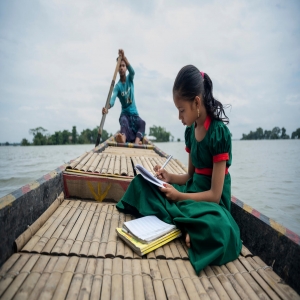
Climate change is no longer a distant threat discussed in big flashy summits or conferences. It is in front of us. It has been affecting millions of children across India, be it in the form of increasing heat, unpredictable rain, choking air or storms that refuse to follow familiar patterns.
UNICEF's recent report, Learning Interrupted: Global Snapshot of Climate-Related School Disruptions, lays bare a crisis we can no longer push under the carpet. Last year, nearly one in seven children in India could not attend school due to climate extremes disrupting their education.
For these 54 million Indian schoolchildren, heatwaves scorched school calendars, floods washed away months of progress, droughts pushed families into distress migration, and cyclones swept away the fragile continuity of learning. India bore the heaviest burden globally, even though South Asia contributes so little to global emissions.
Yet this is not merely a statistic. It is a lived reality in rural and underserved regions where children already navigate long distances, unpredictable family incomes and a schooling system that often struggles to retain them. When climate disruptions shut down a school for a week, two, or three, the loss is not just of lessons but of confidence, continuity, and, in many cases, especially for girls, the loss of school itself.
Every closure raises a question whether a child will return, whether they will be pulled back into labour or even married off at a young age. Every flood becomes a reminder of how fragile our educational foundations are.
The numbers are stark. Heatwaves alone pushed 50 million Indian children out of classrooms in April 2024. Some states shifted timings while others declared blanket closures. In both cases, the learning day shrank, fatigue increased, and the loss accumulated. Floods and cyclones added millions more to the tally. States like Bihar, Uttar Pradesh, Assam, West Bengal, Odisha, Rajasthan and many others saw repeated closures as school buildings were used as shelters or became inaccessible due to damaged roads.
Globally, 242 million children across 85 countries faced such disruptions. India accounted for almost a quarter of them. The scale forces a difficult question: can a country with one of the world's largest school-going populations afford to treat climate-linked school loss as an unavoidable side effect of development? Or should we now see resilient education as its strongest climate adaptation strategy?
This crisis is not episodic; it is becoming structural. With 2025 already signalling trouble through heat, pollution surges, erratic showers, cyclones and floods, the COP30 debate on non-economic losses such as broken learning cycles becomes even more relevant for us. Reports emerging in mid-November already caution that without urgent reforms, the next five years may see a doubling of school disruptions.
What makes the crisis more worrying is its unevenness. Schools in India are not built equally. Many homes lack cooling or ventilation systems during summer, affecting children's health. Some have no pucca roofs that can withstand heavy rainfall. Others lack proper drainage, meaning a single afternoon downpour can flood entire compounds. Early-warning systems rarely reach last-mile communities, and even when they do, schools are not equipped to respond.
The result is predictable: when climate shocks strike, children in vulnerable areas lose the most. Girls carry a heavier burden. Families worry about safety during long walks to school or temporary shelters. When schools stay closed for extended periods, girls are often pulled into household duties, sibling care or early marriages. What looks like a temporary disruption quietly becomes a permanent derailment.
The economic fallout is equally damaging. UNESCO estimates that every lost school day results in learning losses that exacerbate existing gaps in foundational skills, as several studies have shown. When students fall behind in early years, the journey into meaningful employment becomes steep and treacherous.
Community-based skilling organisations across India encounter this regularly. In drought-prone belts and regions hit by extreme heat, training centres lose productive days, students lose motivation, and families prioritise survival over learning. This constant stop-start rhythm drains momentum and widens the very skill gaps the country is trying to close.
Climate disruptions also place enormous stress on teachers, who are already burdened with several administrative tasks. During emergencies, these teachers are responsible for leading relief efforts while keeping learning alive remotely, without digital tools or consistent connectivity. Such issues rarely make headlines, but they shape the quality of education children receive in the long term.
The answer lies in reimagining solutions that ensure preparedness not only to teach but also to withstand shocks. UNESCO's Comprehensive School Safety Framework (CSSF), endorsed by 84 countries, offers a holistic approach to school safety, including climate resilience through infrastructure upgrades (e.g., retrofitting, drainage, early warning systems) and continuity plans such as digital backups. Global pilots show it has reduced disruptions by 25-40 per cent, aligning with needs such as solar cooling and raised plinths for heat waves/floods in India.
India too has endorsed this framework, but the efforts to build resilient schools have been fragmented. For instance, the PM-SHRI claims to upgrade thousands of schools with solar panels and retrofits. Similarly, Samagra Shiksha claims to fund drainage and basic infrastructure and NDMA issues heat-action guidelines every summer. Each effort is valuable, but we need an umbrella programme on the lines of CSSF that holds these isolated schemes together to ensure this safety net.
But without this, we risk repeating disrupted school days, contributing to educational losses and school dropouts. When schools receive even minor upgrades, such as shaded corridors, cross-ventilation, water stations, and uninterrupted power supply, their ability to remain functional during extreme weather rises significantly.
Curriculum reforms must also include mandatory climate drills, disaster preparedness, and the integration of early-warning systems into school timetables. The NEP 2020 already champions experiential learning; climate resilience can become one of its strongest anchors if implemented seriously.
Technology can act as an equaliser. Community-level early-warning apps, SMS grids, and localised climate alerts can help families, teachers and school leaders plan better. States like Kerala have already shown that heat action plans can reduce school closures by nearly 25 per cent. We already have the solutions; we now need the political will to implement them at scale. Without decisive action, climate projections for 2050 suggest a grim possibility: Indian children could experience twice as many school disruptions as today.
But this is not a story of despair. It is a call to act before the window narrows further. Policymakers must treat education loss not as an incidental outcome but as a central part of climate budgeting. District administrations must prioritise safe learning environments in heat, flood, and cyclone management plans.
Philanthropists and corporate leaders must recognise that the future workforce they hope to skill or employ is already under threat. Funding resilient schools and adaptive learning models is not charity; it is an investment in India's long-term economic and social stability.
The country cannot afford a generation whose education was punctured repeatedly by climate extremes. Nor can it afford to pretend the crisis will correct itself.
.jpg)
 A. J. Philip
.png) Cedric Prakash
Cedric Prakash
.jpg)
 P. A. Chacko
.jpg)
.jpg)
.jpg) Thomas Menamparampil
Thomas Menamparampil
.png)
.png)
.png) Robert Clements
Robert Clements
.jpg)
.png)
.png) Chhotebhai
Chhotebhai