


.jpg) Jose Vattakuzhy
Jose Vattakuzhy
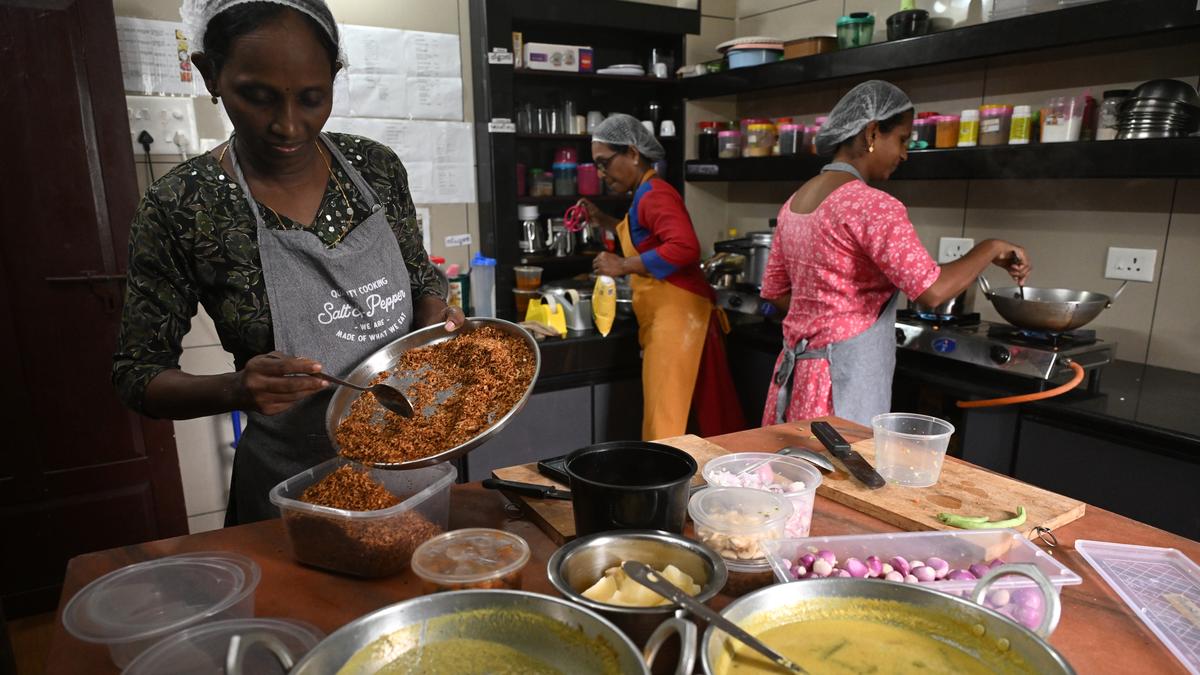
When India speaks about Artificial Intelligence at global platforms, the conversation often revolves around innovation, start-ups, and digital transformation. But in a small rented house in Kochi, AI has a very different meaning for Anitha, a 34-year-old homemaker and mother of two.
For years, Anitha's world was limited to her kitchen. Her husband's irregular income as a daily wage worker made managing school fees and medical expenses a constant struggle. She had no formal employment, no salary, and no economic identity beyond being a "housewife."
Everything changed when she registered on the "Shero Home Food" platform—an AI-enabled home-chef marketplace that connects home kitchens with customers via a delivery network. Using just a smartphone, Anitha received short online and offline training from Shero Home Food Network and uploaded photos of her homemade meals, including edible biriyani and traditional Kerala curries.
The platform's algorithm recommended her menu to nearby customers, suggested pricing based on demand, and even advised her on portion sizes to reduce waste.
Within months, her modest kitchen became a micro-enterprise. Orders began to arrive daily. Delivery partners collected food from her doorstep. Digital payments were credited directly to her account. For the first time, Anitha earned her own income — sometimes ?600–800 a day — without stepping outside her home.
Yet, her story also reflects the fragile reality of AI-mediated informal work. On days when the platform's algorithm reduced visibility of her menu, orders suddenly dropped. Festival promotions introduced heavy competition. Service ratings determined her earnings. She had no written contract, no guaranteed income, and no social security coverage.
Anitha's journey through the platform captures the paradox of AI in India's unorganised sector: technology that empowers and enables, yet simultaneously controls and constrains. Her kitchen is no longer just a domestic space; it is a node in a digital economy governed by invisible algorithms.
As India hosts an international discussion on AI's future, stories like Anitha's remind us that the real impact of artificial intelligence is not only in laboratories and corporate boardrooms, but in ordinary kitchens — where opportunity and vulnerability coexist.
Across India's cities and villages, millions like Anitha perceive algorithms and automated systems not as distant tech, but as forces reshaping livelihoods — especially in the informal sector, where job security is already tenuous. As India hosts the International AI Impact Summit in New Delhi, the promise and peril of AI converge most sharply on these unorganised workers who form the backbone of India's economy.
AI's Growing Footprint in India
Studies assert that India's AI adoption is accelerating across sectors—from AI-enabled tractors in agriculture to automation in services—driven by both private investment and national policy emphasis on frontier technologies. However, economists and labour experts warn that the disruptive impact of AI is not confined to high-tech industries but is also reaching informal employment.
In 2025, the Ernst & Young India report estimates that AI could impact about 38 million jobs across both organised and unorganised sectors by 2030, with significant gains in productivity but also major upheavals in traditional work patterns. Studies also indicate up to 69 per cent of jobs in India may be at risk of automation over the coming decades, with the unorganised sector particularly vulnerable due to its reliance on routine, low-skill work and limited access to reskilling opportunities.
Impact on Unorganised Workers — Data and Trends
India's informal workforce comprises approximately 490 million workers across agriculture, construction, domestic work, street vending, transport, and micro-services. These workers generally operate without formal contracts, social security coverage, or access to structured training. Such conditions heighten their vulnerability as artificial intelligence (AI) systems expand across sectors.
Job displacement and wage insecurity are not new phenomena; however, the spread of AI introduces new pressures. Routine and repetitive tasks—common within unorganised sectors—are increasingly susceptible to AI-enabled automation and optimisation, potentially reducing demand for human labour. At the same time, AI adoption accentuates existing skill gaps. Only a small proportion of India's workforce currently possesses AI-relevant competencies, widening the digital divide between those able to adapt and those at risk of exclusion.
A growing number of informal and gig-based roles are mediated through AI-driven digital platforms that determine work allocation, performance ratings, and earnings. This algorithmic management often limits workers' control over pay rates and working conditions, reinforcing precarity rather than reducing it.
Beyond statistical indicators lies a significant human dimension. While AI technologies promise efficiency and productivity gains, their development and deployment also rely on vulnerable labour.
Investigations have documented the psychological toll on Indian women engaged in moderating and labelling training data for AI systems, many of whom come from rural and marginalised backgrounds. Frequently employed on ambiguous contractual terms and lacking legal or mental health protections, these workers are exposed to distressing content with minimal institutional support.
The experience of such workers underscores a broader reality: the human workforce sustaining AI systems may face vulnerabilities comparable to those threatened by automation itself.
Policy Responses and Inclusive Pathways
To prevent artificial intelligence from deepening socio-economic inequality, India's policymakers have proposed initiatives such as the "Digital ShramSetu Mission," a national programme aimed at empowering informal workers through AI-assisted skills training, improved digital access, and inclusive frameworks.
The government has also established task forces and initiated labour reforms to examine and mitigate AI's potential impact on employment, alongside ongoing social security measures and dialogue with unions to extend protections to gig and informal workers.
These efforts reflect an acknowledgement that AI adoption must be accompanied by human-centric policies rather than driven solely by efficiency metrics, particularly if India's vast unorganised workforce is to participate equitably in technological progress. However, many of these initiatives remain largely at the proposal stage and lack comprehensive legal backing and effective implementation mechanisms.
Toward an Inclusive AI Future
The integration of artificial intelligence into the Indian economy is both inevitable and transformative. The central challenge is to ensure that innovation uplifts the country's 490 million unorganised workers rather than further marginalising them. As India advances its AI ambitions on the global stage, policy attention must remain focused on developing inclusive, equitable, and humane strategies in which technology serves people, not merely productivity.
This requires expanding social safety nets, including pilot programmes for universal basic income, portable benefits for gig workers, and mandatory insurance coverage enabled through regulatory oversight of AI platforms. Ensuring fairness and transparency in algorithm-driven work allocation and wage determination—alongside the enforcement of minimum wage standards and accessible grievance redressal mechanisms—is equally essential.
Furthermore, support for micro-entrepreneurship should be strengthened through improved access to credit, digital financial inclusion initiatives, and AI-enabled matching tools that connect informal enterprises with broader markets.
.jpg)
.png) Cedric Prakash
Cedric Prakash

 ICPA
ICPA
 ICPA
ICPA
 ICPA
ICPA
 ICPA
ICPA
 ICPA
ICPA
 ICPA
ICPA
.jpg)
 A. J. Philip
.jpg)
.png) Jacob Peenikaparambil
Jacob Peenikaparambil
.jpg)
.png) John Dayal
John Dayal