

.png) John Dayal
John Dayal
.jpg)
As they try to connect with advocacy groups in the United States and European Union headquarters, Indian religious minority activists are discovering the reach and power of the Rashtriya Swayamsevak Sangh, RSS, in Western capitals and the offices of ruling political parties.
The RSS's diaspora expansion over the years —fuelled by millions in funding and cultural camouflage— is ready with lobbyists who have access to US Congressmen, Members of the European Parliament, and editorial heads in major international media, selling a counter-narrative against India's Muslim, Christian and Sikh minorities.
Countering Christian and Dalit is seemingly their top priority under the impression, mistaken or not, that the West has a natural and historical empathy towards these two communities, and would give them a sympathetic hearing.
Their main job is to shield the Modi regime while dividing local Indian communities on religious or caste lines. The centenary plans of the RSS, however, include "protecting Hindus abroad," a code for aggressive Hindutva.
Reports show that in the Asia Pacific region and Africa, the RSS has tried to erode pluralism. This writer remembers that even in the early 1980s, senior RSS activists used to go to Mauritius and the Fiji Islands, both with substantial Indian-origin populations, the children of indentured labour taken there by the British to work in the plantations.
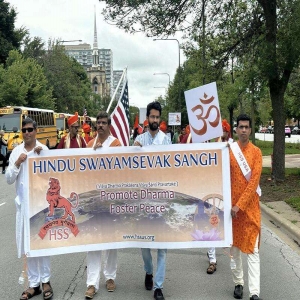
The USA hosts the most robust RSS outpost, with the Hindu Swayamsevak Sangh, USA (HSS USA) serving as its ideological vanguard since its formal registration as a tax-exempt non-profit in 1989.
This is curious because the RSS in India is unregistered, with no income tax record or its name in any government register – apart from rare instances when a case is registered against it for hate and violence against Christians or Muslims.
Inspired by the RSS's Hindutva, which envisions India as a Hindu Rashtra excluding Christians and Muslims as "alien invaders," HSS USA has ballooned from modest beginnings to 222 shakhas (branches) across 32 states and 166 cities by 2020, impacting 45,000 families through 426 affiliated organisations.
Annual reports boast of serving 6,000 participants in 2016, rising to 8,880 in shakhas by 2019-2020, with activities blending yoga, language classes, and festivals such as Vijay Dashami and the foundation day to indoctrinate youth.
Affiliates like the Vishwa Hindu Parishad of America (VHPA), with 21 chapters in 14 states, the Hindu American Foundation (HAF), and Sewa International form a web of 23 organisations holding $97.7 million in assets.
Funding flows from RSS-linked philanthropists: the Bhutada Family Foundation donated $1.74 million (2006-2018), while seven groups funnelled $158.9 million to India (2001-2019), much during BJP rule, supporting supremacist projects.
Following the massacre of Muslims in Gujarat in 2002, an international Coalition Against Genocide based in the US had investigated the funding of the Indian RSS and published a document "Funding Hate" which, for the first time, traced the funding and ideological origins.
RSS-HAF, founded in 2003 by RSS-trained activists, is a key node in this global Hindutva movement, rebranding bigotry as advocacy. It opposes caste discrimination laws like California's SB403, spending $300,000 to argue they victimise Hindus, and lobbies against US resolutions condemning Modi's policies, such as the revocation of Kashmir's autonomy and the Citizenship Amendment Act (CAA), which discriminates against Muslims.
Political influence is brazen: the Hindu American Political Action Committee (HAPAC) disbursed $172,000 (2012-2020) to candidates like Raja Krishnamoorthi and Tulsi Gabbard, who attended RSS events and now head the US government intelligence ecosystem.
Events like the 2019 "Howdy Modi" rally in Texas, attended by 50,000 and Donald Trump, showcase this clout.
Yet, this masks threats: HSS curricula demonise Muslims as "foreign invaders," fueling harassment of scholars like Audrey Truschke via SLAPP lawsuits.
US Commission on International Religious Freedom (USCIRF) scholars warn of HSS's role in alienating minorities, eroding interfaith trust, and supporting the BJP's anti-Muslim agendas. As The New York Times notes, RSS's infiltration ensures its longevity, polarising even progressive diaspora spaces.
In the UK, the RSS operates through HSS UK, registered since 1974, with activities adapted to diaspora life—family-oriented shakhas emphasising a "mythical Hindu past." By 2025, it celebrated 50 years of Sangh Shiksha Varg with record attendance.
Affiliates like VHP UK, headquartered in Leicester, promote "Hindu Dharma" but are tied to RSS's violent history, including the 1992 Babri Masjid demolition and 2002 Gujarat riots. Sewa UK, part of RSS's welfare arm, has been accused of diverting funds to militants, while Param Shakti Peeth UK, founded by Sadhvi Rithambara of Babri Masjid infamy, spreads divisive rhetoric.
Government data from the UK Charity Commission highlights governance issues: a 2016 inquiry into HSS UK noted its RSS links and recommended transparency. Overseas Friends of BJP UK (OFBJP) campaigning in the 2019 elections, urging Hindus to vote Conservative against Labour's Kashmir stance, using WhatsApp to label opponents "traitors."
In 2022, the Leicester riots saw 200 Hindu men marching in Muslim areas, chanting "Jai Shri Ram"—a Hindutva war cry—leading to attacks, flag burnings, and disinformation blaming "Islamic extremists."
Georgetown University's report on Hindutva in Britain calls for impartial reviews to counter disinformation, warning of eroded cohesion in diverse cities.
A new exposure is from Australia and New Zealand, where HSS operates as a "voluntary, non-profit" entity committed to "character building" and promoting Hindu values. Established in the 1990s, it runs shakhas adapted for the diaspora. In New Zealand, HSS celebrated Vijayadashami in 2025, focusing on "community service."
Australian government concerns emerged in 2021 when a New South Wales parliamentarian flagged Hindutva teachings in public schools.
The Diplomat reports Hindutva's East Asian expansion, backed by RSS funding and diaspora networks.
Research reports on Oceania's Hindu diaspora notes RSS's role in Fiji, Australia, and NZ, where indentured labourers' descendants (41% Hindu in some communities) are targeted.
South Africa's Indian community, 2.7% of the population (1.7 million), with 41% Hindu, 25% Muslim, and 24% Christian, has hosted RSS affiliates like HSS and VHP since 1994-1995.
Religion Unplugged warns of threats to pluralism. Anti-Muslim/Christian sentiments, self-censorship, and divisive fundraisers erode apartheid-era unity.
Mauritius, with RSS shakhas since the 2010s, is part of the 39-country network, spreading "Hindu culture" amid a 48% Hindu population. The Times of India reports that indoor gatherings are restricted, but growth ties to Modi's visits.
The Caribbean—Trinidad, Guyana, Suriname—hosts vibrant HSS chapters. In Guyana, HSS has hosted annual Diya lighting since 2014, with 2025 events drawing officials. Facebook posts show collaborations with Indian High Commissions. The Indian Express notes Modi's early visits to Guyana.
India does not allow cadre-based Muslim or Christian organisations, outlawing them at the first instance. The most recent was the ban on the Kerala-based Muslim group, the Social Democratic Party of India (SDPI).
.jpg)
.png) Cedric Prakash
Cedric Prakash
 ICPA
ICPA
 ICPA
ICPA
 ICPA
ICPA
 ICPA
ICPA
 ICPA
ICPA
 ICPA
ICPA
.jpg)
 A. J. Philip
.jpg)
.png) Jacob Peenikaparambil
Jacob Peenikaparambil
.jpg) John Dayal
John Dayal