

 A. J. Philip
.jpeg)
One elementary principle of serving food is to ensure that the food is palatable to the visitor. If I am alone at home, I may be perfectly happy having a glass of milk with some porridge for dinner. But I would not dream of serving the same meal to a guest who has come to my house for dinner.
I would first ask what they would like to eat. Would they prefer chapattis with mutton curry? Would they like vegetable kurma? Or would they prefer rice, sambar and the other traditional dishes of Kerala?
My wife often tells me that cooking for a non-vegetarian is easier than cooking for a vegetarian. For a non-vegetarian, one good meat or fish dish can make a meal. A vegetarian, particularly one accustomed to variety, may expect several dishes to make the meal satisfying.
That, however, is not the point. The purpose of hospitality is to satisfy the guest's taste buds, not to impose the host's food habits on them.
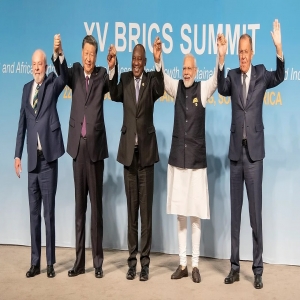
This elementary principle of hospitality acquired an international dimension at the BRICS summit in New Delhi. The gala dinner hosted for the visiting leaders was entirely vegetarian.
There is nothing wrong with vegetarian food. India possesses a rich vegetarian culinary tradition, and it deserves to be showcased before the world. But India possesses an equally extraordinary non-vegetarian culinary tradition. To leave it out altogether was to present only one part of the Indian gastronomic story.
The omission becomes more striking because the BRICS gathering brought together people from countries where vegetarianism is not necessarily the norm. A diplomatic dinner is not an ordinary family meal. It is an opportunity to tell visiting dignitaries something about the host country.
At a recent marriage reception I attended at a temple in Kerala, food was served on banana leaves. Among the dishes was one that was blackish and looked remarkably like beef fry. I knew it could not be beef, but it tasted sufficiently like beef to arouse my curiosity. Finally, I asked the woman serving the food what it was.
"Soyabean granules," she said. We seem to have perfected the art of making vegetarian food imitate non-vegetarian food. There is nothing wrong with that either. But it would be unfortunate if India's culinary diplomacy became a celebration of vegetarian dishes pretending to be non-vegetarian dishes while the real thing was kept out of sight.
Consider what could have been presented. North India has tandoori murgh, smoky chicken marinated in yoghurt and spices and roasted in a tandoor. It has mutton galouti kebab, the famously delicate minced-meat kebab associated with Lucknow.
Eastern India has kosha mangsho, the rich, slow-cooked Bengali mutton preparation, and ilish bhapa, hilsa steamed with mustard. Goa has pork vindaloo, with its distinctive combination of vinegar, garlic and spices. Rajasthan has laal maas, a fiery mutton curry traditionally associated with the region.
South India has chicken ghee roast from the Mangalorean coast and karimeen pollichathu from Kerala, where pearl spot is marinated with spices, wrapped in a banana leaf and cooked until the flavours permeate the fish. And then there is the Northeast, which is often ignored in India's gastronomic imagination.
Assam offers masor tenga, a light and tangy fish curry, and preparations of duck with ash gourd and spices. Nagaland has smoked pork with bamboo shoot. Meghalaya has jadoh, made with red rice and pork. Manipur has iromba, in which vegetables, fermented fish and fiery chillies come together. Sikkim has phagshapa, a preparation of pork with dried chillies and radish.
The menu at an international summit need not have included all of them. No menu could. But some representation of India's non-vegetarian traditions would have made the culinary portrait of India more complete.
There is another point. India is not a vegetarian country in any simple sense. Dietary practices vary enormously by region, caste, community, religion, family and individual. My own experience tells me how absurd it is to speak of a single Indian food culture.
My mother never cooked non-vegetarian food during the ten days of Onam. But when I went to North Kerala, I discovered that non-vegetarian dishes could be served alongside vegetarian dishes during Onam celebrations.
When I first went to Patna in 1980, I was surprised to find mutton being served in an upper-caste household as part of a Dussehra celebration. A few years later, when I returned to the city, two former colleagues organised a mutton-and-litti-chokha party. Mutton was cooked slowly until it became tender and richly flavoured.
The lesson was obvious: Indian food habits cannot be reduced to neat categories. Even religious practice is not uniform.
The recent controversy in West Bengal provides an interesting illustration. Dhirendra Krishna Shastri, popularly known as Bageshwar Baba, appealed to Bengali Hindus to refrain from non-vegetarian food during Durga Puja. The remarks provoked controversy because fish and meat are deeply embedded in Bengali food culture.
West Bengal Chief Minister Suvendu Adhikari subsequently visited Kalighat Temple and partook of the traditional fish bhog, including fish head, fried fish and basanti pulao. Reports noted that his participation came amid the controversy over Shastri's remarks.
If Narendra Modi had been born in Nagaland, he might have grown up eating pork. If he had been born into a Bengali family, fish might have been a daily part of his diet. If he had been born into a Muslim family, his food habits would almost certainly have been different. If he had been born into a Maithil Brahmin family in Bihar, he might have grown up with yet another culinary tradition.
Food is largely a matter of where and how one grows up. I consider myself a vegetarian, but I would happily have a piece of fish, fried or curried, with rice or a wheat preparation. I am not particularly fond of meat. But if someone served me a beef preparation without giving me a choice, I would probably eat it rather than embarrass my host.
There is an old Buddhist story about the Buddha accepting pork from a host rather than disappointing him. The precise historical details of that story are debated, and the account of his death after eating the dish is likewise the subject of different interpretations. But the underlying idea is familiar: accepting food graciously can itself be an act of courtesy.
I once saw a similar cultural accommodation in Mongolia. During a visit there, I had an interpreter who later became a minister in the Mongolian government. He had picked up a little Hindi while undergoing a medicine-related course in Jaipur.
Mongolians are traditionally great meat eaters. My interpreter had brought to Jaipur a large jar of powdered horse meat with him. Whenever he was served dal or another vegetarian dish in Jaipur, he would sprinkle some of the meat powder into it. That was how he made an unfamiliar vegetarian meal palatable to himself.
I found the story amusing, but there was a lesson in it. Food preferences travel with people. When people travel, hosts have to accommodate them. Diplomacy has understood this for a long time.
"When Donald Trump and Kim Jong-un met in Singapore in 2018, the working lunch included a deliberate mixture of Western and Asian foods. There was prawn cocktail, Korean stuffed cucumber, beef short-rib confit, sweet-and-sour pork with fried rice and soy-braised cod. The menu was designed to bring together different culinary traditions rather than make either side eat only what the other side preferred." (NY Times)
Food can establish intimacy between nations. It can also cause offence. In diplomacy, even the origin of an ingredient can become politically significant. A dish may carry geographical associations, historical memories and territorial sensitivities. That is why a diplomatic menu is often examined almost as carefully as a diplomatic communiqué.
There is an amusing irony in all this. Some years ago, the Catholic Bishops' Conference of India (CBCI) invited Sri Sri Ravi Shankar of Art of Living fame as chief guest. Out of deference to him, only vegetarian food was served. But he apparently chose not to eat, playing with a lemon instead. If the story is correctly remembered, I would regard that as poor manners.
A guest should either politely eat what has been served or, if the food is incompatible with his dietary practice, discreetly explain his preference in advance.
Prime Minister Modi himself has reportedly faced a similar situation abroad. When the US President hosted him at a dinner, care was taken to accommodate his dietary preferences. Alas, the guest merely drank water. Hospitality is reciprocal.
When I invite someone to dinner, I do not expect him to become a copy of me for the evening. The same principle applies to governments.
A state dinner is not a private meal in the Prime Minister's house. The guests are representatives of countries and cultures. Their food habits are part of who they are. The host has the opportunity to introduce them to Indian cuisine while also making sure that they are comfortable.
The Indian government could have done both. It could have served an impressive vegetarian spread and included a few non-vegetarian choices. Nobody would have been forced to eat meat or fish. Vegetarians could have enjoyed the vegetarian dishes; non-vegetarians could have chosen something else. This is not difficult.
Imagine, for a moment, that an Indian leader who does not eat beef were invited to a banquet where the hosts proudly served Beef Wellington, a fillet coated with mushroom duxelles and pâté, wrapped in puff pastry and baked, or Beef Bourguignon, the classic French stew of beef slowly braised in wine. The hosts might say, quite innocently, "This is the food we eat." Would the Indian guest feel entirely comfortable?
Unfortunately, we Indians sometimes make the mistake of imagining that the rest of India eats what we eat. Many people in the North assume that South Indians live on idli, dosa and sambar. They forget that Kerala has an enormous repertoire of dishes, from appam and stew to puttu and kadala, fish curry, karimeen and a bewildering variety of preparations made with coconut and spices.
Tamil Nadu and Karnataka have equally diverse cuisines. Amritsar is famous not only for Amritsari kulcha, generously enriched with ghee, but also for Amritsari fish, the crisp, spiced fish preparation that is a favourite of visitors to the city.
India's culinary map is almost as complicated as its linguistic map. The mistake is to imagine that vegetarian India represents all of India. It does not. Nor does non-vegetarian India represent all of India. Both exist. They coexist. Often they exist within the same family.
I remember an embarrassing episode from my journalistic days in Patna. When Bindeswari Dubey was chief minister, the Patna edition of the Hindustan Times carried a photograph of him eating a large piece of chicken. The picture was headlined "Sunday Meal."
The photograph did not go down well with the Chief Minister. He stopped advertisements to the paper, and we had to find ways of mollifying him. Dubey was a Kanyakubja Brahmin, but his eating chicken was hardly a matter for public judgement.
The greater mistake was ours. A person should not be photographed while eating without his knowledge or consent. If the photograph is to be used, the person should at least know that the camera is clicking.
The central point is not whether vegetarianism is good or bad, nor whether non-vegetarian food is superior or inferior. These are personal choices. The point is that hospitality is about choice.
The BRICS dinner was an opportunity to display India's extraordinary culinary heritage. Perhaps the visiting leaders did not mind. Perhaps they enjoyed the food. Perhaps some of them later returned to their hotels and ordered what they really wanted through room service. We do not know.
The Government of India may rightly wish to showcase vegetarian India to the world. It may rightly celebrate millets, regional vegetarian dishes and its sustainable culinary traditions. But India is also the land of fish curries, kebabs, mutton, chicken, pork and innumerable regional preparations. That is the India we should be confident enough to present.
A. J. Philip
.jpg)
.png) Jacob Peenikaparambil
Jacob Peenikaparambil
.jpg)
.png) John Dayal
John Dayal
.jpg)
 Pachu Menon
.jpg)

.png)
.png)
.png) Robert Clements
Robert Clements
.jpg)