

.png) John Dayal
John Dayal
.jpg)
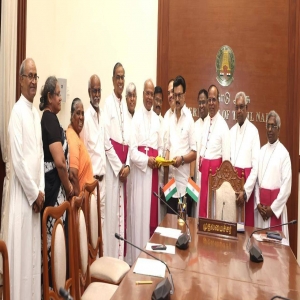
Tamil Nadu Chief Minister MK Stalin, who the Catholic and Protestant Bishops blessed for his work for Dalit Christians and others in the community, lost his seat, but an unheralded but popular cinema star Vijay Joseph, who challenged him in the state, is the new Chief Minister-Designate of the important southern state as the dust settles on the 2026 Assembly elections.
Vijay could well have gone with the All-India Anna DMK, which came third after Stalin's DMK, but he chose to accept the support of the Congress Party, offered by its leader Rahul Gandhi.
The two comparatively young leaders had, in fact, considered a pre-poll alliance, but Rahul Gandhi chose to stick with Stalin, who was then considered invincible.
For Rahul Gandhi, this is a double gain, as the Congress has also swept neighbouring Kerala, ending the ten-year rule of Marxist chief minister Pinarayi Vijayan.
Post-election analysis of the 2026 Assembly elections in Kerala, Tamil Nadu, Puducherry, West Bengal, and Assam shows that Christian voters remain electorally important where they are regionally concentrated, institutionally organised, or embedded in coalition politics.
They are not, however, a single transferable vote bank; therefore, while their influence was strong in Kerala and visible in Tamil Nadu and Puducherry, it was limited in West Bengal and Assam, where larger Hindu-majoritarian and regional narratives dominated.
A precise count of Christian winners by party and gender is not officially available because the Election Commission does not classify candidates or MLAs by religion, but is unofficially known by public identity and party nominations.
Kerala is the clearest case of Christian electoral weight. The Congress-led UDF returned to power with 102 seats, while the LDF fell to 35 and the BJP won three seats, its best Assembly performance in the state.
The Congress alone won 63 seats, while the CPI(M) fell to 26, but the swing was strongest in minority-influenced regions, including Muslim-majority northern Kerala and Christian-significant central Kerala.
Though Christian voters were central to the UDF victory, this was not simply a religious vote but reflected anti-incumbency, anger over governance, welfare fatigue, institutional anxiety, and the UDF's ability to rebuild local alliances.
The BJP made its most visible Christian outreach in Kerala, fielding prominent Christian faces, including PC George in Poonjar, Shone George in Pala, George Kurian in Kanjirappally and Anoop Antony Joseph in Thiruvalla.
The gamble did not deliver a Christian-belt breakthrough as Anoop Antony lost Thiruvalla to Kerala Congress candidate Varghese Mammen by 10,146 votes, and Shone George's campaign also became controversial after a public clash over alleged Catholic clergy support for Congress.
The BJP's three victories came through non-Christian candidates, showing that symbolic minority nominations alone could not overcome community distrust, local church signals and the UDF's deeper social base.
Kerala's Christian winners were concentrated mainly in the UDF, especially in the Congress and the Kerala Congress faction. According to activists of the All India Catholic Union, 16 who won were members of the Syro-Malabar Catholics, 5 Latin, 5 Church of South India, 5 Jacobite, 3 Orthodox, a Mar Thoma, and a solitary Pentecostal who made history in his own way.
The most striking result was VS Joy's Congress victory from Thavanur in Muslim-majority Malappuram, where Christians are a tiny minority, defeating KT Jaleel by 14,647 votes with the support of the main Muslim League group.
Church interventions in Kerala were issue-based rather than formally partisan, as the Latin Catholic Church pressed a 15-point charter that included implementing the JB Koshy Commission recommendations, coastal development, education, employment, and wider Christian anxieties over institutional autonomy, FCRA restrictions, land, welfare, and minority safeguards.
Tamil Nadu witnessed the most dramatic political shift, with Vijay's Tamilaga Vettri Kazhagam emerging as the single-largest party with 108 seats in the 234-member Assembly, short of the 118-majority mark. The DMK won 59, AIADMK 47, Congress 5 and PMK 4, breaking the old Dravidian DMK-AIADMK binary.
Christian identity mattered in Tamil Nadu, but less directly than in Kerala, as they are a small but influential minority in southern districts and among educational networks.
Vijay's Christian background gave TVK minority visibility, but his success came from a broader anti-incumbency and youth-driven appeal. As he did not campaign as a Christian but on a political menu of welfare and renewal campaign that drew minorities without frightening non-minority voters.
The number of Christian candidates fielded by TVK has been reported in political discussions as significant, but a verified final list by religion is not available from official sources.
One notable Christian woman winner in Tamil Nadu was Coimbatore-based billionaire 'Lottery king' Martin's wife Leema Rose Martin, who fought on an AIADMK ticket and won from the Lalgudi constituency. Her son floated his own party in neighbouring Puducherry and won, while her son-in-law also won in Tamil Nadu as a Vijay ally.
Puducherry gave the NDA a clear victory, with AINRC winning 12 seats, BJP 4, AIADMK 1, and LJK 1, giving the NDA 18 seats in the 30-member Assembly. Christians are electorally visible in Puducherry but not decisive across the whole Union Territory.
West Bengal moved in the opposite direction, with the BJP sweeping the polls, winning 207 seats, while the TMC fell to 80, and the Congress and Left were humiliated, winning one seat each.
Christian voters in Bengal are concentrated in pockets, including tribal and hill regions, parts of north Bengal and small urban communities, and are too few and too dispersed to alter the statewide result.
The BJP's victory was built on broader consolidation among Hindu voters, Scheduled Caste mobilisation, Scheduled Tribe dominance in several belts, and excellent micromanagement. It was aided by the presence of central forces and a general fatigue with 15 years of Mamta Bannerjee's rule.
Assam confirmed the limits of Christian electoral influence where demographic weight is small, and politics is structured by identity, security, welfare and ethnic coalitions. The NDA won 102 of 126 seats: BJP 82, AGP 10 and BOPF 10. Congress won 19, AIUDF 2, RJRD 2 and TMC 1.
Christians in Assam, including tribal and tea-garden communities, matter in local pockets, but they did not shape the overall verdict, and the election was dominated by Chief Minister Himanta Biswa Sarma's Islamophobic campaign and Hindu consolidation, welfare schemes and the fragmentation of the Opposition parties.
Political pundits who have studied these five states say Christian voters can swing close contests in plural states, but they cannot withstand a statewide wave when they are numerically small and politically dispersed.
The gender picture remains thin. Kerala elected several women overall, but Christian women winners were not visible as a major bloc. Tamil Nadu produced at least one prominent Christian woman winner, the billionaire Leema Rose Martin, but no other prominent faces.
It seems Christian representation in Indian politics remains male-dominated and mediated through parties, churches, family networks and caste-community calculations.
Compared with the previous Assemblies, Christian influence rose in Kerala because the UDF's comeback restored Christian-heavy central Kerala to the centre of government formation.
It rose symbolically in Tamil Nadu because Vijay's TVK gave Christian identity a new public visibility without making it sectarian. It remained limited in Puducherry. It declined in practical relevance in West Bengal and Assam because BJP-led victories were built on wider consolidations that did not depend on Christian voters.
Indian Christians are politically active but not politically uniform, and experts say they vote through local histories, denominational anxieties, welfare interests, concerns about institutions, and also caste and tribal identity, with youth aspirations and fear of majoritarian pressure as the overall issues.
Parties that treated them as citizens with institutional and economic concerns did better than parties that treated them as a symbolic nomination category, and Christian political weight was real in Kerala and visible in Tamil Nadu, but minimal elsewhere.?
.jpg)
.png) Cedric Prakash
Cedric Prakash
 ICPA
ICPA
 ICPA
ICPA
 ICPA
ICPA
 ICPA
ICPA
 ICPA
ICPA
 ICPA
ICPA
.jpg)
 A. J. Philip
.jpg)
.png) Jacob Peenikaparambil
Jacob Peenikaparambil
.jpg) John Dayal
John Dayal