

.png) Jacob Peenikaparambil
Jacob Peenikaparambil
.jpg)
The most important lesson for opposition parties from the recently concluded Assembly elections is clear: if they fail to stand united, not only will they lose politically, but democracy itself may gradually vanish from India's political landscape.
After consolidating its dominance in North, West, and Central India, the Bharatiya Janata Party (BJP) has expanded its influence eastward, capturing power in Bihar, Odisha, and, most recently, West Bengal, where it won 206 out of 294 seats. When the BJP came to power at the Centre under Narendra Modi in 2014, it (and its allies) governed only seven states. In May 2026, that number has risen to 22, with 14 ruled by the BJP and 8 by its allies. According to a report in The Times of India (May 5), 8 out of 10 Indians now live in states governed by the BJP or the NDA.
Regional parties that aligned with the BJP have often been weakened or marginalised over time. A recent example is the Janata Dal (United) (JDU) in Bihar. Conversely, parties that directly confronted the BJP have faced intense political battles, with the BJP employing all available means—fair or otherwise—to defeat them.
The defeats of key opposition leaders such as Mamata Banerjee and MK Stalin—both seen as strong challengers to the BJP—have further weakened the opposition. BJP leader Suvendu Adhikari remarked, "Mamata, Tejashwi, and Rahul are finished; Akhilesh is next," referring to Akhilesh Yadav, who is expected to be a key challenger in the upcoming Uttar Pradesh elections.
The BJP is not merely another political party operating within conventional democratic norms. Its ideology clearly advocates majoritarian autocracy, and its policies and actions over the last 12 years have amply proved that it aims for an opposition-free (vipaksh mukt) Bharat. Moreover, "it is a party with killer instinct, with an infinite hunger for victory and always willing to walk an extra mile to win," as journalist Ashutosh wrote in Free Press on May 5.
Once in power, the BJP is often accused by critics of consolidating control over democratic institutions by placing ideologically aligned individuals in key positions. The influence of the Rashtriya Swayamsevak Sangh (RSS), which runs various training bodies for professionals, is frequently cited in this context. It is no wonder that some judges are influenced by the RSS ideology, and it is reflected in their judgments. Allegations include the politicisation of institutions, pressure on opposition leaders, and the misuse of investigative agencies, making it difficult to dislodge the party from power once it is established.
Although the BJP faced a setback in the 2024 Lok Sabha elections by failing to secure an outright majority, it quickly recovered by winning a series of state elections, including Haryana, Maharashtra, Bihar, Delhi, West Bengal, and Assam.
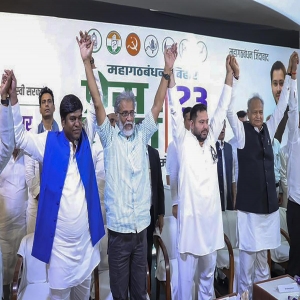
In contrast, the opposition alliance failed to regroup effectively. The INDIA bloc did not undertake a serious post-election review or strategy reset. In Bihar, the Mahagathbandhan alliance failed to reach a seat-sharing agreement, leading to "friendly contests" between parties such as the Congress and the RJD. This created confusion among voters, who questioned how parties unable to agree on seats could govern together. The result was a landslide victory for the NDA, which won 202 out of 243 seats in the 2025 Bihar Assembly elections, leaving the opposition with just 35 seats.
A similar pattern emerged in West Bengal, where the Left and Congress contested separately, splitting anti-BJP votes. Had they coordinated with the Trinamool Congress, the outcome might have been different. At the same time, Mamata Banerjee's decision to take on the BJP alone, without forging broader alliances, also contributed to the scale of defeat.
A key difference between the BJP and the opposition lies in organisational cohesion and strategic discipline. The opposition, especially the Indian National Congress, has struggled to match the BJP's intensity and coordination.
Concerns have also been raised about the functioning of the Election Commission of India (EC). Opposition leaders, including Rahul Gandhi, have alleged irregularities such as "vote chori" (vote theft). However, these concerns have not translated into sustained, united action against the EC functioning as a department of the BJP.
One contentious issue is the EC's introduction of "logical discrepancy" as a criterion for voter exclusion, which reportedly led to 2.7 million people being denied the right to vote in West Bengal. Critics argue that this lacks a legal basis under the Representation of the People Act, 1950, and the Registration of Electors Rules, 1960. Former Chief Election Commissioners Ashok Lavasa and OP Rawat have publicly questioned its validity.
According to political analyst Yogendra Yadav, these deletions account for 4.3% of votes in the state—close to the BJP's 4.6% lead over the TMC—raising serious questions about their potential impact on election outcomes.
Even where the Congress has performed well, such as in Kerala, its overall position remains weak due to poor results in Assam and West Bengal. Structural challenges, such as constituency delimitation, have played a role in Assam in helping the BJP win, but they do not fully explain the opposition's failure to stand together and challenge the BJP. Has Congress put its heart and soul into fighting the Assam election?
The way forward requires urgent and decisive action. With each election, the space for democratic competition appears to be narrowing. The Congress must take the initiative to convene a comprehensive meeting of opposition parties for honest introspection and strategic planning.
Key priorities should include:
1. Ensuring the impartial functioning of the Election Commission and addressing controversial practices like "logical discrepancy." Approaching the Supreme Court for legal remedies may not be enough.
2. Contesting elections as a united front to avoid vote fragmentation.
3. Improving governance in opposition-ruled states to present credible alternatives.
4. Developing a compelling narrative addressing unemployment, education, healthcare, inflation, inequality, and women's safety—while avoiding overreliance on populist giveaways.
5. Upholding core constitutional values such as secularism and democratic integrity.
If necessary, Congress should be willing to hand over the leadership of the opposition alliance to a more strategically positioned regional party to strengthen the alliance.
Time is running out. Unless opposition parties rise above narrow political interests and unite, the future of democratic pluralism in India may be at risk. In the absence of a functioning democracy and constitutional safeguards, political diversity itself could diminish—leaving space for only one dominant force.
.jpg)
.png) Cedric Prakash
Cedric Prakash
 ICPA
ICPA
 ICPA
ICPA
 ICPA
ICPA
 ICPA
ICPA
 ICPA
ICPA
 ICPA
ICPA
.jpg)
 A. J. Philip
.jpg) Jacob Peenikaparambil
Jacob Peenikaparambil
.jpg)
.png) John Dayal
John Dayal