

.jpeg)
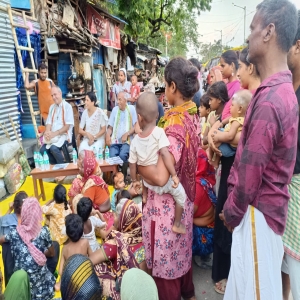
When flames tore through the fragile shanties along the Narkeldanga canal one humid evening in February 2025, families lost everything in minutes. Bamboo poles, tin sheets, plastic and tarpaulin roofs collapsed into ash. Mothers clutched children, rickshaw pullers watched their meagre belongings burn, and despair hung heavy over the settlement. For decades, they had endured floods and disease, but this fire was different—it stripped them bare. Into this devastation stepped the Salesians of Don Bosco, who had cared for Kolkata's street children since 1985, now determined to bring dignity to canal dwellers neglected by civic authorities and overlooked by local NGOs.
Forgotten Settlement by Drainage Canal
Kolkata's canals were once the lifelines of the city. Dug during the colonial era by the East India Company to connect the Hooghly River with saltwater lakes and wetlands, they carried boats laden with rice, jute, and salt. By the mid-20th century, however, these waterways had become neglected drains, clogged with sewage and industrial waste. Along their banks, families fleeing rural poverty erected fragile shelters of bamboo, tin, and plastic sheets.
One such settlement was Kapali Bagan in Narkeldanga, where hundreds of families lived precariously beside the canal. The monsoon rains brought flooding, kerosene lamps sparked fires, and stagnant water bred disease. Yet amid hardship, the settlement grew into a neighbourhood with its own rhythms—rickshaw pullers, domestic workers, scrap dealers, and small vendors forming a fragile but resilient community.
"Every monsoon, the water rose to our knees. We tied our beds to bamboo poles so they wouldn't float away. Still, we stayed, because where else could we go?" said Mohammad Salim, a rickshaw puller who raised four children in Kapali Bagan.
For Shabana Begum, the canal was both a curse and a refuge. "We came here fifty years ago from Bihar with nothing but a bundle of clothes. The canal was dirty, but it gave us space to live. My children studied under streetlights, and now one of them works in an office. We survived because we had no choice."
These testimonies reveal the paradox of canal-side life: danger and deprivation, yet also community and resilience. The settlements became tightly knit, organised by caste, religion, or place of origin. Despite poverty, they nurtured informal economies—tea stalls, tailoring shops, rickshaw services, scrap collection —sustaining families through sheer determination.
Kolkata Salesians: A Legacy of Care
The Salesians' intervention was not sudden charity. Since 1985, they have walked the streets of Kolkata, caring for lost and runaway children living on Kolkata's railway platforms. Their credibility and compassion were rooted in decades of presence among the city's poorest.
Fr. Joseph Pauria, former Provincial of the Salesians in Kolkata, explained: "We saw the same faces of despair we had known since 1985 among street children—only now entire families were homeless by the canal. We could not ignore them."
Despite the fire, civic authorities offered little intervention. Local NGOs, overstretched and hesitant, did not step in. Families rebuilt shanties on ashes, resigned to face the monsoon and another cycle of deprivation.
"We had nothing left, not even a cooking pot. That night we slept on the road," recalled Hasina Begum, a mother of three who lost her home in the blaze.
Yet resilience persisted. Rickshaw pullers returned to work, scrap collectors returned to scan the streets, the women stitched garments, and children studied under streetlights. The settlement refused to vanish, even in ruin.
Fr. Mathew George's Mission
It was here that former Theology professor and Province Secretary Fr Dr Mathew George saw a moral imperative to step in and help.
"We could not stand by while families rebuilt shanties on ashes. They needed homes that would not burn, roofs that would not collapse," he said.
For Fr George, housing was not charity—it was justice. His vision was clear: replace fragile huts with brick-and-tin houses, restore dignity, and rebuild community life.
In 2019, Don Bosco Reach Out launched its low cost housing project. With brick and cement, each 10 ft x 10 ft home offered sanitation, security, and permanence.
By 2026, 678 houses had been completed. On May 1, 2026, thirty more were inaugurated at Kapali Bagan.
"This house gave us back our dignity. My children sleep safely, and I no longer fear the monsoon or the fire," said Hasina Begum, now a proud homeowner.
Ayesha Khatun added, "The new houses are a miracle. For the first time, I can lock my door and sleep without fear. My daughters have a toilet they can use safely."
Solidarity Across Continents
The project's success was inseparable from the support of European benefactors, particularly from Belgium and Germany.
Heinrich Hackenberg from Germany wrote: "When we heard about the fire, we knew our support had to be urgent. These families deserved more than tarpaulin shelters."
From Belgium, Maria Ketels shared: "Our solidarity is not charity—it is solidarity. Every family deserves dignity. These houses are symbols of hope."
Their generosity ensured that the project did not falter, even during the pandemic years when local resources were strained.
Beyond Shelter: A Community Reborn
The housing project did more than replace shanties with brick-and-tin homes. It restored dignity and reshaped community life. Children now attend school regularly; families have access to sanitation; women feel safer.
Fr. George's vision extended beyond housing. He encouraged ecological responsibility, organising canal clean ups and tree planting drives. He promoted livelihood and nutrition programs. His holistic approach ensured that the transformation was not just physical but also social and spiritual.
Kapali Bagan's story mirrors Kolkata's urban journey—from colonial canals to neglected drains, from shanty settlements to community renewal. It offers a model for tackling urban poverty in other neglected corners of the city.
Urban planners often debate whether slum clearance or rehabilitation is more effective. Fr George's initiative demonstrates that community-centred housing, rooted in dignity and solidarity, can succeed where bureaucratic schemes falter. By involving residents, respecting their stories, and ensuring continuity of community life, the project avoided the pitfalls of displacement.
Faith, Solidarity, and the Future
At the inauguration ceremony on Labour Day (May 1), Fr George reflected: "These houses are not just shelters—they are symbols of solidarity and hope. They remind us that with commitment and compassion, transformation is possible, even in the most neglected corners of our cities."
His words capture the essence of the mission: faith translated into action, solidarity bridging continents, and dignity restored to families long forgotten by the city's planners.
The Kapali Bagan settlement, once a symbol of urban neglect, now stands as a beacon of renewal. Its story is not just about bricks and tins —it is about human resilience, collective compassion, and the power of one man's vision, supported by the Salesians of Kolkata and benefactors from Belgium and Germany, to turn drainage canals into pathways of dignity.
.jpeg)
 A. J. Philip
.jpg)
.png) Jacob Peenikaparambil
Jacob Peenikaparambil
.jpg)
.png) John Dayal
John Dayal
.jpg)
 Pachu Menon
.jpg)

.png)

.png)
.png) Robert Clements
Robert Clements
.jpg)