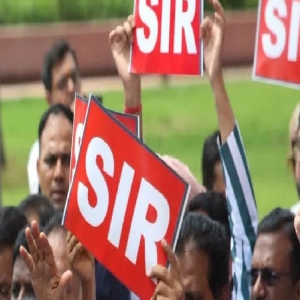


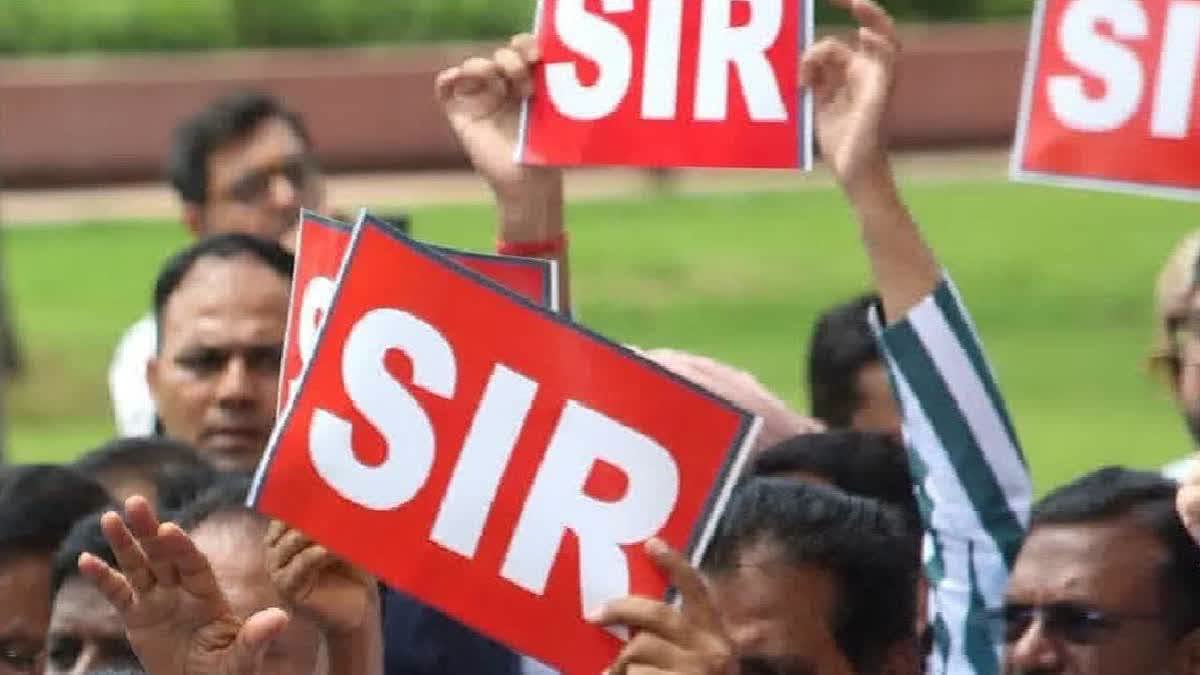
Electoral democracy is not rhetoric; it is democracy in practice. But when the fundamental principles of electoral democracy are violated, the claim no longer holds. It becomes rhetoric, with democracy as the victim.
That is the unfortunate state India finds itself in today, demanding that all measures be taken to restore it, lest the nation spiral into a failed state, as has happened in countries where electoral democracy is dead.
As per the latest reports, more than 13 crore names have been excluded from draft electoral rolls across 30 States and Union Territories. Delhi's draft roll eliminated about 32.8 per cent of its pre-Special Intensive Review (SIR) electorate. In comparison, Maharashtra's fell by more than 21 per cent and accounts for the largest absolute number of deletions.
Since the stated reason for SIR was to identify aliens in electoral lists, and only a handful have been discovered by the government in the post-SIR voter lists—what anomaly, hitherto undiscovered, came to light between 2024 and the start of SIR that resulted in such mass deletions?
Names could be removed because of death, relocation, duplication and other forms of legitimate ineligibility. But by any stretch of imagination, how can deleting 13 crore voters be the result of legitimate causes rather than dubious ones when so many of those disenfranchised voters were on the electoral rolls, including the 2024 Lok Sabha elections—held after new, updated lists were created earlier that year?
The EC has not explained what changed between the 2024 electoral rolls and the SIR to justify such mass deletions, but the manner in which the SIR has been conducted and the expansion of the grounds on which voters can be disenfranchised raise fundamental questions about the process.
In West Bengal, for instance, the Election Commission introduced the category of "logical discrepancy," under which it initially flagged about 1.36 crore voters. The discrepancies included spelling mismatches, a father's name, differences in parents' ages, unusually large or small age gaps between generations, and voters with more than six children.
As a result, the final SIR roll reduced the electorate by more than 1.15 crore, or roughly 15 per cent, with extraordinarily high reductions in several districts. Based on broader data analyses by India Today and Scroll, total voter-roll deletions (including dead, duplicate, and shifted voters) exceeded the BJP's winning margin in 95 seats, according to India Today, and in 105 seats, according to Scroll.
For example, in Jadavpur, the BJP won by 27,716 votes against 45,892 deletions; in Indus, by 900 against 4,617; and in Tollygunge, the TMC lost by 6,013 against 33,533 deletions.
None of these, among many other examples, conclusively proves that SIR produced all these outcomes, as deletions also exceeded margins in TMC-won constituencies. But a constituency-level analysis by Scroll found a strong relationship in Bengal between contraction of the SIR electoral roll and BJP wins.
What further implicates SIR as malevolent is that, as of August 7, 2026, about 38,10,620 appeals had been filed; only 82,782 had been decided. Of those, 75,443, or 91.13 per cent of the decided appeals, resulted in restoration, while more than 37.27 lakh remained pending.
Such levels of exclusion could swing the elections in favour of one party or the other. At the very least, the fact that the BJP went on to form the government by a landslide margin in a state in which it has not had a substantial base of its own dispels any false notions the EC tries to sell to the electorate about the methodological piety of SIR and its democratic legitimacy.
Delhi provides an example of an altogether different level of electoral decay. Its SIR came after the February 2025 Assembly election and therefore does not affect that result, but the electorate has radically changed before the next election. The draft roll reduced Delhi's electorate by about 32.8 per cent, excluding roughly 47.5 lakh names. An independent study found excluded voters exceeded the 2025 victory margin in 68 of the 70 constituencies.
The vagaries of SIR in Delhi are best seen in Bela Estate in Chandni Chowk. The previous roll reportedly contained 729 voters at the booth. The draft roll contained just one, while 728 voters had disappeared. Reports indicate that the exclusions were linked to the demolition of the homes in the area. When a booth loses 99.8 per cent of its electorate, it clearly indicates that something very wrong is afoot in the enumeration of voters.
Maharashtra, on the other hand, highlights the pan-Indian nature of questionable electoral lists. Between the 2024 Lok Sabha and Assembly elections, the Commission's own records show 8,00,391 electors deleted for reasons including death, shifting and duplication.
At the same time, about 48 lakh new electors were added in five months, which, according to The Quint, is a 4.25 per cent increase compared with roughly 1.3 per cent in the comparable period before the 2019 election.
In three constituencies, the current draft roll is reportedly smaller than the number of votes actually cast in 2024.
Similarly, Andhra Pradesh demonstrates that the deletion mechanism itself can be abused. Ahead of the 2024 elections, allegations of wrongful removals led the Commission to order 100 per cent field verification of deletions dating back to January 2022. It also filed 70 cases or FIRs over fraudulent Form 7 applications allegedly used to delete eligible voters.
Karnataka and Haryana raise the mirror-image problem. Leader of Opposition (LOP) Rahul Gandhi presented evidence of more than a lakh suspect entries among roughly 6.5 lakh electors in Mahadevapura and later, roughly 25 lakh suspect entries in Haryana. The Election Commission rejected the allegations and sought evidence, even though the onus lies entirely with the EC. If anything, these examples point to the malfeasance of it all.
The electoral issues do not end with the electoral roll. Electoral integrity is a chain: legally tenable registration, revision, polling, custody, counting and declaration. Even a flawless voter list cannot guarantee a clean election if polling, custody, counting or declaration is compromised.
Mamata Banerjee alleged that she was manhandled at the Bhabanipur counting centre and that her counting agents were excluded and counting manipulated. Taking cognisance of her petition, the Calcutta High Court admitted her election petition and ordered preservation of CCTV footage, EVMs and VVPAT-related material for further scrutiny. Similar issues have occurred in other constituencies in the state, as well as in other states.
The broader problem in the state of electoral affairs, however, also extends to post-result shenanigans.
According to data compiled by the Association for Democratic Reforms (ADR), at least 211 elected MPs and MLAs had switched to the BJP between 2014 and 2022, with the flow continuing thereafter. Since 2022, the procession has continued with sitting Lok Sabha MPs crossing over. Elected representatives who secured their mandates under one party's banner have repeatedly transferred that political capital to the BJP without first seeking a fresh mandate from their constituents.
Critics and analysts argue that both money and state power have been used to hijack democratically elected candidates, but whether those arguments are backed by evidence, the scale of political defections to the BJP since 2014 is hard to dismiss as a series of isolated individual decisions. The bottom line is that the defections point to a systematic effort to steal democratically elected state governments through political migration rather than elections.
The questions that arise from all this are forceful: With 13.37 crore names being deleted from India's electoral rolls under the Special Intensive Revision (SIR), are we to believe that 13.37 crore people suddenly legitimately ceased to be entitled to vote despite being historical voters?
Since only citizens may vote, did India suddenly discover 13.37 crore non-citizens through an exercise launched in the name of purifying the electoral rolls of illegal aliens?
How did a Delhi polling booth that once had more than 700 voters end up with just one?
What part of jurisprudence and the Constitution allows wanton mass deletion of voters in West Bengal through SIR and then have 91.13 per cent of appeals result in restoration—after the election was over?
How can a Supreme Court judge tell voters wrongly deleted that their remedy lies in a subsequent election—when the election in which they were disenfranchised has already passed?
Which political party can claim that over 211 MPs and MLAs have crossed over to the ruling party of their own free will, especially considering the cross-over fiasco involving the MPs from West Bengal?
Is this what a functioning electoral democracy looks like? Whichever way you look at it, the opposite is true.
Most importantly, the Election Commission can conduct revisions. Courts can review them. Political parties can challenge them. Journalists can investigate them. Citizens can protest them. But in a democracy, the citizen is sovereign. The electoral roll exists for the voter. The election exists for the voter. The government derives its legitimacy from the voter. When the voter disappears from the roll, democracy loses its most basic unit.
That is when the overused phrase "Death of Electoral Democracy" stops being rhetoric. An electoral roll can be corrected after an election. An electoral result can be challenged in court. But a citizen whose vote was taken away before the election cannot be given that lost vote back.
With even the courts failing to address the issue judiciously and circumspectly, and with the SIR continuing in its present form unfettered, the solution now rests entirely with the political class and citizens in general.
The only avenue left for both is clear: reject the new SIR-managed voter lists and revert to a list acceptable to all political parties and the electorate.
If that fails, boycotts of elections, widespread protests by civil society, and a movement by the legal fraternity to ensure the courts re-examine their entire approach to giving the EC sanctity it does not legally merit are in order. It is not an overstatement to say that judges have failed democratic elections in the country.
.jpeg)
 A. J. Philip
.jpg)
.png) Jacob Peenikaparambil
Jacob Peenikaparambil
.jpg)
.png) John Dayal
John Dayal
.jpg)
 Pachu Menon
.jpg)

.png)
.png)
.png) Robert Clements
Robert Clements
.jpg)