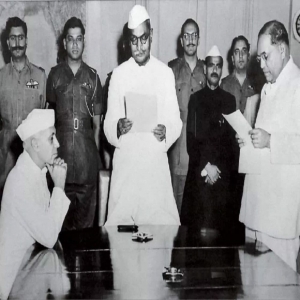


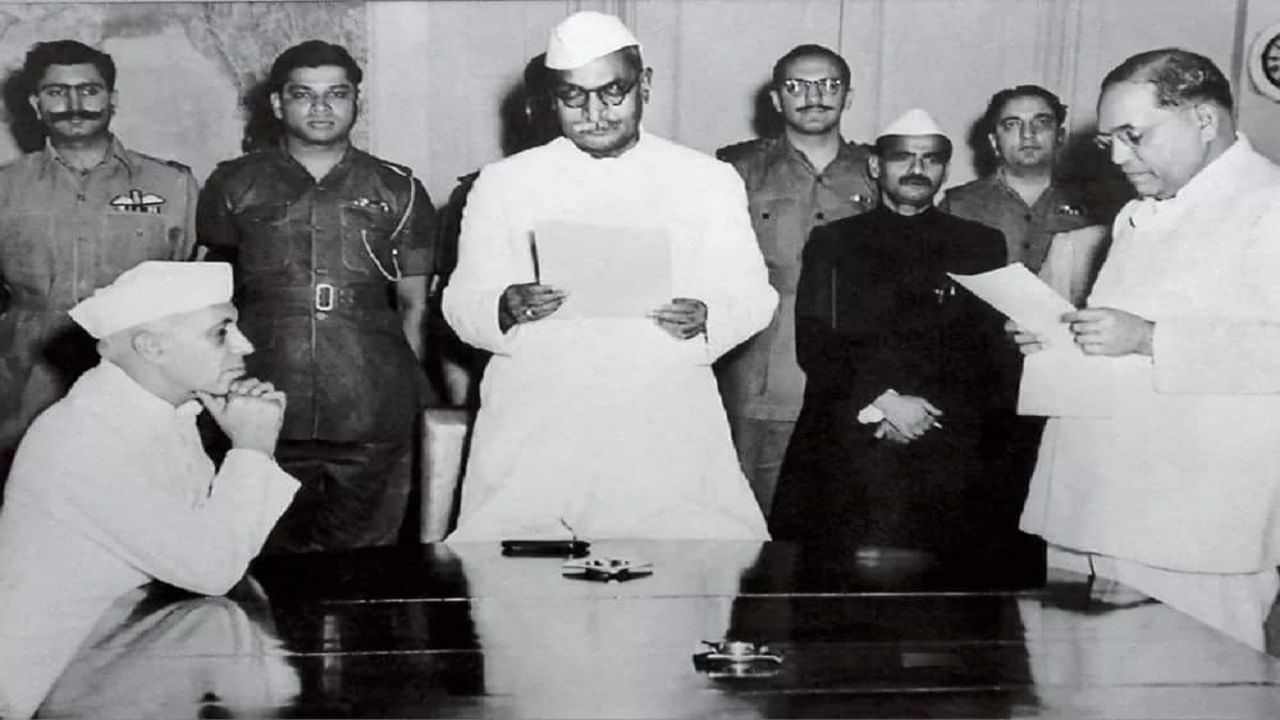
Mark Twain said, "truth is stranger than fiction." And one could learn the art of turning truth into fiction from Modi and his ministers. Dharmendra Pradhan, Education Minister, says, "Nehru got Ambedkar defeated twice to ensure that the lead author of the Constitution and the inspiration for our Dalits did not enter Parliament. Indira Gandhi hounded another great Dalit leader, Jagjivan Ram out of the party and Sonia Gandhi humiliated Sitaram Kesri... Kesri was shunted out to make Sonia Gandhi the party chief."
It is not that they don't know the history; it is a wilful distortion of truth to malign Pandit Nehru and the Gandhi Family to reap political dividends.
It was Pandit Nehru who made Ambedkar the Law Minister in his first cabinet and facilitated his election to the Constituent Assembly. When Ambedkar contested from a reserved constituency of Dalits for a seat in the Lok Sabha and lost, it was again Pandit Nehru who made him a member of the Rajya Sabha in 1952, and he remained a member till his death on December 6, 1956.
Jagjivan Ram (also a minister in Nehru's first cabinet) was a vocal supporter of the Emergency. He had betrayed Indira Gandhi, left the Congress, and formed his own political outfit, Congress for Democracy. He joined the Janata Party, contested the election in 1977, and became Deputy Prime Minister of Morarji Desai's government.
Sonia Gandhi refused to enter politics after Rajiv Gandhi's assassination in May 1991. The Congress performed very poorly in the 1996 Lok Sabha election and lost power at the Centre, when Kesri was the President. Consequently, veteran leaders of the Congress - Madhavrao Scindia, Rajesh Pilot, ND Tiwari, Arjun Singh and Mamata Banerjee - rebelled against Kesri and left the party. The Congress pleaded with Sonia Gandhi to rescue the party, and she reluctantly joined the Congress party as a primary member in December 1997, coming out of the self-imposed wilderness of nearly seven years. She was elected as the Congress President in March 1998 on the eve of the midterm election to the Lok Sabha. The rest is history.
Incidentally, Indira Gandhi, Rajiv Gandhi, Sonia Gandhi and Rahul Gandhi, destined to make a mark in history, were reluctant to join politics.
As a student of political science, I thought I should correct the distortion of history that the ruling party has mastered.
.jpg)
 A. J. Philip
.jpg)
.png) Jacob Peenikaparambil
Jacob Peenikaparambil
.jpg)
.png) Cedric Prakash
Cedric Prakash
.jpg)
.png)
.jpg)
.png) Ram Puniyani
Ram Puniyani
.png)
.png) Robert Clements
Robert Clements
.jpg) Cedric Prakash
Cedric Prakash
.jpg)
 Pachu Menon