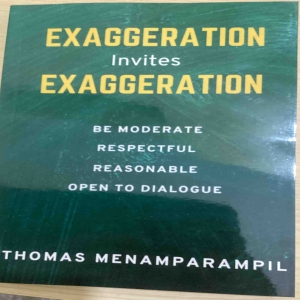



Thomas Menamparampil's Exaggeration Invites Exaggeration is a wide-ranging, deeply reflective engagement with some of the major crises confronting contemporary humanity: violence, religious fundamentalism, aggressive secularism, nationalism, political polarisation, the criminalisation of public life, inequality, economic exploitation, cultural exclusion, and the weakening of social solidarity. The title captures the book's central argument: excess generates counter-excess. Humiliation produces resentment, anger provokes anger, fanaticism foments fanaticism, exclusion intensifies identity, and violence creates conditions for further violence.
A major strength of the book is that Menamparampil does not examine these issues merely as political or theological problems. He approaches them through human relationships, collective identities, social structures, power relations and the moral imagination of communities.
Identity, Difference and the Social Production of Conflict
The first major debate concerns the relationship between identity, difference and conflict. Human beings find meaning and security through family, community, language, religion, ethnicity, territory, memory and tradition. Identity creates belonging, but it can also generate exclusion. When differences are exaggerated, the distinction between "us" and "them" becomes increasingly sharp. The neighbour becomes a rival, the rival an enemy, and the enemy a perceived threat.
Menamparampil illustrates this dynamic through religious fundamentalism and aggressive secularism. Secularism can protect freedom of conscience and religious equality, but when it becomes aggressively dismissive of religion, religious communities may experience humiliation and respond defensively. Conversely, religious fundamentalism can strengthen secular hostility. Each extreme can become nourishment for the other.
The same process can occur in nationalism, ethnic politics and communal mobilisation, particularly when memories of humiliation, injustice or defeat are politically revived. Importantly, Menamparampil distinguishes understanding a grievance from justifying violence. Understanding why resentment develops does not mean morally approving violent responses.
His reflection on the "curse of victory" is particularly significant. Victory without restraint may humiliate the defeated, whose collective memory can preserve that humiliation across generations. Thus, conflict is sustained not merely by material interests but also by memory, symbols, narratives and perceptions of dignity. Peacebuilding must therefore address both structural injustice and cultural memory.
Violence, War and the Institutionalisation of Fear
The second debate addresses the normalisation and institutionalisation of violence. Menamparampil moves from anger and fanaticism to war, criminality, gun culture and the economic interests that can sustain insecurity.
One important concern is the "sanitising" or "prettifying" of war. War may be presented as heroic, necessary or technologically sophisticated, while the suffering of ordinary people becomes invisible. Violence thereby acquires a different moral meaning and can become socially acceptable.
Fear generates insecurity; insecurity creates demand for protection; protection increases the demand for weapons; weapons contribute to violence; and violence generates still greater fear. This becomes a self-reinforcing cycle. The arms industry adds a political-economic dimension: when weapons become commodities and insecurity becomes a market, conflict can acquire its own economic logic.
Menamparampil also connects violence with criminalised politics. Strongmen can become attractive where formal institutions fail to provide justice, employment, protection and public services. Extra-legal power then appears useful, but its growing influence further weakens the rule of law. Violence consequently becomes institutionalised, normalised and socially reproduced. Sustainable security therefore requires justice, functioning institutions, trust and solidarity.
Power, Rights, Inequality and Exclusion
The third debate concerns the unequal distribution of power, dignity, rights and resources. Menamparampil insists that rights cannot be defended selectively. If people demand freedom and dignity only for their own community while denying them to others, universal principles become fragmented.
Inequality is understood broadly, not simply as unequal income but as unequal access to power, institutions, opportunities, recognition and social voice. Economic inequality can become political inequality when wealth determines access to decision-making; political inequality can become cultural inequality when some narratives receive greater legitimacy than others.
His critique of the "idolatry of the market" asks fundamental questions: Who benefits? Who is excluded? Who carries the burden? Whose voice is heard? The COVID-19 experience, as discussed in the book, exposed the vulnerability of informal workers, migrants and economically weaker communities, while simultaneously demonstrating the importance of solidarity.
His reflections on Gandhi and Ambedkar underline that democracy cannot be reduced to elections or majority rule. Constitutional morality requires liberty, equality, fraternity, justice, institutional restraint and protection of minorities. Majoritarian power without these values can turn numerical strength into a claim of moral entitlement.
From Reaction to Response: Reconciliation and Communion
The fourth and most constructive debate concerns the movement from reaction to response. Reaction is immediate, emotional and retaliatory; response is reflective, responsible and discerning. Reaction asks, "How do I answer the wrong done to me?" Response asks, "What will break the cycle of wrong?"
This distinction recognises human agency. Individuals and communities are not condemned to reproduce the violence they have experienced. They can choose reflection, transformation and reconciliation. If exaggeration invites exaggeration, then the opposite is also possible: moderation can invite moderation, understanding can invite understanding, compassion can invite compassion, and reconciliation can invite reconciliation.
Menamparampil does not separate peace from justice. Peace without justice can conceal oppression, while justice without reconciliation can perpetuate resentment. Genuine reconciliation requires dialogue, humility, listening, mutual recognition and the capacity for self-criticism.
His final vision of a "communion of civilisations" goes beyond mere coexistence. Coexistence may mean tolerating differences; communion implies recognising interdependence. Civilisations need not abandon their distinctiveness, but they must learn to encounter difference without dehumanising the other. This is pluralism without fragmentation, solidarity without uniformity, and communion without the erasure of identity.
In Conclusion
The deepest contribution of Exaggeration Invites Exaggeration is its moral anthropology of contemporary society. It shows how identity, memory, fear, inequality, exclusion and power can perpetuate conflict. Yet humanity is not trapped in these cycles. Menamparampil calls for a transformative movement from reaction to response, from domination to dignity, and from division to dialogue. Ultimately, dignity, justice, compassion, reconciliation and human interdependence can build a civilisation where diversity becomes encounter and peace becomes communion.
.jpeg)
 A. J. Philip
.jpg)
.png) Jacob Peenikaparambil
Jacob Peenikaparambil
.jpg)
.png) John Dayal
John Dayal
.jpg)
 Pachu Menon
.jpg)
.png)
.png)
.png) Robert Clements
Robert Clements
.jpg)