

 Pachu Menon
.jpg)
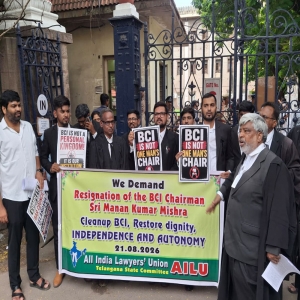
Bar Council of India (BCI) chairman Manan Kumar Mishra sparked controversy with his action and subsequent U-turn on an order barring students from the 2026 batch of Hyderabad's National Academy of Legal Studies and Research (NALSAR) from enrolling as advocates.
The BCI directed every state Bar Council not to enrol any student graduating from Hyderabad's NALSAR University of Law in 2026 as an advocate until further orders, after students of the institution protested an invitation to Chief Justice of India Surya Kant to attend the University's convocation.
Is this volte-face on this controversial issue a consequence of the 'persuasive' approach by the Cockroach Janta Party?
Recent policy reversals and institutional climb-downs are widely viewed by the public and media as a direct reaction to the massive digital pressure, satirical mobilisation, and street protests wielded by the viral, youth-led CJP.
Notably, the CJP has shifted from a viral digital satire movement to an active public pressure group and accountability watchdog following nationwide youth and student protests over examination irregularities.
Continuing to monitor government actions, legal developments, and institutional responses, the outfit has now initiated decentralised public campaigns like 'School Thik Karo' and hospital infrastructure checks to independently evaluate public spending, teacher-to-student ratios, and conditions in state-run rural facilities.
The 'School Thik Karo' in particular deserves to be considered from multiple civic, educational, and political angles.
First, we need to understand what a 'social audit' is. A 'social audit' is a formal review of how an organisation's actions affect society, ethics, and the environment. It compares stated goals with real-world results to build public trust, fix wrongdoings, and measure social responsibility.
The Cockroach Janta Party, led by founder Abhijeet Dipke, launched the citizen-led campaign on Independence Day. CJP's 'School Thik Karo' campaign targets long-standing neglect, highlighting missing basic facilities like drinking water, functional toilets, electricity, and seating benches in rural government schools. This initiative urges parents and citizens across India to conduct grassroots social audits of rural government schools to document chronic infrastructure neglect and push local authorities for reform.
It began with Dipke's visit to his native village in Maharashtra, where he saw the deplorable condition of a zilla parishad school. "If basic things like water are missing from government-run schools even 80 years after India became independent, how is the country going to develop?" he remarked.
Dipke's observations come against the backdrop of his newly launched campaign and the broader political agitation raised by the CJP, targeting rural education neglect, steep private school fees, and major investments in elite public optics over grassroots infrastructure.
The initiative also pairs demands for school accountability with calls to cap private school fees.
At a time when education is being given a facelift with a new policy that aims to overhaul the country's learning landscape, we are still stuck with the incongruities of a system where a wide chasm in basic infrastructure, teacher quality, and funding between elite private setups and underfunded public institutions obliterates the true essence of teaching and learning.
A severe lack of basic amenities in government schools has led to declining student enrollment and higher dropout rates. The absence of usable, private sanitation facilities forces many older girls to leave school entirely. Lack of electricity, proper ventilation, and digital tools prevents effective modern teaching. Poor conditions drive low-income families to seek private alternatives wherever possible, contributing to the closure or merger of tens of thousands of under-resourced public schools nationwide.
A severe infrastructure crisis has left dozens of government-run schools across Goa in dangerous disrepair, forcing students to study under leaking roofs, cracked walls, and exposed iron rebar. Despite claims of infrastructure upgrades by the administration, recent safety incidents, such as a false ceiling collapse at a Sanguem Higher Secondary School and a falling ceiling fan injuring a student in Poriem, have put intense public focus on structural safety, reports the local press.
It is more than obvious that government schools in India often face poor amenities and structural problems because of a lack of funds, weak local management, heavy bureaucracy, and low social accountability from wealthier families who use private schools instead. Inadequate infrastructure in government schools deepens social inequality by trapping low-income and marginalised children in a cycle of low-quality learning.
While private schools offer advanced facilities for the wealthy, broken buildings, lack of clean water, and crowded classrooms in public schools deny poor students a fair chance at upward mobility.
The National Education Policy (NEP) states that schools must provide safe, well-maintained, and adequate physical infrastructure, including clean drinking water, working toilets, electricity, computing devices, internet access, libraries, and sports facilities, to ensure inclusive, quality education for all children from preschool to Grade 12.
This guideline does not pertain only to private schools. The NEP explicitly states that all schools must have safe, adequate infrastructure, with a primary focus on public and government-run school systems to close existing gaps and achieve universal, inclusive education.
In India, though, school guidelines rarely take effect without public or judicial pressure due to a systemic culture of compliance over commitment, severe underfunding, fragmented regulatory enforcement, and a lack of active internal accountability.
However, despite severe infrastructural and funding challenges, many government schools across the country continue to produce students who achieve extraordinary academic success. These institutions often overcome deep systemic hurdles to foster excellence.
The 'School Thik Karo' campaign initiated by the CJP can drive tangible local attention to infrastructure gaps, but deep or permanent structural upkeep depends heavily on sustained community pressure and official administrative cooperation rather than audits alone.
.jpeg)
 A. J. Philip
.jpg)
.png) Jacob Peenikaparambil
Jacob Peenikaparambil
.jpg)
.png) John Dayal
Pachu Menon
John Dayal
Pachu Menon
.jpg)

.png)
.png)
.png) Robert Clements
Robert Clements
.jpg)