

 A. J. Philip
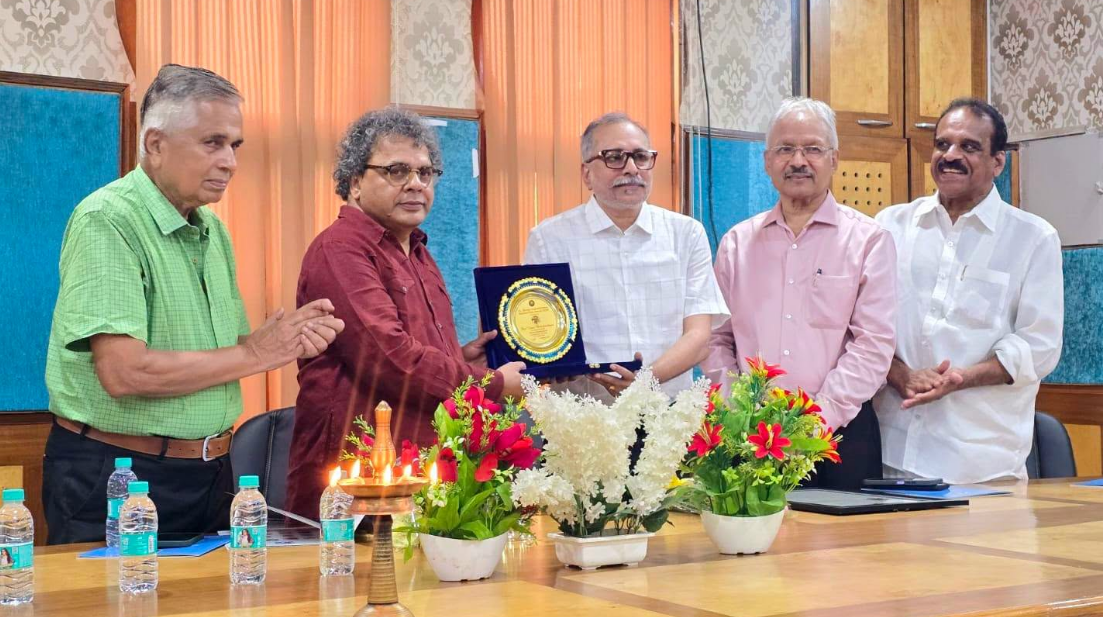
There are occasions that begin as award ceremonies but end up becoming journeys through memory. The first Fr. Xavier Vadakkekara–Kerala Club Award 2026, presented to well-known journalist Unni Balakrishnan on July 25 was one such occasion. It celebrated not merely an accomplished journalist but also the ideals of fearless journalism, intellectual honesty and friendships that transcend institutions and ideologies.
The evening unexpectedly took me back more than half a century.
While felicitating the awardee, my friend Advocate Dr. K.C. George referred to Fr. John Vallamattom, the visionary priest who founded Indian Currents. That single reference unlocked a floodgate of memories.
In the early 1970s, Kerala witnessed a major agitation by the managements of private colleges. The movement was spearheaded by Archbishop Benedict Mar Gregorios, the architect of the growth of Mar Ivanios College, Thiruvananthapuram. Representatives of organisations such as the Nair Service Society and the Muslim Educational Society stood with him, making it an unusual coalition united by concern over educational policy.
The Archbishop wrote an article in The Hindu defending the agitation and justifying the decision of private managements to close educational institutions as a form of protest. I disagreed fundamentally. I believed that educational institutions existed for students and that no management, however justified its grievance, had the moral right to deny young people their education.
À student, I wrote a detailed letter to The Hindu rebutting the Archbishop’s arguments. To my delight, the newspaper carried it prominently.
The next day appeared an even longer reply from Fr. John Vallamattom, then Principal of Newman College, Thodupuzha, and secretary of the organisation representing the private managements. He defended the Archbishop’s position point by point.
I prepared another response to his rebuttal, but The Hindu chose not to publish it. Such editorial decisions are part of a journalist’s life. You argue your case, accept the editor’s verdict and move on.
Many decades later, the story acquired an unexpected footnote. Justice Cyriac Joseph, who would later adorn the Supreme Court Bench and subsequently serve as the Lok Ayukta of Kerala, told me that as a young lawyer he had drafted Fr. Vallamattom’s reply to my letter. The revelation delighted me. What had appeared to be merely a newspaper exchange had quietly involved a future judge of the Supreme Court.
Differences of opinion never prevented personal warmth.
When Fr. Vallamattom heard that I was travelling to Germany, he worried more about the weather than about our ideological disagreements. He handed me his long overcoat so that I would not freeze in the European winter. After returning, I faithfully returned the coat to him. That simple gesture remains one of my cherished memories of Christian fellowship—where affection rises above argument.
Years later, on December 2, 1992, I, as secretary, invited Fr. Vallamattom to be the chief guest at the annual day of St. Thomas Mar Thoma Church, Karol Bagh. In his address, he expressed the hope that the Babri Masjid would remain untouched and that communal harmony would prevail. Unknown to him—and to most of us assembled there—the kar sevaks had already begun the demolition work in Ayodhya. History sometimes overtakes even the most sincere prayers.
Fr. Vallamattom had founded Indian Currents, but when the Capuchin Fathers later assumed responsibility for the magazine, it entered a new and influential phase under Fr. Xavier Vadakkekara. He transformed it into one of India’s most respected voices of dissent, never afraid to question authority, regardless of who occupied the corridors of power.
One day Fr. Xavier asked me to write a regular column.
I christened it “Close Look” and adopted the pen name “Bharat Putra.” Looking back, I sometimes regret abandoning that pseudonym after I left full-time journalism in 2009. It had acquired an identity of its own.
There was another reason why the column meant so much to me. The modest honorarium did not come to me. It went directly to my mother in Kerala. Every article became, in a sense, a small act of gratitude towards her.
Writing columns had already become an important part of my journalistic life. During my days at the Hindustan Times in Patna, editor Pradipta Sankar Sen encouraged me to write a column titled In Retrospect. It continued for nearly three years until I moved to Delhi and, at the time, was probably the longest newspaper column in the country.
The columnist who influenced me most was Prof. M. Krishnan Nair. Week after week, I devoured his celebrated Sahitya Varaphalam in Malayalanadu. I admired not merely his literary criticism but the freedom with which he wrote. He often mentioned that readers sent him books from across the world to review. I secretly envied him. I never dreamed of climbing the administrative ladder in journalism. My ambition was much simpler, to be a columnist free to travel, observe, read and write about anything under the sun.
That dream, in many ways, came true.
For nearly thirty-two years, Close Look has appeared with remarkable continuity. Every successor of Fr. Xavier encouraged me to continue writing. Editorial leadership changed, but their confidence in the column never wavered. Few writers are fortunate enough to enjoy such sustained trust.
My association with Fr. Xavier extended beyond journalism.
It was I who introduced him to Prof. Omchery N.N. Pillai, then President of Kerala Club. They became close friends almost immediately. Omchery often remarked that Fr. Xavier embodied the spirit of the Prayer of St. Francis of Assisi: “Where there is hatred, let me sow love.” Their friendship enriched both institutions they represented.
Fr. Xavier’s affection for Omchery expressed itself in a remarkable labour of love. He painstakingly collected Omchery’s scattered writings with the help of well-known theatre personally Ajit Maniyan and supervised the publication of his Complete Works in four substantial volumes. It was an extraordinary scholarly tribute to an extraordinary writer.
After Fr. Xavier passed away, those of us at Kerala Club felt that his memory deserved to live through something meaningful rather than merely ceremonial. The result was the institution of the Fr. Xavier Vadakkekara–Kerala Club Award for courageous journalism.
Our mutual friend Justice Kurian Joseph generously provided the financial support for the award. It comprises a citation, a memento and a cash prize of Rs 50,000.
For the inaugural award, we could not have chosen a more deserving recipient than Unni Balakrishnan, whose five-day programme Surgical Strike on Asianet has earned respect for fearless commentary and uncompromising analysis.
The selection itself reflected credibility.
The jury was chaired by R. Rajagopal, one of India’s finest editors, who rose to head The Telegraph. If governments feared anything, it was Rajagopal’s headlines. I remember with gratitude that on two occasions he published articles I had written, one virtually as the second lead on Page One. I had not sought the favour. He published them because he believed they deserved publication. That is what independent editors do.
Another jury member was Pamela Philipose, among the country’s finest writers with a delightful sense of humour, though public responsibilities have lately claimed much of her attention. Eminent journalist P.M. Narayanan, Kerala Club Secretary K. Madhavan Kutty, and I served as ex-officio members.
Rajagopal could not travel to Delhi because of some personal problems. His absence, however, was more than compensated by the presence of S. Prasannarajan, Editor of Open. Pamela and Prasannarajan were my colleagues at The Indian Express for nearly six years.
I have always regarded Prasannarajan as one of the best essayists writing in English today.
Watching him write was itself an education. He drafted every article by hand. Before the pen touched paper, the sentence had already been composed in his mind, complete with commas, semicolons and colons. The manuscript would emerge almost flawless. He also possessed an extraordinary gift for headlines. Two that he gave my articles remain unforgettable: “The Khomenist Threat from the Mutt” and “The Missionary Position.”
His interviews with writers like Salman Rushdie and V.S. Naipaul reflected not merely preparation but deep reading. His love for books proved contagious. If my personal library has steadily grown over the years, he deserves part of the credit.
True to his meticulous nature, Prasannarajan watched several episodes of Surgical Strike before attending the function. Having known Unni Balakrishnan from his Delhi days with Asianet, he evaluated the programme not as a friend but as an editor. Journalism, he observed, is not merely about saying something different. It is about saying something true, significant and worth remembering. Surgical Strike, he said, succeeded because it identified what mattered amidst the daily clutter and presented it with clarity and conviction, calling a spade a spade whenever necessary.
Pamela Philipose drew attention to the concluding words of the citation, expressing the hope that the award would inspire young journalists to pursue the profession “with courage, integrity, intellectual rigour and an unwavering commitment to truth.” Those words capture precisely what Fr. Xavier stood for.
My friend, Victor Thomas, who heads the Alumni Association of my alma mater, St. Thomas College, Kozhencherry, and serves on the BJP National Council, recalled how he and Justice Kurian Joseph had once worked shoulder to shoulder in the Kerala Students’ Congress. It was a reminder that friendships forged in youth often outlive political differences.
Former Ambassador K.P. Fabian, another distinguished friend of Kerala Club, recalled how he had helped Asianet during its formative years while serving in Doha. A walking encyclopaedia on Malayalam cinema ànd vice-president of Kerala Club, U. Radhakrishnan described Unni Balakrishnan as an eminently worthy choice for the inaugural award.
In his welcome address, Dr. Anil K., a member of the Club’s Executive Committee, traced the Club’s rich history and its continuing commitment to Kerala’s cultural and intellectual life in the national capital.
When his turn came, Unni Balakrishnan spoke with characteristic humility. He said the award held special meaning because it came from Kerala Club, an institution that has preserved Kerala’s cultural identity in Delhi for generations. He thanked the jury for their confidence, paid tribute to Fr. Xavier Vadakkekara’s legacy of fearless journalism, acknowledged the affection shown by the audience, and promised to continue speaking the truth without fear or favour.
While presiding over the meeting, I mentioned a touching incident. A senior member of our church, Mrs. Leelamma Issac, had travelled all the way from Dwarka simply to meet Unni Balakrishnan. She never misses an episode of Surgical Strike. Her presence demonstrated that it was not publicity but genuine public affection that had drawn so many people to the function.
A beautifully produced brochure, designed and printed by our member T.O. Thomas, added permanence to the occasion. It contained tributes to Fr. Xavier Vadakkekara and Prof. Omchery N.N. Pillai, a brief history of Kerala Club and the full text of the citation presented to the awardee.
The evening concluded, as memorable Kerala gatherings often do, over tea accompanied by crisp dal vadas and soft, fragrant neyyappams.
As I looked around the hall, I could not help feeling that the function belonged as much to those who were absent as to those who were present. The values that Fr. Xavier Vadakkekara lived by and the cultural vision that Omchery N.N. Pillai nurtured had come alive once again through an award dedicated to fearless journalism.
If, somewhere beyond our sight, those two dear friends looked upon the gathering, I hope they smiled, not because we had remembered them, but because we had tried, in our own modest way, to keep alive the ideals they cherished: courage without bitterness, conviction without intolerance, scholarship without vanity, and journalism without fear. That, more than the award itself, was the true celebration of the evening.
ajphilip@gmail.com
Courtesy: Indian Currents
.jpg)
.jpg)
.png) Jacob Peenikaparambil
Jacob Peenikaparambil

.png) John Dayal
John Dayal
.jpeg)
.png) Joseph Maliakan
Joseph Maliakan

.png) Dr Arnald Mahesh SDB
Dr Arnald Mahesh SDB

.jpg) Jose Vattakuzhy
Jose Vattakuzhy
.png)

.jpg) Isaac Gomes
Isaac Gomes
.png)
.png) Robert Clements
Robert Clements