

.png) Aarti
Aarti
.jpg)
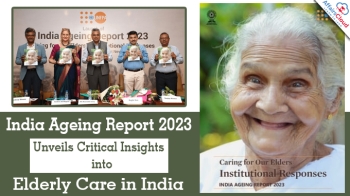
The main takeaway of "2023 India Ageing Report" of the United Nations Population Fund, India (UNFPA) released this September 27, is that by 2046 elderly population will likely surpass the population of children (aged 0 to 15 years) in the country.
The decadal growth rate of our elderly population, currently estimated to be at 41 percent, is projected to double to over 20 percent of total population by 2050. Women, on an average, when compared to men, were found by UNFPA to have a higher life expectancy of 20 years at the age of 60 in Rajasthan, Haryana, Gujarat, Uttarakhand, Kerala, Himachal Pradesh and the Union Territory of Jammu & Kashmir.
However, more than 40 percent of the elderly in India are in the poorest wealth quintile, with about 18.7 percent of them living without an income. Since the levels of poverty of the elderly may affect the quality of life and healthcare utilisation, it has been suggested that at a macro level, the government must work on increasing awareness about schemes for older persons, bring all Old Age Homes under regulatory purview as also focus on facilitating in-situ ageing to the extent possible.
The Report has also highlighted that the elderly in India have low awareness about the social security schemes designed for them like Indira Gandhi National Old Age Pension Scheme (55 per cent of the elderly are aware of the scheme), the Indira Gandhi National Widow Pension Scheme (44 per cent are aware) and Annapurna Scheme (12 percent are aware).
Well, life expectancy in India has risen from 50 (1970-75) to 70 years (2014-18) and the country ranks second and third respectively in the 60+ demographic and the 80+ or ‘oldest old’ demographics in the world. As per the 2011 Census, over 47 percent of the elderly in rural areas and 20.5 percent in urban centres continue to work. That our elderly population is highly vulnerable to both communicable and non-communicable diseases (NCDs) is a cause for worry. The National Sample Surveys -- NSSO 42nd round (1986-87), 52nd round (1995-96), and 60th round (Jan-June 2004) -- have addressed elderly health and social issues. The overall findings warn that the burden of morbidity in old age is enormous.
NCDs (life style related and degenerative) are extremely common in older people irrespective of socio-economic status. Disabilities which are very frequent affect the functionality in old age compromising the ability to pursue the activities of daily living. The prevalence of diseases among elderly people is that 75.68 percent of them have one or the other disease. 53.63 percent of the morbid have one chronic disease. 20.83 percent have two chronic diseases and 3.01 percent have three chronic diseases. The disability profile among the elderly people is equally disturbing as 40 percent have one or the other disabilities; 39.9 percent disabled have one disability;15.44 percent have two disabilities and 5.88 percent have three disabilities.
It is quite normal, as one gets old, to experience forgetfulness, a diminished attention span, mild memory loss, some confusion, impaired judgment including difficulty in learning new things and effectively using a smartphone. Such cognitive signs may appear after 60 years of age and more often after 70. Various studies seem to suggest that dementia is a set of symptoms that includes memory loss, having trouble making decisions and personality changes that interfere with getting through the day.
Alzheimer’s, a specific disease that causes dementia is the root cause of between 60 to 80 percent of dementia cases. An active healthy brain keeps one’s body young, and vice versa. And what one does earlier in life matters later in life. Researchers who tracked the health of younger adults in their 20s and 30s, and those who were physically active, when compared with those who weren’t physically active, had stronger cardiovascular health and better cognitive functioning in mid-life, 25 years later.
So, on the flip side, keeping mentally active and engaged will likewise stave off cognitive decline, and even guard against severe diseases like Alzheimer’s. Engaging in intellectual activities can give positive results on the nervous system, which in turn may prevent dementia has been substantiated by a recent study in Japan. It was found that participants among middle-aged and senior citizens who took part in adult education had a lower risk of developing dementia five years later by nearly 19 percent. The need to avoid excess sugar which health experts have been consistently warning is imperative because excess sugar can lead to insulin resistance, pre-diabetes and diabetes, which are an often overlooked, fast track to brain issues including accelerated brain aging.
A 2021 study found that insulin resistance doubles the risk of developing major depressive disorder, even if someone has never experienced depression previously. Untreated diabetes raises the risk of developing Alzheimer’s by 65 percent, making it the greatest risk factor as one ages. Notably, pollutants in our environment also seem to disrupt our insulin function and are an under-reported risk factor for diabetes. A study reported that air pollution accounted for 3.2 million, or 14 percent, of all new diabetes cases globally.
In case of marginalized communities of lower socioeconomic status who often live near areas of high pollution, there is an increased prevalence of type 2 diabetes in their mid-life. Even as more and more elderly people across the globe are choosing to live in retirement villages which offers several benefits such as companionship, security, healthcare etc. But such an alternative lifestyle also depends upon the financial resources one has.
A page out of Robert Marchand, the record-setting centenarian French cyclist who passed away in 2021 at the age of 109 can serve as a motivator. Marchand, who travelled extensively as a young man, worked as a truck driver in Venezuela, then as a lumberjack in Canada and also as a firefighter, had left him with no time for sports. Although he was once told he would never excel in cycling, when he turned 68 years, he took up cycling. His series of cycling feats remained simply unparalleled till his death. Well, the secret behind Marchand's longevity is attributed to his healthy lifestyle -- he ate a lot of fruits/vegetables, didn't smoke, exercised on a daily basis, called it a day at 9 p.m. and woke up at 6 a.m.
It needs to be realised that old age is not an illness but it is natural. The bottom line for healthy aging is a healthy brain which needs somewhere between seven and nine hours a night of sleep. At an individual level, mindfulness, that is being in the present moment and enjoying what one is doing, can go the extra mile. One needs to find activities that give enjoyment and embrace them.
.jpg)
 A. J. Philip

.png) Cedric Prakash
Cedric Prakash
.jpg)
 P. A. Chacko
.jpg)
.jpg)
.jpg) Thomas Menamparampil
Thomas Menamparampil
.png)
.png)
.png) Robert Clements
Robert Clements
.jpg)
.png)
.png) Chhotebhai
Chhotebhai