

.png) Bp Gerald John Mathias
Bp Gerald John Mathias
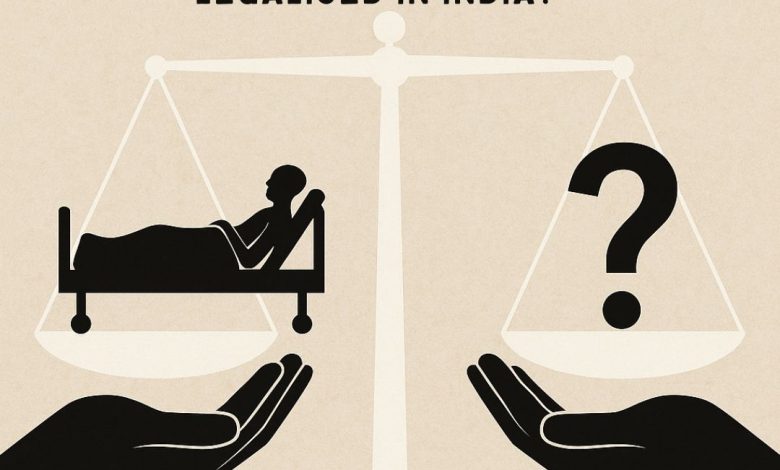
The recent Supreme Court Judgment in the case of Harish Rana, a comatose or persistent vegetative state (PVS) patient for over 13 years, permitting his parents to withdraw all life support, has triggered the Euthanasia debate once again. On March 9, 2018, a five-judge Constitution Bench of the Supreme Court legalised passive euthanasia while maintaining that active euthanasia is still illegal in India.
The present case of Harish Rana, where the Apex Court has permitted withdrawal of all life support, is considered by many as passive euthanasia. Is what the Court has done morally or ethically correct? The Supreme Court has asked the parents of Harish Rana to take him to the Palliative Care Unit of AIIMS (All India Institute of Medical Sciences), Delhi and get the withdrawal of life support done humanely.
As far as I understand, Harish is not on a ventilator or any mechanical support, except perhaps on artificial nutrition and hydration via Ryles tubes and a catheter for bladder drainage. For the parents and family who have cared for him for about 13 years at this stage, all that seems to be burdensome and futile, as Harish's condition is irreversible.
In itself, artificial nutrition and hydration via Ryles tubes, in my opinion, is not an extraordinary means of support in the present-day context of medical advances, even though it requires trained personnel to administer it.
The real ethical question that needs to be answered is: Is withdrawal of nutrition and hydration in Harish Rana's case and other similar cases passive euthanasia, or is it morally or ethically permitted to withdraw life support, including nutrition and hydration, in some cases? What is ethically permitted and what is obligatory in such cases?
The Catholic Church's teaching on euthanasia can help us understand the meaning of euthanasia and our moral obligations in caring for terminally ill patients or those in a coma or persistent vegetative state (PVS).
The Vatican Congregation for the Doctrine of the Faith, in its Declaration on Euthanasia, defines euthanasia as "an action or an omission which of itself or by intention causes death, in order that all suffering may in this way be eliminated."
Active and Passive Euthanasia
By active euthanasia is understood the voluntary commission of a life-terminating action. It designates someone doing something to the patient with the intention of shortening the patient's life. It refers, therefore, to any procedure that has as its end the shortening of a patient's life. In other words, it is the direct and deliberate killing of another with the intention of putting an end to the pain and suffering of that other. Active euthanasia is the same as positive and direct euthanasia.
Passive euthanasia means allowing oneself or another person who is terminally ill to die when there is no hope that the person will recover. While active euthanasia is killing, passive euthanasia is letting die. Thus, passive euthanasia involves the removal or withholding of life-supporting means, such as antibiotics, transfusions, respirators, dialysis and so on, because no reasonable hope of recovery exists for the dying person.
Therefore, while in active euthanasia, one causes something to happen when it can and should be prevented, in passive euthanasia, one allows something to happen when there is no way to prevent it. And these two actions are distinct ethically. We should also note here that some authors equate passive euthanasia with negative euthanasia and mean by it a voluntary omission of an ethically obligatory life-preserving action.
The aforementioned Vatican document states firmly that:
"Nothing and no one can in any way permit the killing of an innocent human being, whether a foetus or an embryo, an infant or an adult, an old person, or one suffering from an incurable disease, or a person who is dying. Furthermore, no one is permitted to ask for the act of killing, either for himself or herself or for another person entrusted to his or her care, nor can he or she consent to it, either explicitly or implicitly. Nor can any authority legitimately recommend or permit such an action. For it is a question of violation of the divine law, an offence against the dignity of the human person, a crime against life, and an attack on humanity."
Sometimes those who are gravely ill and suffering unbearable pain may ask for death. Or their relations or caregivers may want to end their suffering by asking the doctors to put the patient to sleep with a dose of lethal injection or withdrawal of all life support and treatment. Such requests can never be legitimate.
The above-mentioned Declaration advises us that "the pleas of gravely ill people who sometimes ask for death are not to be understood as implying a true desire for euthanasia; in fact, it is almost always a case of an anguished plea for help and love. What a sick person needs, besides medical care, is love, the human and supernatural warmth by all those close to him or her, parents, and children, doctors and nurses."
While everyone has the duty to care for his or her own health or to seek such care from others, is it necessary in all circumstances to have recourse to all possible remedies?
The moral obligation to preserve life is not absolute. That is to say, it is not necessary in all circumstances to have recourse to all possible remedies or means.
Moralists tell us that one is never obliged to use 'extraordinary' or 'disproportionate' means. However, it is not always easy to make a correct judgment as to what constitutes ordinary/proportionate means and extraordinary/disproportionate means.
Ordinary/Extraordinary Means
Gerald Kelly, a Catholic expert on medico-moral matters and one of the leading moralists in his now classic interpretation of this distinction, defined the terms as follows:
Ordinary means of preserving life are all medicines, treatments, and operations that offer a reasonable hope of benefit to the patient and can be obtained and used without excessive expense, pain, or other inconvenience.
Extraordinary means of preserving life are all medicines, treatments, and operations, which cannot be obtained or used without excessive expense, pain or other inconvenience, or which, if used, would not offer a reasonable hope of benefit.
A correct judgment as to the means can possibly be made, as the Declaration suggests, "by studying the type of treatment to be used, its degree of complexity or risks, its cost and the possibilities of using it, and comparing these elements with the result that can be expected, taking into account the state of the sick person and his or her physical and moral resources."
The rapid progress in medical science and technology has made these decisions even more complicated. For what was extraordinary some years ago seems ordinary today, and what is ordinary for a rich person may seem extraordinary to a poor person. Similarly, what is ordinary in a city may be extraordinary in a rural set-up. A decision must be made by the sick person (if conscious) or by relatives/doctors, taking into account the various factors mentioned above.
But the general principle holds good that one is not obliged to use extraordinary/disproportionate means to save or preserve life. However, all ordinary means of treatment, including nutrition and hydration, must be used. Furthermore, human life in all its stages and every state should be respected, treated with dignity and cared for.
.jpg)
.png) Cedric Prakash
Cedric Prakash
 ICPA
ICPA
 ICPA
ICPA
 ICPA
ICPA
 ICPA
ICPA
 ICPA
ICPA
 ICPA
ICPA
.jpg)
 A. J. Philip
.jpg)
.png) Jacob Peenikaparambil
Jacob Peenikaparambil
.jpg)
.png) John Dayal
John Dayal