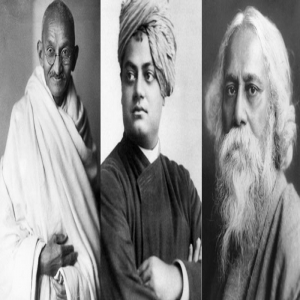


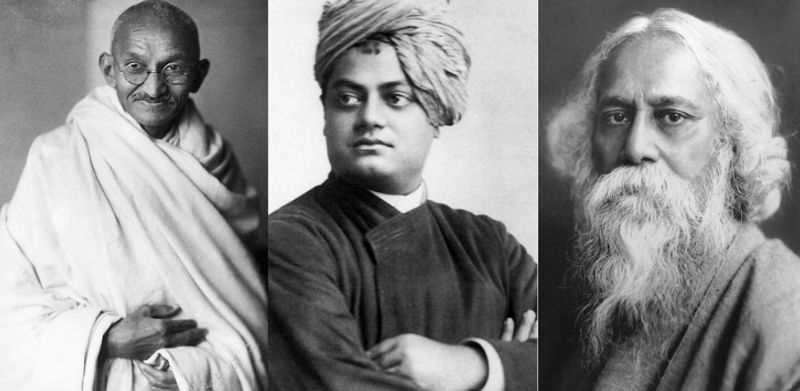
India is fortunate to have given birth to Rabindranath Tagore, Swami Vivekananda, and Mahatma Gandhi, who inspired generations not only in India but across the world. Apart from their liberal thinking, their thoughts on religious freedom were monumental and therefore serve as the basis for this very idea in this country. The world revered them as champions of universal religion. Today, when religion is used as a political tool to enforce unity through similarity rather than through diversity, the views of Tagore, Vivekananda, and Gandhi, particularly on religious tolerance and freedom, are what the country badly misses.
Rabindranath Tagore was a liberal thinker who strongly emphasised the philosophy of man-centric universal religion. In his own admission in 'Sadhana,' one of his great literary works, his life, he said, was much influenced by the Upanishad and the Bhagavad Gita, the two great texts upon which Hinduism rests. But he also made no secret about Buddha's teachings having influenced him immensely, nor did he ever talk of the supremacy of one religion over the other. According to him, true religion is a rhythm of life, joy, action, and co-existence. He believed in the philosophy of a mind without fear and a head held high, where knowledge is free, where the world is not broken up into fragments by narrow domestic walls. He aspired for his countrymen wake up to this environment every day of their lives.
Swami Vivekananda spoke of acceptance for all religions. He said that all religions are true because they all lead to the same destination. "If one religion is true, all others must be true," he said, arguing for the inherent validity of diverse spiritual paths. Talking about tolerance and acceptance, he said India's strength is in sheltering all faiths and that all religions teach purity and kindness, each deserving equal respect. In an article 'Vivekananda on Religion' (Janata Weekly-Jan 2023), Neeraj Jain wrote, "Unlike other saints, he did not offer prayers to the Almighty for his own salvation but sought salvation of the poor and the marginalised—be they Hindus, Muslims or Christians." For him, freedom of religion meant freedom from religious bigotry, a spiritual realisation, achieved through mutual respect, reason, and the recognition of universal truth.
Mahatma Gandhi was a believer in the Vedanta philosophy of Hinduism, which holds that all mankind is essentially spiritually united. He said his brand of Hinduism was "all-inclusive. It is not anti-Muslim, anti-Christian or anti-any other religion. But it is pro-Muslim, pro-Christian and pro-every other living faith in the world." Like Swami Vivekananda, Mahatma Gandhi also had a conviction about the truth of all religions. Undoubtedly, therefore, the philosophies of these three Hindu thinkers greatly influenced the founding fathers of the Indian Constitution during its drafting, so that equality, liberty, fraternity, and freedom of religion ultimately formed its cornerstones.
Freedom of religion is a fundamental right, and under Articles 25-28, citizens enjoy the liberty to follow, profess, and promote any religion of their choice. However, these rights are not absolute. Certain religious practices are subject to restrictions. They should conform to the requirements of public order, morality, and health in society as a whole. The executive is therefore empowered to prevent activities that violate these conditions. The judiciary, not individuals or organisations, has the mandate to interpret whether the executive action is constitutionally valid.
For example, the Supreme Court, in Acharya Jagdishwaranand Avadhuta vs. Commissioner of Police, Calcutta (1984), ruled that the Tandava dance in procession or public places by Ananda Margis carrying lethal weapons and human skulls was not an essential religious rite of Anand Marga followers. Thus, the order prohibiting such procession in the interest of 'public' order and morality was not a violation of Articles 25 and 26 of the Constitution. In other words, both violation and exploitation of freedom of religion are viewed seriously.
In today's India, however, this robust arrangement is blatantly ignored. Outfits like the Vishwa Hindu Parishad and the Bajrang Dal have assumed executive powers and restricted the religious activities of minorities – Muslims and Christians – by taking advantage of the dozen-plus anti-conversion laws in the country.
Under these laws, even prayer services are criminalised because the sweeping and vague definition of the term 'conversion' leaves ample room for exploitation. Between January and November 2025 alone, 702 cases of physical violence against Christians, in the form of murder, sexual assault, threat, intimidation, damage to religious properties, desecration of religious symbols, and disruption of prayer services, were reported, with Uttar Pradesh topping the list with 183 incidents, closely followed by Chhattisgarh with 156. Of the 702 incidents, FIRs were filed in only 45 cases. In 2024, there were 834 instances of attacks on Christians, which included the registration of 197 FIRs against Christians on false charges. Of them, 128 cases were under the anti-conversion laws.
Today, the Vishwa Hindu Parishad and the Bajrang Dal are actively monitoring the movements of Christians in the Hindi heartland. They act as policemen, detain innocent people, and force the authorities to formally arrest them. The detention and arrest of two nuns from Kerala in Durg Railway Station and the wrongful confinement of a nun with 19 young people who were heading for a workshop on youth mental health and skill development in Jamshedpur are some recent examples. The list goes on.
In the lead-up to Christmas this year, there were unprecedented incidents in various parts of the country where individuals claiming to be protectors of the Hindu religion prevented people from organising Christmas-related programmes. In India's capital, Delhi, these rogue elements ordered young people to remove their Santa Claus caps and head home. As if this wasn't enough, they warned them of dire consequences should they venture again to celebrate the Christian festival. The same people even prevented shopkeepers from selling Christmas items. Meanwhile, states with anti-conversion laws keep increasing, with Rajasthan as the latest addition, while Maharashtra and Goa, too, are understood to have readied their respective anti-conversion law drafts. Thus, in the land of Tagore, Vivekananda, and Gandhi, targeting Christian minorities has become a new normal.
While all of this is happening on the ground, Prime Minister Modi gives the impression of being the most Christian-friendly politician. Apart from meeting Pope Francis twice and exchanging warm hugs, even inviting him to visit India, which never materialised, he had regularly met bishops and Christian leaders. This Christmas, he had even attended a service in one of the churches. He was also on record publicly acknowledging and appreciating the contributions of Christians to the country. But, on the ground, selective targeting of Christians goes on unabated while the Prime Minister chooses to maintain inexplicable silence.
He is perhaps waiting for Bishops and Christian leaders to plug their courage and talk to him about Christian persecution in the country? It is time the leadership politely tells him,
Dear Prime Minister, thank you for your cordiality with the Christian community, and for your appreciation of our contributions to the nation. Taking cues from your kind gestures, we hope that people who perceive Christians as enemies of the country will change their minds and stop targeting Christians.
It will be the strongest message ever conveyed on behalf of every Indian Christian.
.jpg)
 A. J. Philip
.png) Cedric Prakash
Cedric Prakash
.jpg)
 P. A. Chacko
.jpg)
.jpg)
.jpg) Thomas Menamparampil
Thomas Menamparampil
.png)
.png)
.png) Robert Clements
Robert Clements
.jpg)
.png)
.png) Chhotebhai
Chhotebhai