

In the present context of growing ineffectiveness of the United Nations to curb international conflicts and its failure to provide international peace and security, and in the face of unilateralism of Donald Trump and his refusal to abide by the rules based world order, his withdrawing from international agencies, including more than 30 UN agencies, interestingly coinciding with the loss of India's image and reputation as a global peace maker and her credibility nosediving under the current political dispensation, it is essential to remind ourselves of what India meant to the world in 1950s during the Nehru Era, and Prime Minister Nehru's peace mission to rescue the UN. The world saw in Nehru the statesman of the highest order.
This piece is based on 'A Rescue Mission' – a subsection of Chapter 6, Nehru and the United Nations of my doctoral thesis, Jawaharlal Nehru: His Contribution to World Peace, published as a book, Nehru and World Peace.
The Congo crisis in 1960 plunged the UN into a serious existential crisis, with the Soviet Union threatening to withdraw from the UN. It heightened East-West tensions, giving the Cold War a new twist. With Nikita Khrushchev virtually declaring war on the UN, it seemed the split in the UN was inevitable. Nehru's efforts to defuse the UN crisis have received little scholarly attention. As a Reuters report stated, Prime Minister Nehru undertook the 'greatest peace mission' of his life to save the UN from disaster. In reality, it became a rescue mission. An attempt is made here to analyse briefly the events leading to the Congo crisis, the subsequent UN crisis, and the efforts made by Nehru to prevent the UN system from collapsing.
Following Congo's independence from Belgium, the local political situation became fluid. President Kasavubu and Prime Minister Lumumba developed some political differences. Consequently, Kasavubu dismissed Lumumba, and Lumumba, in turn, dismissed Kasavubu. The Congolese Parliament, which appointed them, disapproved of the actions of both the President and the Prime Minister. President Kasavubu appointed Joseph Ileo as the new Prime Minister. Kasavubu, when he attended the UN session, was subsequently accepted as the Congo's representative by a majority vote in the General Assembly. The Western powers supported Kasavubu during Congo's political crisis, while African countries recognised Lumumba as the legitimate head of the Government of Congo.
In the meantime, Colonel Mobutu, who was the Chief of Army in Lumumba's government, staged a military coup and had Lumumba arrested. A civil war broke out. Throughout these developments, the UN Peacekeeping Forces in Congo remained mere spectators and could not assist Lumumba in maintaining law and order. The Belgian government supported Colonel Mobutu in suppressing his opponents. Lumumba was caught, while trying to flee the country, and murdered.
These developments plunged the UN into a serious crisis. The Soviet Union suspected the involvement of Western powers in the murder of Lumumba. Colonel Mobutu ordered the Russian and the Czech Embassies to leave Congo. This, obviously, infuriated Khrushchev. He accused the UN of being partial and the UN Secretary-General Dag Hammarskjöld of partisan actions, and threatened to withdraw from the UN. The Congo crisis had thus become another Cold War issue of serious consequences. And the General Assembly session scheduled to begin in September 1960 became crucial due to East-West tensions.
Khrushchev vehemently condemned the UN's handling of the Congo question. He demanded the shifting of the UN Headquarters from New York. He also demanded the resignation of the UN Secretary-General for following a one-sided, pro-Western line in the Congo crisis. He wanted the replacement of the Office of the Secretary General by a three-member Executive Committee- one each from the Western and the Eastern blocs and the third from the neutral countries, with all three enjoying the veto power. The 'Troika,' as it was monikered, made the Western diplomatic circles anxious about the raging rift between Khruschev and the West.
It was at this critical stage that Prime Minister Nehru's role in defusing the UN crisis assumed vital historical significance. Khrushchev, in his letter to Nehru, urged that he should attend the crucial UN session and that he himself was heading the Soviet Union delegation to the UN. Nehru was regarded as 'the last hope for rapprochement between Khrushchev and the West.' It was obvious the UN was heading towards a split. Nehru's role, therefore, became an extremely delicate one.
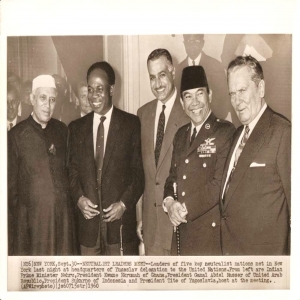
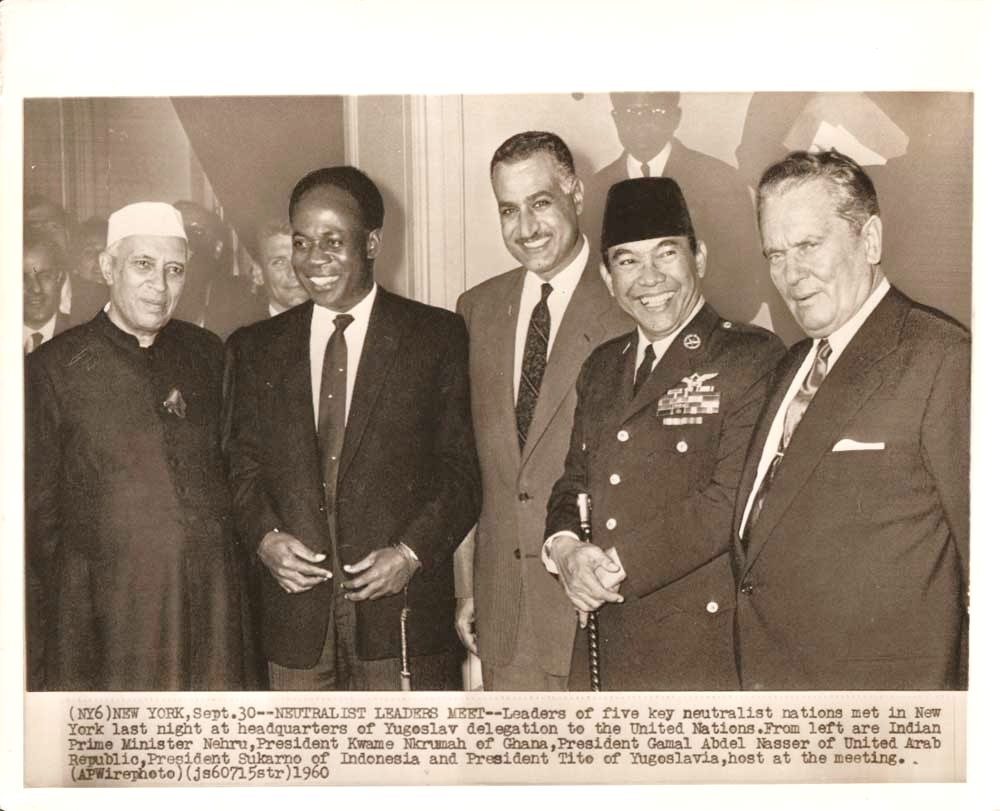
At this time, non-aligned countries were trying to form a neutral bloc in the UN by enlarging the Afro-Asian bloc. Prime Minister Nehru, President Nasser of Egypt, President Sukarno of Indonesia, President Tito of Yugoslavia and President Nkrumah of Ghana were planning to create a natural bloc that would serve as a unified 'third force' within the portals of the world body. Tito and Nasser were busy working on the neutral bloc to defuse the crisis. They were anxious to take Nehru's counsel and persuade him to take the active leadership of the neutral bloc.
Krishna Menon, who led the Indian delegation, arranged a private talk between Nehru and Khrushchev. Before that, Nehru met President Eisenhower and Prime Minister Macmillan. Nehru and Macmillan served as mediators between the Soviet Union and the USA. However, Macmillan didn't press hard in his role for fear of American displeasure. Nehru used his good offices to bring about a fresh 'East-West détente.' Nehru and other leaders tried to bring about reconciliation between the Russian delegation and the UN Secretary-General over the controversy surrounding the UN's role in the Congo crisis. Nehru told Khrushchev that the Secretary-General, Hammarskjöld, was acting impartially in major crises among the big powers. This was also shared by Nasser.
Everyone looked to the Indian Prime Minister for a mediating role. Eisenhower and Macmillan met Nehru separately. He remained at the centre of the world stage, and this was about the most difficult role Nehru ever played. His habitual modesty is standing him in good stead. Consequently, Eisenhower adopted a conciliatory attitude, as evidenced by the White House communique calling for calm, issued after the Nehru-Eisenhower meeting. The Western observers felt that 'if anyone could succeed in persuading Mr. Khrushchev to hold his horses at the preset it would be Mr. Nehru.'
The Rueter reported: "Prime Minister Nehru arrived ... in what many diplomats regard as the most important international peace mission of his career." The ground for Nehru's efforts to ease East-West tensions that threatened to undermine the UN's effectiveness was undoubtedly laid by Krishna Menon's quiet, behind-the-scenes talks with top world leaders. In his efforts, he received the support of Nasser and Tito.
Nehru held joint discussions with Tito, Nasser, Nkrumah and Sukarno on September 29, 1960. Consequently, the big five neutral countries - India, the United Arab Republic, Indonesia, Ghana and Yugoslavia – sponsored the five-power resolution. Prime Minister Nehru introduced the resolution in the General Assembly "to bring together President Eisenhower and Khrushchev for renewed contacts." The General Assembly session turned out to be the most stormy and critical in UN history. In his address to the General Assembly, four days later, Prime Minister Nehru said:
"I presented on behalf of Ghana, the United Arab Republic, Indonesia, Yugoslavia and India, a resolution to the General Assembly ... The main purpose of the resolution is to help avoid a deadlock in the international situation ... we are deeply concerned with the recent deterioration in international relation which threatens the world with grave consequence ... Responsibility for this deadlock has to be shared by all of us. But in the circumstances as they exist today, a great deal depends upon two mighty nations, the United States of America and the Soviet Union, and if even a small step can be taken by them, the world will have a sigh of relief."
The five-power resolution did not seek to pre-judge any issue or to bring pressure to bear on any country or individual. Subsequently, it led to renewed contacts between Kennedy and Khrushchev. Nehru and Khrushchev exchanged letters on the Congo-UN crisis. Nehru exercised a moderating influence on Khrushchev, who sought his support in dismissing Hammarskjöld. While agreeing with the Soviet Premier that the Belgians should withdraw completely from Congo, Nehru told Khrushchev that the UN's withdrawal from Congo would have disastrous consequences. He was also opposed to the dismissal of the UN Secretary-General, although the UN had failed in Congo. The 'greatest peace mission' of Nehru ultimately helped to resolve the UN crisis. The UN literally received a new lease of life.
.jpg)
.png) Cedric Prakash
Cedric Prakash
 ICPA
ICPA
 ICPA
ICPA
 ICPA
ICPA
 ICPA
ICPA
 ICPA
ICPA
 ICPA
ICPA
.jpg)
 A. J. Philip
.jpg)
.png) Jacob Peenikaparambil
Jacob Peenikaparambil
.jpg)
.png) John Dayal
John Dayal