

.jpg)
A Convention Turned into a Target
The Divine Love Retreat Centre at Jalalkhali, on the outskirts of Krishnanagar in Nadia district, had been hosting a Santali Bible Convention since October 1. The eleven-day gathering, scheduled to conclude on October 11, brought together Santali-speaking Catholics for prayer, Scripture reflection, catechesis and community fellowship.
For the participants, many of whom belong to Adivasi communities, the convention was not merely a religious programme. It was a space where they could express their faith in their own language, where elders and young people could pray together, and where a minority community could affirm its cultural and spiritual identity.
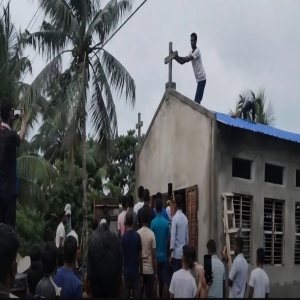
That space was shattered on the evening of Friday, October 9. According to accounts shared by local Catholics and the Bangiya Christiya Pariseba (BCP), a large group arrived near the Retreat Centre, raised slogans, accused the Church of converting Adivasis by force, and allegedly attacked Christians who objected to the provocative speeches and abuses directed at their faith.
The Times of India reported that members of the Hindu Jagran Manch had organised a gathering near the Church, where provocative speeches were made against Christians. When some church members protested, they were allegedly attacked. Villagers later blocked the road in protest before the police arrived and restored order.
'They Came in Mini Trucks'
Local Catholics allege that the mob did not consist only of people from the immediate neighbourhood. According to persons present at the Retreat Centre, attackers came from Shantipur and Nabadwip in mini trucks, carrying sticks, stones and other materials. They allegedly gathered local Hindu residents, addressed them near the Church, and used filthy and humiliating language against Christians, priests, religious sisters and the Catholic community.
One local Catholic, speaking on condition of anonymity because of fear of reprisal, said the attackers appeared to have planned the action in advance.
"They came with vehicles full of people. They brought sticks and stones. They switched off the lights and began attacking people. It was not a spontaneous quarrel," the person alleged.
Witnesses estimate that the group initially numbered around seventy but grew after local people joined them, eventually swelling to more than two hundred. These figures could not be independently verified at the time of writing, but the gathering was large enough to terrify those inside the Retreat Centre.
The alleged attackers repeatedly accused the Church of converting Santali Adivasis "by making fools of them." Catholics present at the convention reject the charge outright. They point out that the programme was a pre-announced Santali Bible Convention, with printed schedules indicating the days and timings of prayer services.
"There was nothing secret about it," one participant said. "The leaflet only had the programme. There was no conversion activity."
Abuse, Intimidation and Violence
According to accounts from victims and local Church representatives, the mob did not limit itself to slogans. Its members allegedly shouted abusive remarks against Jesus, mocked Christian belief in healing, insulted priests as "foreigners," and made derogatory claims that Christians were bringing alcohol and drugs into the area.
The allegation that priests were "foreigners" was particularly resented by local Catholics. Several pointed out that many priests serving in Bengal are Indian citizens, including those from Kerala and other States.
"Kerala is part of India. How can our own priests be called foreigners?" one Catholic asked.
As tensions rose, eyewitnesses allege that the mob deliberately switched off the lights around the Retreat Centre and began throwing stones from the road towards the premises.
"They thought that if the lights were off, they could attack more easily," one Catholic said. "Stones were being thrown from the road. People were running for shelter."
The situation allegedly turned violent when some Christians attempted to prevent the mob from entering the Retreat Centre or attacking participants. Witnesses claim that young men and others who tried to resist were beaten with sticks and rods.
One witness described the assault as severe.
"They beat the boys who tried to stop them," the person said. "It was as if they were using whips. One person's hand was injured. Another was hit on the head with a rod, and his head swelled."
One person's hand was reportedly injured, while another sustained a head injury. Victims said the assault continued even as people tried to flee into nearby rooms for safety.
The alleged attackers are also accused of damaging property around the Retreat Centre and breaking or tearing items. Some Catholics said they were prevented from leaving the premises during the confrontation, leaving women, children and elderly participants frightened amid the shouting and violence.
The victims allege that those who came forward to protect others were particularly targeted. The extent of the injuries and property damage requires formal medical and police verification.
The Conversion Allegation
The mob's central accusation was that the Church was forcibly converting Santali Adivasis. This claim has become a recurring pretext in anti-Christian incidents across West Bengal, where prayer meetings, house churches and Church-run programmes have been interrupted by groups alleging conversion.
At Jalalkhali, Catholics insist that the convention was an internal religious gathering for already baptised Santali Catholics. They reject the suggestion that non-Christians were being induced or pressured to change their religion.
"If this had been a Bengali convention, perhaps they would not have made this claim," one participant said. "Because it was a Santali Adivasi convention, they assumed we were converting Adivasis."
The distinction matters. A Bible convention is a religious gathering of believers, not necessarily a conversion campaign. Reducing every Adivasi Christian gathering to an alleged act of conversion not only misrepresents the community's faith but also denies Adivasi Christians their own religious agency. It implies that Santals cannot become Christians by conviction and that their presence at a Christian prayer service must be explained as coercion or inducement.
Members of the Hindu Jagran Manch who demonstrated near the Church alleged forced conversion. When the police arrived, they reportedly claimed that they had been attacked while reciting the Hanuman Chalisa and demanded the arrest of the church head. The group has denied all allegations.
The competing accounts make an impartial and prompt investigation essential. Allegations of forced conversion must be examined on evidence, just as allegations of assault, intimidation and property damage must be investigated without prejudice.
Fear After the Attack
Even after the police arrived and order was partially restored, fear remained. Local Catholics said some group members had not left the area immediately, and people inside the Retreat Centre did not know whether the mob would return.
"Even now they are around," one person said shortly after the incident. "We do not know what they will do next. We only want the police to stay and protect us."
The community submitted a written complaint and sought protection for the remaining days of the convention. Father Vincent George reportedly informed the Nadia District Magistrate about the incident.
At the time of reporting, calls to the local police station went unanswered, and detailed information about arrests, FIRs or the exact provisions under which complaints were registered was unavailable.
What is clear from the accounts is that the incident occurred during a religious gathering, in the presence of a large, hostile crowd, and amid open allegations of conversion. This combination demands serious administrative attention.
Church representatives have sought:
1. Immediate police protection for the Divine Love Retreat Centre and convention participants.
2. An impartial inquiry into the identity and role of those who organised or participated in the mob action.
3. Action against those responsible for hate speech, intimidation, assault and property damage.
4. Assurance that the remaining days of the Santali Bible Convention could be held without further disruption.
The appeal also reflects concern that the attackers portrayed an internal Catholic prayer gathering as a conversion event. Church representatives insist that the convention was a pre-scheduled religious programme for Santali Catholics, with printed schedules and no conversion activity.
The investigation should examine CCTV footage, mobile videos, medical records, statements from neutral witnesses, vehicle movements and call records. These could help establish the sequence of events, identify those responsible and determine whether the mobilisation was organised in advance.
A Wider Pattern in Bengal
The Jalalkhali incident was not isolated. Christian organisations and rights monitors have documented a growing number of attacks, raids and intimidatory actions against Christians in West Bengal in recent months.
The India Hate Lab documented at least 60 anti-Christian incidents across 13 districts of West Bengal between May 13 and September 20, 2026. These included 52 raids on private prayer meetings, homes, churches and other Christian gatherings, as well as eight incidents involving physical assault, mob violence or vandalism.
The report noted that Hindu nationalist organisations frequently entered places where Christians were praying, accused organisers of conversion, questioned attendees about their religious identity and, in some cases, demanded identity documents.
The documentation names Hindu Jagaran Manch/Bangiya Hindu Jagaran, Vishwa Hindu Parishad, Bajrang Dal, Hindu Suraksha Samiti, Hindu Ekta Manch, and Hindu Sanghati.
The pattern described in these reports closely resembles what Catholics at Jalalkhali allege: a religious gathering is identified, a crowd is mobilised, conversion is alleged, abusive speeches are made, and intimidation follows, sometimes accompanied by violence and vandalism.
The BCP has earlier alleged a wider series of attacks on Christians across the State and has approached statutory bodies for redress. The organisation has described such incidents as grave breaches of public harmony and has demanded immediate intervention by the State government.
Authorities must investigate the allegations surrounding Jalalkhali on their own merits. However, the wider pattern makes it even more important that authorities respond promptly and ensure intimidation does not disrupt religious gatherings.
The Danger of Impunity
The most dangerous aspect of the Jalalkhali attack is not only the violence allegedly inflicted on Catholics but also the message it sends: that a mob may gather outside a place of worship, abuse a minority community, accuse it without evidence and disrupt its prayer with little immediate consequence.
When such incidents end only with the police restoring order, without accountability or adequate protection for victims, they risk encouraging repetition. The fear expressed by local Catholics after the incident—that the group had not fully left the area and that further trouble might follow—reflects a deeper insecurity.
Religious freedom is not an abstract constitutional promise. It becomes real only when people can gather for prayer without being surrounded by hostile crowds, when priests can celebrate the Eucharist without being called foreigners, and when Adivasi Christians can pray in Santali without being accused of betraying their identity.
Article 25 of the Indian Constitution guarantees all persons freedom of conscience and the right to freely profess, practise and propagate religion, subject to public order, morality and health. No group has the right to turn that guarantee into a licence for intimidation or violence.
The West Bengal government, the Nadia district administration and the police must treat the Jalalkhali incident with the seriousness it deserves. They must register and investigate the community's written complaint without delay, preserve evidence, identify those who delivered hate speeches or incited violence, and prosecute those found responsible in accordance with the law.
They must also provide adequate police protection to the Divine Love Retreat Centre until the convention concludes peacefully. No Christian attendee, priest, religious sister or convention organiser should be harassed or detained merely because of allegations made by the mob.
The authorities must issue a clear public message that allegations of conversion do not justify trespass, abuse, obstruction of worship or violence. They must also resist the temptation to treat the incident as a "local dispute." The alleged arrival of outsiders in vehicles, the mobilisation of a crowd, the use of abusive language and the targeting of a Santali Christian convention raise serious questions about possible coordination and the intention to intimidate a minority community.
A Community Refuses to Be Silenced
In the hours after the attack at the Divine Love Retreat Centre, the Catholic community moved from shock to action: securing the injured, informing civil authorities, filing complaints, seeking police protection and appealing to Church and rights bodies. The response reflects both the immediacy of the danger and a growing sense among Bengal's Christians that such incidents can no longer be treated as isolated local disputes.
Despite the violence, local Catholics made it clear that they did not intend to abandon the convention. Their response combined prayer, documentation and public testimony.
"We were only praying," one Catholic said. "We will not accept that praying has become a crime."
The statement captured the community's mood: grief and fear, but also a refusal to accept intimidation as normal. For Santali Catholics, the convention affirmed their identity as Adivasi Christians. They believe the attack was intended to tell them that their faith and language had no public place.
The Church's response, therefore, has been to insist on the opposite: Santali Catholics have the same constitutional right as any other community to gather, pray in their own language and practise their faith without fear.
For the Catholic community, justice in Jalalkhali will be measured not merely by whether an FIR is registered, but by whether those responsible are identified, whether the victims receive protection, and whether the Santali Bible Convention is allowed to conclude in peace.
Not Only a Christian Issue
The attack at Jalalkhali concerns all who value constitutional democracy. If a Catholic prayer service can be disrupted today, the same logic can tomorrow be used against Muslims, Sikhs, Buddhists, Jains, atheists or any other community whose religious practice is falsely portrayed as a threat.
The Christians of Jalalkhali are not asking for privilege. They are asking for the most basic protection every citizen deserves: the right to pray in peace, live without fear and seek justice when attacked.
Their demand can be summed up in the words that have circulated among local believers since the incident:
"No religious hatred; we want harmony. No fear; we want security. No injustice; we want justice."
As one local believer put it, "We do not want revenge. We want safety, truth and justice."
The message from the Church and local Catholics is unambiguous: religious freedom must be defended in practice, not merely invoked in principle. Until the State demonstrates that such demands will be met, the promise of India's constitutional secularism will remain fragile—not only for Christians in Jalalkhali, but for every minority community in West Bengal and beyond.
.jpg)
 Cedric Prakash
.jpg) Elsa Lycias Joel
.jpg)
 A. J. Philip
 Jacob Peenikaparambil
.jpg)
 John Dayal
.jpg)
 Joseph Maliakan
.png)
 Robert Clements
.jpg) Cedric Prakash
 ICPA