
 John Dayal
.jpg)
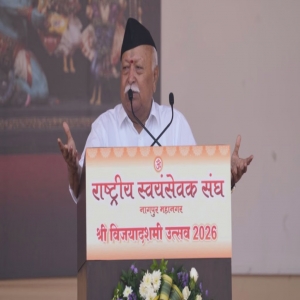
The Rashtriya Swayamsevak Sangh has not softened its core Hindu majoritarian thesis one whit in its hundred years of existence, and its current supremo, Mohan Bhagwat, made it clear in his centenary address on Vijayadashami, or Dussehra, that, in its view, Indian citizenship is cultural rather than juridical.
The Constitution, in this reading, is not a charter of rights that individuals, especially religious minorities, hold against the majority but the formal ex
Bhagwat invokes "We, the People of India" of the Constitution's Preamble not as a legal fiction constituted by equal citizens but as evidence of an "emotional unity" that predates the document and gives it meaning.
Delivered at Reshimbagh in Nagpur on October 20, 2026, at the close of the RSS's centenary year, Bhagwat's speech, with its rhetorical elisions, was an accounting of the organisation's reach, a restatement of its ideological core, and a signal about how the Sangh intends to position itself in its second century.
There was a touch of satisfaction and a tone of arrogance in Bhagwat's accounting of the Sangh's growth, saying its Sampark Abhiyan contacted 10,19,88,511 households across 4,61,527 villages and 41,076 urban settlements; that Prabuddha Nagrik Goshtis were held in 1,117 districts with 4,26,497 participants; and that Yuva Sammelans drew 39,25,225 young people, a depth of penetration unmatched by any other civil society body in India.
The Sarsanghchalak described the Sangh's purpose as awakening the Hindu spirit and building an "organised and strong Hindu society," insisting this is compatible with respect for all faiths because Hindu society's worldview is "inclusive" and "all-embracing", a familiar defence against charges of majoritarianism. Its core, however, rests on a series of contestable claims and rhetorical elisions that repay close scrutiny.
Hindu consolidation is presented as the precondition for national unity rather than a threat to it, a logic that has direct consequences for Muslims and Christians.
Bhagwat invoked the 650th birth anniversary of Sant Ravidas, the centenary of Swami Shraddhanand's martyrdom, and the birth centenary of Swami Laxmanananda Saraswati, the Vishwa Hindu Parishad leader whose murder by Maoists in Odisha had triggered a massacre of Christians and a torching of almost 5,000 houses in 400 villages in 2008.
The section that drew most attention concerns what Bhagwat called a storm from the West: "demonic forces" seeking to dismantle Bharat, Hindu society, and the Sangh, citing upheavals in France, Albania, Bangladesh, and Nepal, and asserting that regime change has never improved any country's circumstances.
He said India is the target, with ambitious politicians assisting these forces, and that protests must aim at solutions rather than creating divisions.
Bhagwat conceded that "problems do exist" and that shortcomings in the system may naturally produce agitation, but he also undermined the legitimacy of the motives of those who agitate by suggesting they are, wittingly or otherwise, instruments of a larger design.
He did not elaborate that the French protests were driven principally by cost-of-living pressures and domestic political grievance; the upheavals in Nepal and Bangladesh have complex histories rooted in governance failure, generational discontent and crises of institutional legitimacy.
Attributing them to a unitary Western storm flattens radically different phenomena into a single conspiratorial narrative.
More seriously, the framework does not distinguish between violent destabilisation and democratic accountability, and it seeks to delegitimise people's agency and their constitutional rights to free speech, assembly, and protest.
Protest is the ordinary currency of a constitutional democracy, and demanding that institutions answer for their conduct is not evidence of a foreign hand.
Bhagwat's insistence that agitation should aim at solutions is unobjectionable in itself, but it leaves unanswered who adjudicates whether a movement is solution-oriented or merely divisive.
He called drug addiction a serious national problem requiring a coordinated response from government, administration and society, and announced that Swayamsevaks would build a nationwide movement against it.
He called for restrictions on OTT platforms, noting that other countries have introduced regulations after experiencing adverse consequences.
He warned that artificial intelligence could be used to mislead, deceive, and spread falsehoods, and insisted that young people must be taught discernment.
He linked the Nepal floods to one-sided development in the Himalayan region and argued that development must protect human welfare, remain sustainable and avoid imposing costs that threaten survival.
The Sangh can reach millions of households; whether it can translate contact into durable improvement in public health, education or environmental governance is a separate question the address does not confront.
In politically important references, Bhagwat credits the Sangh's discipline and organisational strength for the BJP's electoral success, a more explicit political claim than the organisation has traditionally made.
For decades, the RSS described itself as cultural rather than political; if the Sangh's strength produces electoral outcomes, then it is a political actor and should be held to the standards of transparency and accountability that apply to political actors, a point Bhagwat did not elaborate on.
The speech does not address that implication, nor, as a centenary address purporting to speak to the nation's future, does it engage with economic inequality, judicial accountability, or the quality of democratic institutions, making culture the primary objective and institutions merely instrumental.
.jpg)
 Cedric Prakash
.jpg) Elsa Lycias Joel
.jpg)
 A. J. Philip
 Jacob Peenikaparambil
John Dayal
.jpg)
.jpg)
 Joseph Maliakan
.png)
 Robert Clements
.jpg) Cedric Prakash
 ICPA