

.jpg)
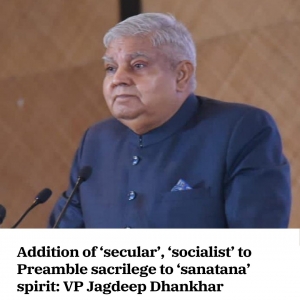
The Modi government has adopted a 'pick-and-choose' policy of who to elevate as high court judges, even after the Supreme Court collegium has reiterated the names of lawyers whom it has cleared for judgeship. Recently, Vice President Jagdeep Dhankar called the Emergency-era addition of the words "socialist" and "secular" to the Constitution's Preamble a "sacrilege to the spirit of Sanatan." It has been made abundantly clear that only certain lawyers who align with the government will be elevated to the bench as judges.
There are 29 advocates still awaiting elevation to the high court, of which five are women advocates. One of them is Advocate Shamima Jahan, whose name the collegium recommended on January 4, 2024, for elevation to the Guwahati High Court. The other women advocates recommended are Sreeja Vijayalakshmi (April 16, 2024, for Kerala High Court), Tajal Vashi (October 15, 2024, for Gujarat High Court), Shwetasree Majumdar (August 21, 2024, for Delhi High Court), and Sheetal Mirdha (March 5, 2025, for the Rajasthan High Court). This makes a mockery of the populist slogan 'Beti Bachao, Beti Padhao,' promoted since 2015.
The government has emulated Indira Gandhi, whom Dhankar, Prime Minister Narendra Modi, and Home Minister Amit Shah have flayed for hand-picking her judge, AN Ray, as the 14th CJI, superseding judges like JM Shelat, AN Grover and KS Hegde. The 15th CJI, MH Beg, superseded HR Khanna, who disagreed with the majority view that life was a gift of the state that could be taken away by the state during an Emergency.
Dhankar has also warned the judiciary against usurping the powers of Parliament, which is an elected body. He has criticised the judiciary for formulating the 'basic structure doctrine' in the Kesavananda Bharati judgment, which AN Ray dissented from, gaining the favour of Indira Gandhi.
Leaders such as Union Minister Shivraj Singh Chouhan, Assam Chief Minister Himanta Biswa Sarma, and RSS General Secretary Dattatreya Hosabale have all called for the deletion of the words "secular" and "socialist" from the Preamble, thereby turning India into a Hindu theocratic state. By ignoring the recommendations of the top court's collegium, the government has reduced the Memorandum of Procedure to a scrap of meaningless paper.
The Modi government elevated lawyers such as LC Victoria Gowri to the Madras High Court, against whom a petition was filed alleging she made hate speeches against the minority communities. The Supreme Court collegium recommended five advocates for elevation to the High Court as judges on January 17, 2023. However, the government appointed four out of the five to the Madras High Court, including L Victoria Gowri, but dropped the name of Advocate Ramaswamy Neelakandan, who had prepared throughout his life for a high court judgeship.
He is an OBC. Twenty-eight other advocates share his fate. Judges like Shekhar Yadav of the Allahabad High Court, who was instructed to apologise for stating in public that the law reflected the majority's wishes, continue to decide cases. But lawyers whom the Supreme Court collegium proposes and the government opposes may never be elevated as judges.
Demand to drop the word "Secular"
The words "socialist" and "secular" were added to the Preamble through the Constitution (42nd Amendment) Act of 1976, which the Janata government reversed through its 44th Amendment in 1978, leaving the Preamble untouched. When the Modi government came to power in 2014, it gradually supplanted the heads of all institutions with its appointees, with the judiciary being the last organ outside its purview.
A vision statement
The Supreme Court described the Preamble in a 1961 ruling in In Re: The Berubari Union as "a key to open the mind of the makers" of the Constitution. The 42nd Amendment in 1976 of the Preamble declared India to be a "…Sovereign Socialist Secular Democratic Republic…" and added the ex
The 42nd Amendment in 1976 introduced the chapter on fundamental duties, added new directive principles on state policy, diluted the powers of judicial review, and froze the delimitation process. Redistributing land to the poor was what India Gandhi wanted. She placed this outside the scope of judicial review by including it in the Ninth Schedule and reclassifying the right to property as a legal right rather than a fundamental right.
Syama Prasad Mookherjee, who was a former president of the Akhil Bharatiya Hindu Mahasangh, which was adamant on some precepts of the Manusmriti being incorporated in the Constitution, which they flayed as incorporating western concepts. When Mookherjee sought to open the Mahasangh to all communities, the hardcore leadership opposed this, leading to the formation of the Bharatiya Jana Sangh, which would later become the precursor to the BJP. All within the Sangh Parivar leadership adhere to the precepts of the Manusmriti, including the caste system.
In the 1967 general elections, the Jana Sangh won 35 seats, its best performance to date, and the Congress' tally dropped to 283. While the Congress bounced back in 1971, the Jana Sangh nonetheless remained among Indira Gandhi's foremost political opponents through the Emergency, when a number of its leaders, including Atal Bihari Vajpayee and LK Advani, were jailed.
Many retired judges like Kurien Joseph feel the founding fathers of our Constitution and of our country had intended Indian society to be secular and socialist, though not explicitly mentioned. "…… they rightly deserve to be mentioned there," Indira Gandhi had told the Lok Sabha in 1976.
While Indira Gandhi is demonised and others like Nathuram Godse, who assassinated Mahatma Gandhi, are lionised, lawyers like Advocate Arun Kumar are waiting for his elevation after his name was cleared on May 9, 2023, as a judge of the Allahabad High Court.
When the government declares what the Preamble should declare, and judges concur, democracy has turned into a theocracy.
.jpg)
 A. J. Philip
.jpg)
.png) Jacob Peenikaparambil
Jacob Peenikaparambil
.jpg)
.png) Cedric Prakash
Cedric Prakash
.jpg)

.png)
.jpg)
.png) Ram Puniyani
Ram Puniyani
.png)
.png) Robert Clements
Robert Clements
.jpg) Cedric Prakash
Cedric Prakash
.jpg)
 Pachu Menon