

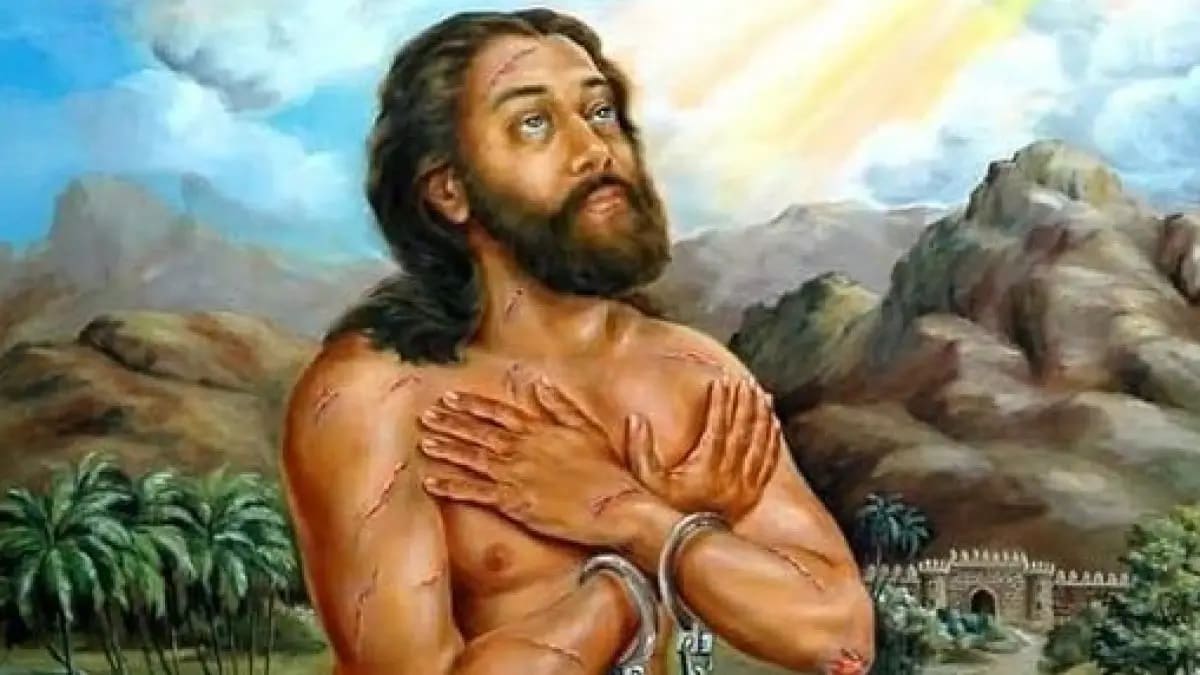
In a historic move that has sent ripples of joy through the subcontinent and the global Catholic community, the Conference of Catholic Bishops of India (CCBI) has officially announced that St Devasahayam has been declared the Patron Saint of the Laity in India. This confirmation, issued in July 2025 by a Vatican decree under the authority of Pope Leo XIV, marks a watershed moment for the Indian Church. It recognises the first Indian layman-martyr saint not merely as a historical figure, but as a living model for millions of ordinary believers.
The formal proclamation was celebrated on January 14, 2026, culminating in a grand Eucharistic celebration presided over by His Excellency Most Rev. George Antonysamy, DD, Archbishop of Madras-Mylapore, in the presence of His Excellency Archbishop Leopoldo Girelli, the Apostolic Nuncio to India and Nepal, and in communion with Archbishops and Bishops at Devasahayam Mount in the Kottar Diocese. This date is deeply symbolic, as it marks the anniversary of the day in 1752 when the saint was shot dead for his unwavering faith.
The Life of a Courtier Turned Christ-Bearer
Born in 1712 as Neelakandan, later known as Neelakanda Pillai, in the village of Nattalam in the Travancore Kingdom (now in Tamil Nadu), the man who would become St Devasahayam was raised in a high-caste Nair family. His father was a Hindu priest, and Neelakanda himself rose to a position of significant influence as an official in the court of King Marthanda Varma, the powerful ruler of the Kingdom of Travancore.
His life was comfortable and predictable until 1741, following the 'Colachel War.' It was then that he met a Dutch sea captain, Eustachius Benedictus de Lannoy, who had been taken as a prisoner of war but later served the Maharaja. Under the shade of mango trees, de Lannoy shared the Gospel with Neelakanda. He spoke of a God who made no distinction between high caste and low caste, rich and poor.
Moved by this message of universal equality and divine love, Neelakanda chose to be baptised in 1745. He took the name "Devasahayam," meaning "God is my help." His wife followed him into the faith, marking the beginning of a radical transformation that would eventually lead to his death.
A Radical Witness Against Caste and Clericalism
In 18th-century India, breaking caste barriers was more than a religious choice; it was a social and political transgression. By embracing Christianity, Devasahayam surrendered his Nair privileges and placed himself among the "lowly." According to Vatican records, his preaching particularly insisted on the equality of all peoples despite caste differences. This "Kenosis," a self-emptying of worldly status, aroused the intense hatred of the royal household.
Accused falsely of treason and espionage, St Devasahayam was stripped of his post and arrested in 1749. For three long years, he endured systematic torture. He was paraded through villages in chains, mocked by crowds, and whipped. Yet, he remained firm, forgiving his tormentors and comforting his fellow prisoners. On January 14, 1752, at the age of 40, he was taken to a remote hill at Aralvaimozhy and shot dead.
From Martyrdom to Patronage: A 300-Year Journey
While the local faithful, fishermen, farmers, and labourers, immediately recognised his holiness, the official path to sainthood spanned centuries. The process gained modern momentum in 1993. He was beatified on December 2, 2012, at the diocese of Kottar, during the papacy of Pope Benedict XVI, who hailed him as a "faithful layman." He was proclaimed "Blessed" by Cardinal Angelo Amato on behalf of Pope Benedict XVI, recognising him as a martyr for his Christian faith, preceding his later canonisation in 2022.
The journey reached its zenith on May 15, 2022, when Pope Francis canonised him at St Peter's Basilica. Pope Francis noted that Devasahayam's life proves holiness is not an unreachable goal for a select few, but comes from sharing God's love in service to our brothers and sisters without expecting anything in return.
Now, in 2025, the designation of St Devasahayam as the Patron Saint of the Laity in India specifically entrusts the millions of Christ's faithful in India to his care. Cardinal Filipe Neri Ferrão, President of the CCBI, expressed the collective hope of the Bishops: "We hope that devotion to St Devasahayam will inspire the lay faithful in India to grow in love for God, deepen their practice of faith, and actively serve both the Church and society."
Why Devasahayam? A Patron for Modern Challenges of the Laity
The declaration of St Devasahayam as the patron of the laity is highly significant for several reasons:
1. Recognition of the Lay Vocation: For too long, the face of sainthood in India was perceived through the lens of the clergy or religious life, with figures like St Alphonsa, St Kuriakose Elias Chavara, St Mariam Thresia, and St Euphrasia, etc. St Devasahayam, a married layman and court official, reminds the Church that the path to the highest levels of holiness is open to those living in the world.
2. A Challenge to Casteism: His martyrdom was a direct result of his stand for human equality. In a society still grappling with caste hierarchies, St Devasahayam's patronage is a call to the Church to be truly inclusive and synodal. As a high-caste convert who identified with the marginalised, he challenges the Church to turn away from any residual strands of caste-based discrimination.
3. A Beacon for the Persecuted: The timing of this patronage feels especially poignant. Reports indicate that attacks on Christians in India have seen a sharp rise, with innumerable incidents recorded in recent years. For those facing harassment or displacement for their faith, St Devasahayam is a patron who understands their pain.
4. The Antidote to Clericalism: By elevating a layman to this position of patronage, the Church challenges the spirit of clericalism. It reminds the hierarchy that they must become a "poor church for the poor," as Pope Francis often says, and that the laity are "creative subjects" of evangelisation, not merely passive recipients of grace.
Bishop Nazarene Soosai, Bishop of Kottar, states, "St Devasahayam stands as a beacon of hope for all who suffer. His courageous endurance of persecution is a powerful inspiration, not only for the people of India but also for the millions of Christians across the world who continue to suffer in silence for the sake of their faith. He didn't find "magical protection" from hardship, but he found a "hope that does not disappoint."
Bridges Instead of Walls
What does it mean for a layperson in 2025 to look to St Devasahayam? It is an invitation to discover that holiness is found in the "daily-ness" of life, in preparing meals, resolving workplace conflicts with fairness, standing up for a neighbour who has suffered injustice, remaining courageous and steadfast in one's convictions and beliefs even amid every form of adversity, and placing God first above all else.
St Devasahayam teaches the Indian laity to recognise the dignity of every person, to forgive even when it costs dearly, and to build bridges instead of walls. The message to the Indian Church is clear: The laity have a patron who is one of their own, a courtier who served his king well, but served his God first. Through his intercession, the Church in India seeks the courage to live the Gospel with the same "unflinching faith" that led Neelakanda Pillai from the comfort of the palace to the glory of the martyr's crown.
.jpg)
.png) Cedric Prakash
Cedric Prakash
 ICPA
ICPA
 ICPA
ICPA
 ICPA
ICPA
 ICPA
ICPA
 ICPA
ICPA
 ICPA
ICPA
.jpg)
 A. J. Philip
.jpg)
.png) Jacob Peenikaparambil
Jacob Peenikaparambil
.jpg)
.png) John Dayal
John Dayal