

.png) Jaswant Kaur
Jaswant Kaur
.jpg)
There is something deeply unsettling about a country that celebrates its demographic dividend. We speak of India as the world's youngest nation, a rising economic force, a talent powerhouse, and a superpower in the making. But beneath that narrative lies a statistic that should force us to pause, reflect, and engage in deep introspection.
The youth we proudly call our assets face a huge dilemma: to be educated or not? Nearly 40% of our graduates under 25 and 20% between 25 and 29 are unemployed! This is despite educational enrolment over the last four decades having grown substantially.
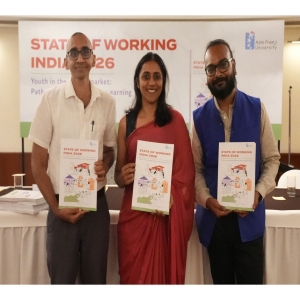
The State of Working India 2026, published by Azim Premji University, states that "the transition from education to employment remains uncertain, and for many, [it does] not [lead] into stable, remunerative employment."
For decades, India's development story rested on a simple and powerful promise: that education is the only passport to upward mobility. Families stretched their finances, young people deferred earnings, and entire social aspirations were reorganised around the idea that a degree would open doors to a promising career and would lift people out of poverty. However, it seems the promise does not hold. It has weakened to the point that it can no longer be relied upon.
The 254-page report makes another observation that should fundamentally alter how we think about this issue: "The rapid expansion in the number of graduates has not been matched by commensurate growth in graduate employment."
This is not a failure of individuals but of a system that is not producing enough jobs. India has succeeded in producing a more educated, more connected, and more aspirational generation than ever before. But it has not built an economy that can absorb them at the same pace. Each year, millions of graduates enter the labour market. A far smaller number find employment that matches their qualifications. An even smaller number find stable, salaried work. And only 7% of graduates find a permanent job a year after completing their graduation!
And yet, the public conversation continues to lean on the skills gap as a major issue behind this backlog. Employers lament that graduates are not job-ready, while institutions say they have done their best to produce a contributing workforce. The policymakers respond with skilling initiatives, digital platforms, and certification ecosystems. And then, hundreds and thousands of private players take undue advantage of the unemployed youth, extracting money by either promising a job or by selling another course!
The report says that our labour market is not designed to absorb the scale or the nature of the workforce it is now producing. Much of the employment growth remains concentrated in agriculture and self-employment, often with limited earnings and little security.
A young graduate today is not just unemployed but is put through a long wait that not only pushes them into depression but also reshapes ambition, erodes confidence, and normalises compromise. Over time, young people begin to recalibrate their expectations because the system has taught them to expect less.
And as age increases, unemployment declines. Not that the system becomes more efficient, but individuals become more accommodating, as with age comes more responsibilities, eventually forcing them to take whatever work is available.
The report notes that graduate unemployment has remained persistently high for decades, hovering between 35 and 40%, indicating that it is not a new crisis but a chronic one.
But what has changed is the scale and enormity of the problem. As the number of graduates has increased, so has the absolute number of unemployed graduates. It estimates that around 11 million graduates aged 20 to 29 were unemployed as of 2023.
This is no longer a marginal issue affecting a small segment of the population. It is a defining feature of India's labour market. The gender dimension makes this even more complex. The report notes that graduate unemployment is "most severe for women." When opportunities are limited, social constraints interact with economic ones to push women out of the labour force more quickly. The result is not just unemployment, but invisibility.
We invest in educating women, but fail to create an economy that can retain them. That is not just inefficiency but structural exclusion.
Another uncomfortable pattern emerges from the report. Higher education is increasingly functioning as a holding space. When jobs are scarce, young people remain in the system longer, pursuing additional degrees, preparing for competitive exams, and accumulating credentials that may or may not translate into employment, creating another disappointing loop. As they acquire more degrees, their expectations and aspirations increase. And as they grow, they face limited opportunities, widening the gap and increasing the frustration.
The report acknowledges that India has made "remarkable progress" in expanding access to education, but immediately follows it with a caveat: this progress "has not ... been accompanied by an effective transition into employment."
The state cannot outsource this problem to individuals by asking them to upskill, reskill, or become entrepreneurs. Entrepreneurship cannot be a default pathway for millions without access to capital, markets, or institutional support. Nor can skilling compensate for the absence of demand.
The report also warns that India's demographic dividend is time-bound, with the window expected to close after 2030. The implication is clear. If meaningful employment is not created at scale in the coming decade, the opportunity will be lost. This is not just an economic risk but also a social one.
Because a generation that feels excluded from growth does not remain patient indefinitely. What is required now is not incremental adjustment, but structural clarity. Job creation has to move from a by-product of growth to a central policy objective. This means the government should invest in sectors that can absorb labour at scale, align education with realistic employment pathways, and build stronger institutional linkages between learning and earning.
It also requires a shift in narrative. We need to stop telling young people that the problem lies entirely within them and that they need to try harder, learn more, and adapt faster, as the data does not support this story.
What it shows instead is a system where effort is necessary but not sufficient, where degrees are abundant but do not necessarily guarantee opportunities, and where the transition from a classroom to the workplace is not a pathway but a bottleneck.
India's demographic dividend has been described as its greatest strength. But a dividend is meaningful only if it can be monetised; otherwise, it becomes a liability or a deferred expectation.
And a generation that has done everything it was told to do will eventually begin to ask a harder question, one that would be more uncomfortable than unemployment itself: whether the system they trusted was ever designed to deliver on its promise, or were they simply the consumers to sustain the ever-expanding education economy?
.jpg)
.png) Cedric Prakash
Cedric Prakash
 ICPA
ICPA
 ICPA
ICPA
 ICPA
ICPA
 ICPA
ICPA
 ICPA
ICPA
 ICPA
ICPA
.jpg)
 A. J. Philip
.jpg)
.png) Jacob Peenikaparambil
Jacob Peenikaparambil
.jpg)
.png) John Dayal
John Dayal