

.png) Aarti
Aarti
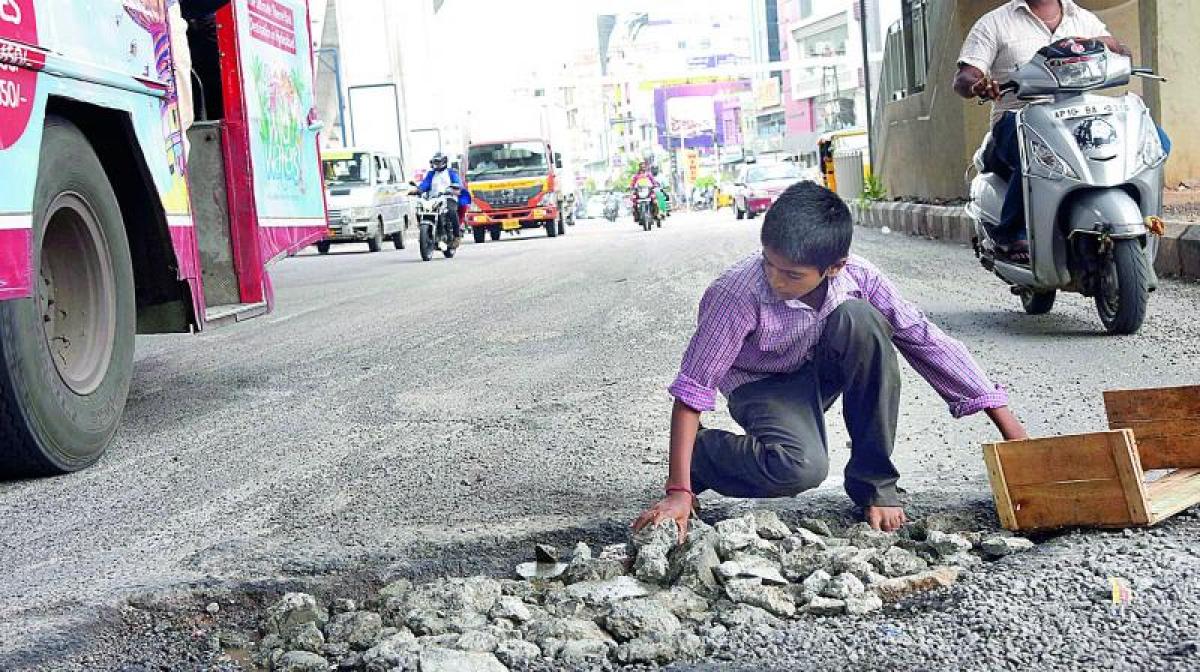
The recent oral observation made by a Division Bench of the Karnataka High Court as reported in the media “When we see a newspaper report of someone dying due to bad roads, we feel guilty” ought to prick the conscience of those who are responsible for such deaths. Not long ago the Kerala High Court, while hearing an accident case, maintained, “A young man has lost his life on the road. The pillar of a family has been lost. We bow our heads in shame. The court apologizes to the parents of the young man on behalf of the society.”
Crores of rupees are allocated and spent by Government agencies to build roads. A properly laid road with quality materials is said to last at least three years and would not require major repairs for up to five years. But when drains are poorly designed and ill-maintained, short spells of rains can cause stagnation leading to road damage. As power, LPG and water lines are also laid under the roads, for some reason or the other roads are dug up frequently. But while closing the dug up roads, adoption of unscientific quick-fix methods coupled with use of substandard materials often shorten the life of even well laid roads.
The issue of a hole or holes on the roads, commonly called pothole/s, poses innumerable problems to vehicles as well as road users. Some potholes are big enough to even swallow people and small vehicles. That entire stretches have been reportedly ruined in many areas including highways speaks volumes of poor quality of construction and upkeep. Accidents arising due to potholes are a global worry and India is no exception. It may be argued that when pothole mishaps happen elsewhere too, why should such instances get highlighted, hyped and blown out of proportion in our country?
Well, going by official statistics, on an average, daily there are about 20 reported pothole related accidents, leaving at least 8 people dead besides injuring many more. During the period 2014-2018 there were a total of 42,698 road accidents due to potholes. Nearly 14,390 lost their lives rather prematurely.
So, is it not a cause for concern?
Definitely. But who is responsible for deaths and injuries caused by unsafe roads? There are several agencies involved and it is a vicious circle. So, when accidents happen due to bad roads, eventually there is none to take the blame. It is also no exaggeration that disasters are waiting to happen for a plethora of reasons. Does it point to the infirmities in the system?
Remember the Wazirabad bus tragedy of 1997? A school bus meant to seat 66 children was being driven at breakneck speed, jam packed with 117 of them plus two teachers. While negotiating across a narrow two-lane bridge, the bus driver lost control after the bus hit a huge pile of sand. The iron railings on the said bridge eventually gave way. The ill-fated bus fell into the Yamuna killing 28 children besides injuring another 60 of them. Twenty-two years later while passing the Judgment, a City Court observed, “we tend to look the other way when it comes to rash driving on roads and no lessons have been learnt for the past.” Now, here, the driver blamed the sand on the road for the mishap.
Once there is a road accident, it is unthinkable agony for the victims and their families. Accidents pose both physical and psychological threats. According to research, often the psychological injuries are more severe than the physical wounds. They need to be prevented in the first place as it can eventually lead to posttraumatic stress disorder resulting in depression, panic and anxiety.
Are all our roads unsafe? Even though no one would accept it officially, let’s see what the Comptroller and Auditor General of India (CAG) had to say. According to a latest CAG report tabled in the Karnataka Assembly last week, it noted that among others, “Bangalore roads were the most hazardous in the state” with almost 20 hazards per kilometre followed by state highways, major district roads and National Highways which had 8.87, 8.43 and 7.39 hazards per km respectively.
What are the authorities and the public at large doing about it? On the flip side, some public-spirited Bengaluru citizens, thought it fit to file a PIL in 2015. The small step initiated by them to halt the mismanagement of roads in Bengaluru city and hazardous potholes has not witnessed about 80 hearings but is progressing. Citizens seem to appreciate that by cracking the whip time and again the High Court has been able to nudge the officials into some action. For instance, interestingly, for reasons whatsoever, a top officer remained absent in one of the court proceedings in spite of its orders to be present. So a bailable warrant did its needful after which he promptly appeared and offered an unconditional apology.
An improvement in the city’s road conditions is the need of the hour because potholes, besides taking away lives, can create disability for life. The cause for concern amongst orthopaedic surgeons is around 30 to 40 percent of patients frequenting hospitals owing to back pain happen to be victims of potholes. In severe cases, the victims may end up with a permanent fracture on the spinal cord besides various neck problems. Those suffering from Osteoporosis, particularly above 60 years can be adversely affected as the sudden jerks arising out of bumpy rides can cause the collapse of vertebra leading to compression fracture. Notably, once the alignment of the spine goes awry, it can lead to arthritis. Pothole rides can harm women who are in their advanced stages of pregnancy.
How much damage do potholes cause to vehicles?
Studies have shown that when a vehicle drives into a pothole, apart from the tyres, it can damage the wheels, knock it out of alignment, bend steering parts, and damage the suspension components. It can cause collateral damage to shock absorbers. The extent of vehicular damage depends on the speed of the vehicle, length of the pothole and the diameter of the tyres. As the tyres try to absorb the impact first, its interior structure can break and even tear the sidewall. While overinflated tyres are vulnerable to structural damage, under inflated tyres could rupture when squeezed between the pothole and the wheel. Smaller the wheel diameter, more severe is the impact, especially if the depth of the hole is the same as the diameter of the wheel. Bigger potholes can cause significant damage to the vehicle’s frame because at practically any speed, the tyres are likely to hit bottom before exiting.
An initiative worth emulation is the manner in which Prime Minister Narendra Modi had reportedly instructed the Cabinet Secretary recently to prepare “dossiers” of delayed projects within one week and identify the officers/agencies responsible for the delays in order to fix responsibility.
Similarly, with regard to potholes, there is an imperative need to show grit and act tough. Bringing about accountability at all levels and quickly put in place a slew of easily implementable measures merit immediate consideration. An effective monitoring mechanism to identify and prevent potholes coupled with professionalism in repairing them using quality materials in the right earnest can go a long way in not only saving precious lives but in also minimising injuries thereof.
We all need to travel at some point or the other, for some purpose. But it doesn’t mean we have to one’s own risk. If we can’t avoid a pothole, it pays to at least slow down as much as possible and let off the brakes just before falling into it as this will help prevent damage to one’s vehicle.
At the macro level, as roads are the lifeline for commuters, they need to be well maintained and accountability fixed with deterrent punishment for lapses. There can be no room for complacency, ineptitude or negligence.
.jpeg)
 A. J. Philip
.jpg)
.png) Jacob Peenikaparambil
Jacob Peenikaparambil
.jpg)
.png) John Dayal
John Dayal
.jpg)
 Pachu Menon
.jpg)

.png)

.png)
.png) Robert Clements
Robert Clements
.jpg)