
.png) Cedric Prakash
Cedric Prakash
.jpg)
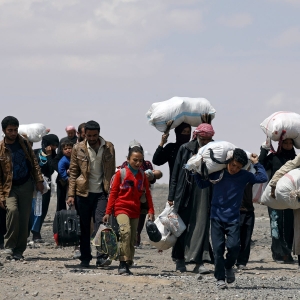
It is 'World Refugee Day' once again! It is a day on which all of us are called to remember and to honour the strength, courage and resilience of people who have been forced to flee their home country to escape conflict or persecution. The day is important because it shines a light on the rights, needs, and dreams of refugees, and helps mobilise political will and resources so refugees can not only survive but thrive. This special day was first established on June 20, 2001, to mark the 50th anniversary of the 1951 UN Convention Relating to the Status of Refugees.
The Refugee Convention was adopted on July 28, 1951, with some 20 nations as original signatories. So this year marks its 75th year! Today, 149 countries have signed the Refugee Convention and its subsequent 1967 Protocol.
Adopted in the aftermath of two devastating world wars, the Convention was born from a determination never again to abandon those fleeing persecution and violence. Seventy-five years ago, after the Second World War, the world made a promise for everyone's benefit: People forced to flee have the right to seek and live in safety.
It was never meant for a few. It was meant for every single person on planet Earth. Seventy-five years down the road, its relevance has never been clearer. According to the UN Refugee Agency (UNHCR), 117.8 million people were forcibly displaced worldwide at the end of 2025 – roughly 1 in 70 people on the planet.
The theme this year is 'Until Everyone is Safe'; a reminder that safety is not a privilege reserved for the few but a fundamental right: the right to life and to a life lived in dignity. For as long as people are forced to flee conflict, climate change or persecution, our shared responsibility endures.
But safety is not just the absence of violence. It means legal protection, shelter, health care, education, the right to work, and the chance to rebuild and live in dignity. No one is safe until the most vulnerable among us are. Protecting refugees helps communities thrive, creates stability and saves lives.
In times like these, we hold onto the promise of safety, dignity and rights. We also renew our commitment to helping refugees move beyond survival towards a future of rights, solutions, dignity and hope.
The 1951 Convention contains several rights and also highlights the obligations of refugees towards their host country. The cornerstone of the 1951 Convention is the principle of 'non-refoulement.' According to this principle, a refugee should not be returned to a country where they face serious threats to their life or freedom.
This protection may not be claimed by refugees who are reasonably regarded as a danger to the country's security, or who have been convicted of a particularly serious crime and are considered a danger to the community.
The rights contained in the 1951 Convention include:
1. The right not to be expelled, except under certain, strictly defined conditions;
2. The right not to be punished for illegal entry into the territory of a contracting State;
3. The right to work;
4. The right to housing;
5. The right to education;
6. The right to public relief and assistance;
7. The right to freedom of religion;
8. The right to access the courts;
9. The right to freedom of movement within the territory;
10. The right to be issued identity and travel documents.
Some basic rights, including the right to be protected from refoulement, apply to all refugees. A refugee becomes entitled to additional rights the longer they remain in the host country, reflecting the recognition that the longer they remain as refugees, the more rights they need.
The Church has always taken an unequivocal stand in support of refugees. Pope Francis has not missed an opportunity to highlight the plight of refugees and to urge us to welcome, protect, promote, and integrate them. Pope Leo XIV has continued the legacy of Pope Francis. During his recent pastoral visit to Spain, Pope Leo spoke often about refugees; he also visited the Canary Islands, where we spoke with and met several refugees.
In his first encyclical 'Magnifica Humanitas' (May 15, 2026) Pope Leo says, "a litmus test for social justice today is the treatment of migrants, refugees and those forced to move due to poverty, violence, climate change and environmental disasters. The way a society treats them reveals whether its sense of justice is driven by fear or by the spirit of fraternity. Pope Francis urged us to see migrants not simply as a problem to be managed, but as a living image of the People of God on the move. They are people with dignity, resources and dreams, who have the right to be treated with respect and to ask to become active members of the societies that welcome them. Social justice in this area entails at least two complementary commitments. On the one hand, this means protecting the rightful hopes of those forced to leave by ensuring safe and legal routes, dignified conditions for receiving them, and genuine pathways to integration. On the other hand, it means promoting the right to remain in one's homeland in peace and security by addressing the root causes that force people to migrate, including those linked to economic injustices and the climate crisis. When these rights are respected, migration can become an opportunity for encounter and mutual enrichment among peoples."
In the past, India took great pride in putting into practise that Sanskrit phrase from the Maha Upanishad, 'Vasudhaiva Kutumbakam' ('the world is one family'). Perhaps it was in our DNA to welcome and provide hospitality to the stranger.
In the past, we have had great visionary leaders who epitomised what welcome, hospitality, and protection are all about! Gone are the days when Nehru welcomed the Tibetans, Indira Gandhi welcomed the Bangladeshis, and Rajiv Gandhi welcomed the Tamils.
We fare very badly today, as a nation, in our treatment of refugees. India is not a signatory to the Refugee Convention. Today, xenophobia, jingoism, false-nationalism and exclusivism seem to have become the order of the day!
The Citizenship Amendment Act (CAA) and the Special Intensive Revision (SIR) are blatant examples of how Muslims are targeted and regarded as 'foreigners.' Besides, discrimination is institutionalised. This is clearly written all over, particularly when one looks at the way the minorities, the Adivasis, the Dalits, the poor and the vulnerable, like the migrant workers and even refugees like the Rohingyas, are being treated in this country. In Ahmedabad, thousands of poor Muslims had their homes demolished because they were 'suspected' to be Bangladeshi!
Last October, in a message for the 111th Day of Migrants and Refugees, Pope Leo XIV said, "In a world darkened by war and injustice, even when all seems lost, migrants and refugees stand as messengers of hope. Their courage and tenacity bear heroic testimony to a faith that sees beyond what our eyes can see and gives them the strength to defy death on the various contemporary migration routes."
The key question, then, for each of us today: do we have the courage to stand in solidarity with the refugees? To accompany them to a more just, equitable, fraternal and humane life? To be there with them ... until everyone is safe?
.jpg) Cedric Prakash
Cedric Prakash
 ICPA
ICPA
 ICPA
ICPA
 ICPA
ICPA
 ICPA
ICPA
 ICPA
ICPA
 ICPA
ICPA
.jpg)
 A. J. Philip
.jpg)
.png) Jacob Peenikaparambil
Jacob Peenikaparambil
.jpg)
.png) John Dayal
John Dayal