

.png) Joseph Maliakan
Joseph Maliakan
.jpg)
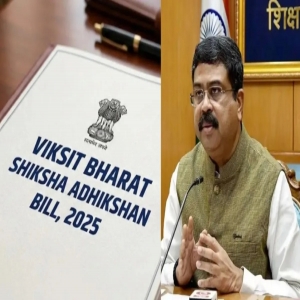
The Viksit Bharat Shiksha Adhishthan (VBSA) Bill, 2025, which seeks to replace the University Grants Commission (UGC), the All India Council for Technical Education (AICTE), and the National Council for Teacher Education (NCTE), proposes a sweeping restructuring of higher education in India. In effect, it centralises authority, weakens the federal framework, and erodes the autonomy that higher educational institutions currently enjoy.
The Bill repeals the Acts that established these bodies, while exempting legal and medical education, which will continue to be governed under separate regulatory frameworks.
It seeks to establish the VBSA as the apex regulatory authority for higher education, supported by three Councils:
(i) a Regulatory Council to function as the common regulator;
(ii) an Accreditation Council to oversee accreditation; and
(iii) a Standards Council to determine academic benchmarks.
These Councils are tasked with providing strategic direction for higher education and research, designing institutional transformation roadmaps, and proposing measures to improve quality.
A significant structural change lies in the removal of grant-disbursing powers. At present, the UGC allocates funds to universities and colleges. Under the proposed Bill, however, neither the Commission nor its Councils will have any role in funding higher education institutions. Instead, financial control is expected to shift to the Union Education Ministry, although the Bill does not clearly specify the mechanism for allocation.
This raises one of the most serious concerns surrounding the Bill—its impact on federalism. While the restructuring of regulatory bodies may be presented as administrative reform, the centralisation of both authority and financial control effectively sidelines the states. Given India's diversity—of language, culture, geography, and social conditions—the Constitution's design, which allows states flexibility in shaping education policy, is both deliberate and necessary.
In this context, the Congress has described the Bill as a "constitutional overreach." In a statement issued on March 19, 2026, Jairam Ramesh argued that the Bill was introduced without consulting the states, bureaucratises higher education, and concentrates financial powers in the hands of the Union Government.
He also drew attention to the Parliamentary Standing Committee on Education's report on the Department of Higher Education, which highlighted a high number of vacancies in key regulatory bodies such as the UGC and AICTE—raising questions about the government's capacity to manage an even more centralised system.
Ramesh further pointed out that the Bill has been introduced under Entry 66 of the Union List in the Seventh Schedule of the Constitution, which permits Parliament to legislate only on the "coordination and determination of standards" in higher education. According to him, the powers granted to the proposed Commission go far beyond this mandate.
He argued that Entry 44 of the Union List prohibits Parliament from legislating on the incorporation and regulation of universities, powers explicitly assigned to the states under the State List. The Bill, therefore, risks violating the constitutional balance between the Union and the states.
The shift in financial governance compounds these concerns. By removing grant-giving functions from bodies such as the UGC and AICTE—institutions traditionally guided by academic leadership—and placing them under the Ministry, the Bill replaces academic discretion with bureaucratic control. In the absence of a transparent, rule-based funding mechanism, there are legitimate concerns about arbitrariness and political bias, particularly in opposition-ruled states.
The Bill has been referred to a Parliamentary Standing Committee headed by Daggubati Purandeswari following its introduction in the Lok Sabha on December 15, 2025. As of March 2026, the Committee is examining issues such as funding mechanisms and the role of states in higher education.
Concerns have also been raised about the autonomy of premier institutions such as the Indian Institutes of Technology (IITs) and the Indian Institutes of Management (IIMs). Clause 49 grants the proposed Commission overriding authority on accreditation and standards, potentially bringing even these Institutes of National Importance under tighter central control.
Finally, the composition of the proposed regulatory structure raises further questions. The Commission and its Councils are likely to be dominated by bureaucrats and administrators rather than academics, who have traditionally led higher education bodies. Representation of states is minimal, reinforcing the broader trend towards centralisation.
Taken together, these provisions signal a fundamental shift in the governance of higher education—from a system that allowed for a measure of institutional autonomy and federal balance to one that is increasingly centralised, bureaucratic, and politically controlled.
.png) Cedric Prakash
Cedric Prakash
.JPG)
 A. J. Philip

.png) Jacob Peenikaparambil
Jacob Peenikaparambil
.jpg)
.png) John Dayal
John Dayal
.jpg)
 Pachu Menon
.png)
.png)
.png) Robert Clements
Robert Clements