
.png) Cedric Prakash
Cedric Prakash
.jpg)
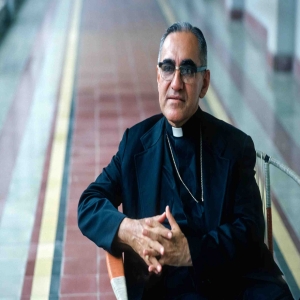
March 24 is celebrated as the Feast of St. Oscar Romero. It was on this day in 1980 that he was brutally gunned down whilst celebrating the Eucharist in his native El Salvador. He was a fiercely outspoken critic of his government, the military and the fascist elements of his country, for their continued exploitation and exclusion of the poor. It was they who killed him!
He visibly and vocally sided with the poor, the marginalised, the vulnerable, the excluded and the exploited and with all who were victims of injustice. His martyrdom spontaneously made him a 'Saint' for millions of his people. It was estimated that more than 250,000 attended his funeral as a sign of gratitude to the man who did so much for them and whom they deeply loved.
In his homily, a few moments before he was assassinated, Romero said:
"Many do not understand, and they think Christianity should not get involved in such things (taking a stand for Truth and Justice). But, to the contrary, you have just heard Christ's Gospel, that one must not love oneself so much as to avoid getting involved in the risks of life which history demands of us, that those who would avoid the danger will lose their life, while those who out of love for Christ give themselves to the service of others will live, like the grain of wheat that dies, but only apparently. If it did not die, it would remain alone. The harvest comes about because it dies, allows itself to be sacrificed in the earth and destroyed. Only by destroying itself does it produce the harvest."
The night before his murder (March 23), Archbishop Romero made a personal but powerful appeal, in a desperate attempt to place some sort of moral obstacle before the escalating pace of the killing in El Salvador. He spoke directly to the soldiers most responsible for the growing horror, asking them to disobey their superiors.
He said, "I would like to appeal specially to the men of the army and in particular to the troops of the National Guard, the police and the garrisons: each of you is one of us. You kill your own brother peasants; and in the face of an order to kill that is given by a man, the law of God that says 'Do not kill!' should prevail. No soldier is obliged to obey an order counter to the law of God. No one has to comply with an immoral law. It is time now that you recover your conscience and obey its dictates rather than the command of sin ... Therefore, in the name of God, and in the name of this long-suffering people, whose laments rise to heaven every day more tumultuous, I beseech you, I beg you, I command you! In the name of God: 'Cease the repression!'"
The applause that followed was so thunderous that the radio station's beleaguered audio technicians at first took it for some sort of short circuit or feedback in the system that had knocked the good archbishop off the air. Sadly, that passionate appeal was his death sentence!
Three years earlier, on March 12, 1977, Archbishop Romero's dear friend Jesuit Fr. Rutilio Grande was cruelly murdered by government thugs. Grande had been living in solidarity with the rural poor and speaking out against the military government. Grande's death was a watershed moment for Archbishop Romero, as he realised that being a Catholic and being a priest meant standing with the poor and being a prophet against the establishment.
Archbishop Romero ordered three days of mourning and a funeral mass in San Salvador's cathedral, despite advice to the contrary from those who feared government repercussions. Romero experienced a profound conversion at the death of Grande, publicly declaring, "When I looked at Rutilio lying there dead, I thought ... I, too, have to walk the same path." He defended Grande's work with the poor as rooted in faith, not politics, famously urging that the Church "cannot remain silent before such injustice."
On December 21, 2010, the United Nations General Assembly, in a fitting annual tribute to Oscar Romero, proclaimed March 24 as the International Day for the Right to the Truth Concerning Gross Human Rights Violations and for the Dignity of Victims:
1. to honour the memory of victims of gross and systematic human rights violations and promote the importance of the Right to truth and Justice;
2. to pay tribute to those who have devoted their lives to, and lost their lives in the struggle to promote and protect human rights for all;
3. to recognise, in particular, the important work and values of Archbishop Oscar Arnulfo Romero of El Salvador, who was assassinated on March 24, 1980, for denouncing violations of the human rights of the most vulnerable populations and defending the principles of protecting lives, promoting human dignity and opposition to all forms of violence.
India today is steeped in untruth, injustice, corruption and communalism. Those who take a stand for Justice and truth are harassed, incarcerated and even killed, like Romero! Corruption is mainstreamed: be it demonetisation or the Electoral Bonds scam.
The minorities (particularly Muslims, Christian and Sikhs) are at the receiving end of a brutal system; divisiveness and discrimination rule the roost. Several political and so-called 'religious' leaders use hate speeches and even resort to violence to nurture their lust for power and greed for wealth.
People are kept divided and on the fringes of society for whimsical reasons. Truth and Justice are conveniently sacrificed for petty political gains; those whose primary duty is to propagate and protect our Constitution, our democratic ethos and pluralistic fabric, just abdicate their responsibility; they feel either too embarrassed or very frightened to take a stand, or they just succumb to the 'diktats' of their masters. The Election Commission is a classic case; the manner in which it has used the Special Intensive Revision (SIR) to disenfranchise thousands of legitimate voters is in the public domain.
Even sections of the judiciary are not beyond reproach! Draconian, anti-Constitutional and anti-people policies/legislation like the Citizenship Amendment Act, the National Education Policy, the three anti-small farmer laws, the four labour codes, which are anti-worker, the anti-conversion laws, the Uniform Civil Code first in Uttarakhand and now in Gujarat; the weaponisation of the use of foreign funds, the treatment meted out to transgenders and much more!
India needs a Romero today! Romero was never afraid to highlight the painful realities of his people and to take on the powerful of his land! He stepped out of his comfort zone and, as a true disciple of Jesus, stuck his neck out on behalf of his suffering people! Some days before he was killed, Romero stated, "As a Christian, I do not believe in death without resurrection. If I am killed, I shall rise in the Salvadoran people." His words are still chanted today: "They can kill me, but they will never kill justice."
Today, our Country and Church desperately need Oscar Romeros, not just one, but many! Romeros who are not afraid to speak truth to power, to take on the fascist, fundamentalist and fascist forces who are doing all they can to destroy the Constitutional rights and freedoms of the ordinary citizen.
A Romero who is neither a hypocrite nor takes recourse to diplomatic 'niceties'; who is not a puppet or a plaything for foreign regimes! Someone who can say 'NO' to war, violence and hate! A Romero who has a spine, who exemplifies servant-leadership and has the prophetic courage to die for others, so that they may rise!
Will a Romero or many Romeros emerge from among our Bishops, clerics, religious and even laity?
Jesus reminds us, "fear no one..."
WANTED, then: a ROMERO for INDIA, TODAY!
.jpg) Cedric Prakash
Cedric Prakash
 ICPA
ICPA
 ICPA
ICPA
 ICPA
ICPA
 ICPA
ICPA
 ICPA
ICPA
 ICPA
ICPA
.jpg)
 A. J. Philip
.jpg)
.png) Jacob Peenikaparambil
Jacob Peenikaparambil
.jpg)
.png) John Dayal
John Dayal