

 A. J. Philip
.jpg)
Three weeks ago, the United States military looked invincible as President Donald Trump assembled what seemed the greatest concentration of force ever deployed in waters around Iran. When it became clear that the "Great Satan" was joined by the "little Satan" — Israel — the world braced for catastrophe for the regime of the Ayatollahs.
Yet today, the question nobody seems eager to ask is a simple one: what exactly has been achieved?
When the United States and Israel abruptly stopped their aggression against Iran last year, both governments declared that their objectives had been met. Trump boasted that the massive bombing had permanently destroyed Iran's enrichment facilities. Media outlets filled their pages with elaborate descriptions of bunker-buster bombs capable of penetrating deep underground and obliterating hardened installations.
The message was clear: Iran's nuclear ambitions had been crushed. But that narrative has steadily begun to unravel.
Iran did retaliate, inflicting significant damage on a US military base in the region. The engagement, therefore, was never entirely one-sided. Yet the swift and decisive victory the White House attempted to project has begun to look more like wishful thinking.
Indeed, even now, it remains unclear what compelled Trump to launch the attack in the first place. Under the US Constitution, only Congress has the authority to declare war. The President may initiate military action only if the United States itself has been attacked.
Congress, moreover, was controlled by Republicans — hardly a hostile chamber for Trump. Yet the President apparently understood that even his own party might baulk at authorising a war against Iran. Rather than risk rejection, he bypassed the constitutional process altogether and pressed ahead like a bully on the streets.
Trump also seemed genuinely surprised that Iran failed to capitulate once the US Navy assembled in force near its shores. What he failed to grasp was that Iran has spent decades preparing precisely for such pressure. It has built its strategy around resilience rather than surrender.
Even the name chosen for the campaign reveals something about the thinking behind it. Trump personally selected the title Operation Epic Fury. By his own account, aides presented him with a list of possible names. None appealed to him. "They gave me like 20 names," he later said. "I was falling asleep." Only when someone suggested Epic Fury did he perk up. "I like that name," he said — and the decision was made.
The choice was revealing. Everything in Trump's political vocabulary is "epic": the biggest, the greatest, the most unprecedented. Previous American interventions had names such as Operation Just Cause in Panama, Restore Hope in Somalia, Uphold Democracy in Haiti, and Enduring Freedom in Afghanistan. Trump, by contrast, prefers fury to freedom.
In the early phase of the conflict, the United States and Israel did achieve a dramatic success. Precision strikes killed Iran's supreme leader and several senior officials, dealing a severe blow to the regime's leadership. Yet the expected collapse never came.
Instead, something very different occurred. The same Iranian citizens who only months earlier had taken to the streets to protest against the regime's repression — particularly its treatment of women — filled those streets again. This time, they were protesting foreign aggression. Trump would do well to remember that nothing unifies a country faster than an external enemy.
Three weeks into the war, it is difficult to point to any decisive achievement. The regime Trump hoped to weaken — perhaps even overthrow — continues to function. Despite the deaths of senior figures, Iran's command structure remains, by and large, intact.
The war has also inflicted enormous hardship on ordinary Iranians. Infrastructure strikes, including attacks linked to Pars Island, have had direct consequences for civilians.
Pars Island plays a crucial role in Iran's energy supply. Gas extracted from fields there provides fuel for homes and electricity for cities across the country. When Israel targeted installations connected to the island — which Iran shares with Qatar — the damage extended far beyond strategic facilities. It struck the daily lives of millions of people.
Trump attempted to distance himself from the attack, claiming he had not been consulted beforehand. Iranian officials, however, seemed more inclined to believe Israeli statements contradicting the President's version of events.
The situation deteriorated further when Iran retaliated by striking Qatar's portion of the same gas complex. Trump responded by threatening to destroy the entire island. Such rhetoric sits awkwardly with his frequent condemnations of Iran's human rights record.
At one stage, Trump even declared that the US–Israel campaign had eliminated "100 per cent of Iran's military capability." Yet the supposedly crippled country still possesses enough missiles and drones to force American aircraft carriers to reposition farther from the Iranian coast. Even a "zero percent" capability, it seems, can impose uncomfortable constraints on the world's most powerful navy.
If the military results have been ambiguous, the economic consequences have been even more surprising. For decades, the United States maintained strict sanctions on Iranian oil exports. Iran survived by selling oil clandestinely at discounted prices. Yet the disruption caused by the conflict threatened to drive global energy prices sharply higher.
Faced with that risk, Washington quietly eased restrictions on Iranian oil sales. The objective was not to reward Tehran but to prevent a surge in fuel prices that could damage the American economy. Trump also "allowed" India to buy Russian oil for one month!
Nevertheless, the outcome is unmistakable. For the first time in years, Iran can sell oil more openly at international prices. What was meant to weaken Tehran has inadvertently strengthened its financial position.
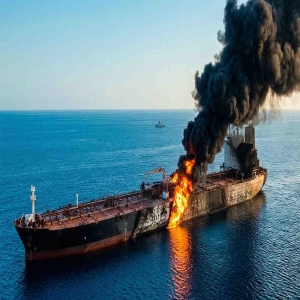
The war has also altered the strategic balance in the Strait of Hormuz, one of the world's most vital maritime chokepoints. US officials have insisted that the waterway remains open to shipping. Yet even the American Secretary of Defence conceded that ships face the constant threat of missiles and torpedoes. In practical terms, that means the Strait operates under the shadow of Iranian power.
For the first time, Iran appears able to decide which vessels pass freely and which face delays or intimidation. The implications are global. Roughly a fifth of the world's oil trade moves through the narrow passage. Any disruption immediately reverberates through energy markets.
Trump understands that air strikes alone cannot resolve this problem. Gaining control of the Strait would require a far more dangerous step: deploying ground forces and seizing territory. So far, the United States has avoided that escalation. Even without it, however, American casualties have begun to occur. Thirteen soldiers have reportedly died during the conflict despite the absence of large-scale ground combat.
Each casualty increases the domestic political cost of the war. Financial costs are mounting as well. Trump has requested $200 billion (about ?18.6 lakh crore) from Congress to sustain operations into a fourth week of fighting. The sum is staggering. It amounts to more than half of India's annual net tax receipts.
Congress may ultimately approve the funding. But American taxpayers will be left with the bill. Beyond the battlefield and the balance sheet lies another, more subtle consequence: the erosion of confidence among US allies.
The conflict has exposed the vulnerability of Gulf infrastructure in countries such as the United Arab Emirates, Saudi Arabia, Kuwait and Qatar. Despite decades of security partnerships with Washington, these states have discovered that American protection cannot guarantee safety from missile strikes or drone attacks. This realisation could trigger a strategic rethinking across the region.
At the same time, Trump has struggled to rally support from traditional allies. When Washington requested European assistance to escort commercial shipping through the Strait of Hormuz, the response was lukewarm. European governments showed little enthusiasm for joining another Middle Eastern conflict. Trump attempted to pressure them by hinting that NATO might not defend Europe in the event of a Russian attack. The threat appeared to have little effect.
Eventually, the President declared that the United States was strong enough to fight alone. Diplomacy has never been Trump's strongest point. His blunt remarks and occasional historical gaffes have repeatedly unsettled allies. Even routine meetings sometimes produce awkward moments.
When Japan's prime minister, a newly elected lady, visited the White House, Trump reportedly referred casually to the attack on Pearl Harbour — a comment that left many observers puzzled. Combined with his periodic provocations about Greenland and other issues, such episodes reinforce the impression of an unpredictable partner.
All of this has weakened what might be called Trump's three political superpowers: his ability to impose his own narrative, his relentless use of leverage, and his near-total control over the Republican Party.
Even before the Iran war began, those advantages were likely to diminish after the midterm elections. War tends to accelerate political change. Trump nevertheless insists that he has already triumphed.
The reality looks rather different. Iran's regime survives. Its stockpile of highly enriched uranium has not disappeared. And its strategy of targeting the global energy system has pushed oil prices sharply upward. Brent crude briefly surged above $119 per barrel after Iranian missile strikes disrupted shipping. For Tehran, that price spike represents proof that its strategy is working.
Meanwhile, the United States and Israel may eventually run out of meaningful targets for aerial bombardment. Iran, by contrast, appears to possess a steady supply of drones and missiles capable of harassing shipping and infrastructure.
Tehran has also begun using access to the Strait of Hormuz as a diplomatic instrument. It has been hinted that vessels from friendly countries will enjoy safe passage, while others may face obstruction. In effect, Iran is transforming geography into leverage.
If the Strait remains partially closed for an extended period, oil prices could climb even higher — perhaps reaching $150 per barrel. Such a surge would reverberate through the global economy and could push vulnerable countries toward recession.
With that bargaining power, Iran may demand concessions before agreeing to restore normal conditions. These could include sanctions relief, limits on the American military presence in the region, or pressure on Israel to reduce its operations. Whether Trump would accept such terms remains uncertain. But the longer the conflict drags on, the more difficult it becomes for Washington to dictate outcomes.
Domestic politics in the United States may soon play a decisive role. If economic conditions deteriorate and financial markets begin to slide, Republican prospects in the midterm elections could suffer. A weakened president often becomes a more volatile one.
Trump might seek to compensate for foreign setbacks by escalating tensions elsewhere. He could abandon NATO commitments, reduce support for Ukraine, or pursue aggressive tariff policies. Each move would further strain America's relationships with allies.
There are also signs that the conflict could intensify political battles within the United States itself. Trump has already suggested that broadcasters critical of the war might lose their licences. At the same time, he continues to pressure the Federal Reserve to cut interest rates — even though wartime inflation makes such cuts unlikely.
The possibility of internal political retaliation cannot be dismissed. All the while, another major power has been watching events unfold with careful attention.
China has drawn its own conclusions from the conflict. If the United States struggles to impose its will in the Strait of Hormuz — despite overwhelming military resources — Beijing may calculate that Washington would find it even harder to defend Taiwan in the event of a crisis. The strategic message of this war, therefore, extends far beyond the Middle East.
The irony is that Operation Epic Fury was conceived as a dramatic demonstration of American power. Instead, it has highlighted the limits of that power when strategy is replaced by impulse. Military force remains formidable, but it cannot substitute for diplomacy, alliances and careful planning.
In attempting to intimidate Iran, the United States may have achieved the opposite effect: strengthening Tehran's position, unsettling its own allies, and signalling to rivals that American dominance is no longer unquestioned. History will judge the ultimate outcome. Yet one conclusion already seems difficult to avoid. Operation Epic Fury was meant to showcase American supremacy. Instead, it may be remembered as the moment the world began to see its limits.
.jpg)
.png) Cedric Prakash
Cedric Prakash

 ICPA
ICPA
 ICPA
ICPA
 ICPA
ICPA
 ICPA
ICPA
 ICPA
ICPA
 ICPA
ICPA
.jpg) A. J. Philip
A. J. Philip
.jpg)
.png) Jacob Peenikaparambil
Jacob Peenikaparambil
.jpg)
.png) John Dayal
John Dayal