
 Dr. M. D. Thomas
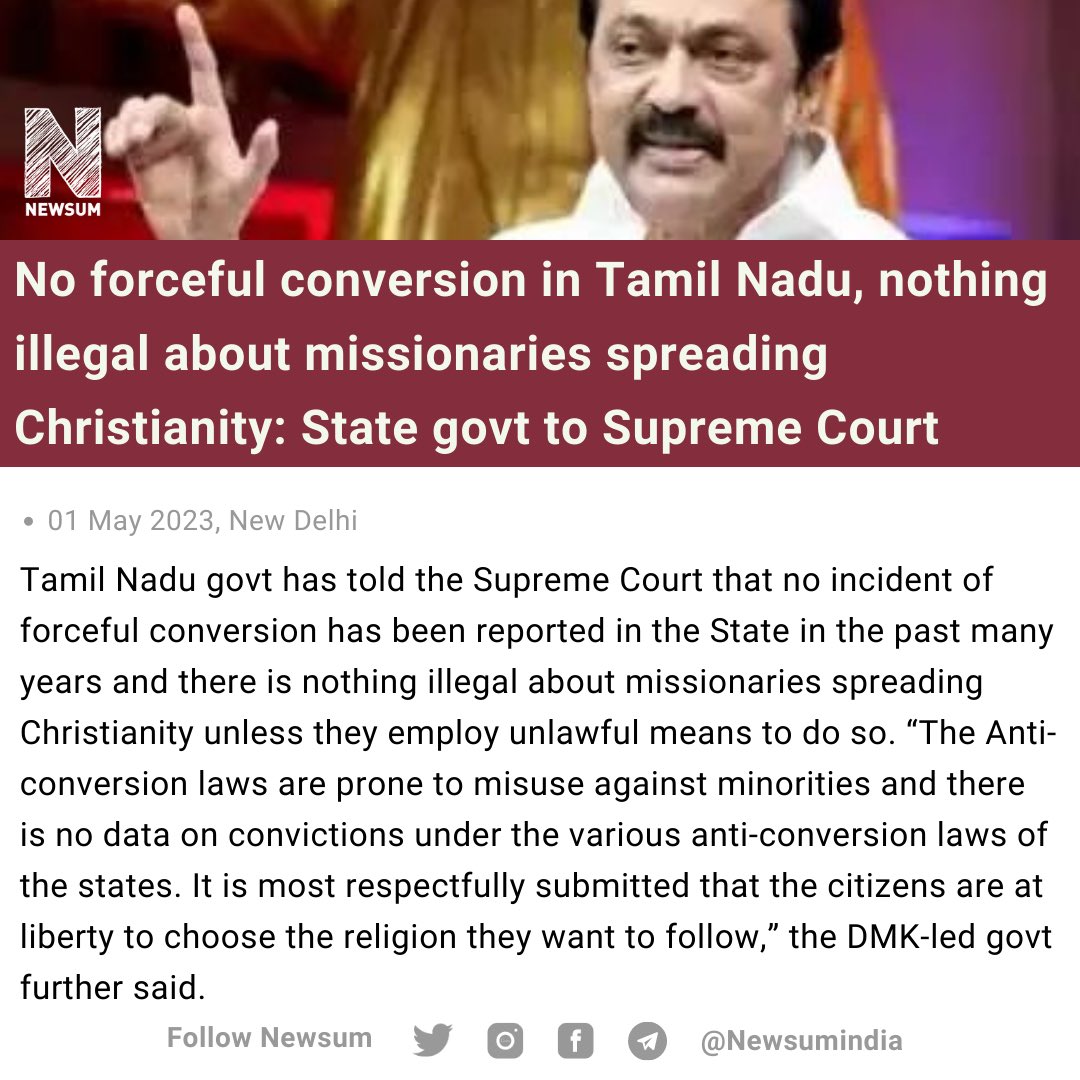
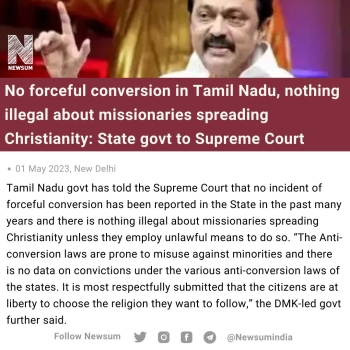
The Tamil Nadu government made a clear-headed and bold statement in the Supreme Court of India on 30 April 2023. The statement in a nutshell says that ‘missionary efforts of Christians to spread their religion are legal and valid’.
The larger implication of the statement is that ‘every person has the right to propagate his or her religion’. Propagation, in its turn, does not mean converting anyone to one’s religion. Everyone has the right to choose any religion or no religion, as well.
This statement is grounded in Article 25 of the Constitution of India which guarantees every citizen the right to propagate his or her religion. The Supreme Court reiterated the right of the citizens without making exception of any person or community.
Problem arises when the act of propagating religion violates the public order, morality and health. The act has to be considered valid when it does not involve intimidation, threat, deceit, allurement, superstition or black magic, obviously so.
The Tamil Nadu government headed by Mr M. K. Stalin was represented by senior advocate P. Wilson. The government affirmed that no government has the right to intervene in this matter against the belief, privacy and choice of the individual.
Besides, Article 21 of the Constitution guarantees the right to a dignified life, which is an inviolable right. This is the foundation for Article 25, which categorically articulates the right to hold a certain belief or no belief at all as well as switching over to another belief.
The statement of Tamil Nadu was in response to the petition filed by advocate Ashwini Kumar Upadhyaya, who sought a NIA/CBI investigation into the ‘root cause’ of the death of a 17-year-old girl in Tamil Nadu, who allegedly was converted to Christianity.
While strongly condemning the false allegation of the affidavit, the State government categorically negated any forcible or deceitful conversion ever taken place in Tamil Nadu.
As a matter of fact, more often than not, there is someone to facilitate any channel of knowledge, religious or other. Parents influence children, seniors inspire juniors, teachers motivate students, religious persons stimulate believers, and the like. This is an accepted truth and cannot be construed as conversion of any sort.
Further, humans are social beings and they are inter-related and their thoughts, sentiments, perceptions, attitudes and decisions are very much a shared reality, though in more or less degrees. When people share certain convictions, it cannot be misinterpreted as allurement or coercion, too.
From this perspective, the statement made by the government of Tamil Nadu is worthy of being saluted for the clarity of thinking and the soundness of logic it reflects. The statement of the TN government in the Supreme Court is a case in point for other State governments as well as the Centre.
No doubt, it follows logically that the ‘Anti-Conversion Laws’, along with the ‘Freedom of Religion Acts’ or ‘Religious Freedom Acts’ passed by some 10 State governments, do not stand to reason and are objectionable. Those laws and bills clearly violate the spirit of the Constitution of India and smack of foul intentions, in line with the distorted drive of ‘Hindutva’ and ‘Hindu Rashtra’.
Moreover, the practice of placing the blame of conversion mostly on the Christian community is not only an obsession, but also a perversion. It is politically motivated and does not correspond to truth. The allegations of conversion raised against Christians go against the reality on the ground.
As per the 2011 national census, the population of the Christian community is 2.3 percent, consecutively for two times before, too. History has it that there were times when the Christian community counted even 2.6 percent and it steadily declined to reach the current percentage.
Obviously, the above statistics contradicts the foul-intentioned claims of the respective State governments as well as anti-Christian warriors like Ashwini Kumar Upadhyaya. Generalizing exceptions, which take place in almost all communities, is a distortion of truth and it has to be considered a criminal offence.
In addition, I keep meeting persons who have changed their Christian affiliation over to other belief systems like Hindu, Muslim, Sikh, Baha’i, Brahma Kumari, ISCON, atheist, and the like, due to marriage or by choice. There are also instances of Christians switching over to other persuasions, though a few.
The above phenomenon reveals the open-ended freedom of affiliation of individuals, in line with the secular credentials of the country. This state of affairs is perfectly fine, in line with the Constitution of India as well as common sense. To manipulate the truth and narrow down the phenomenon of conversion to Christian alone is untruth of the supreme order.
What’s more, religious freedom of the country has to proceed further to respecting the freedom, rights, dignity and choice of every citizen, in a spirit of multi-faith good will and fellowship. There is no foolproof boundary around any individual entity, institution or community, including religion or faith. The spirit of learning from each other has to be the logic of being a nation or a society.
The great wisdom of the Creator is that he, she or it has ‘showered the divine gifts all over the world’, on all individuals, communities and nations. All these gifts are the ‘common cultural heritage of the human society’. Therefore, a ‘common origin, common existence and a common destiny’ has to be the mindset of the humans, necessarily so.
The presidency of G 20 is a golden opportunity for India to make a ‘restart’ of living the ethos and ethics of ‘vasudhaiv kutumbakam’. All violations of the Constitution of India have to end, with immediate effect. Governments of the States and the Centre have to come forward to make affirmative statements, like the heroic government of Tamil Nadu, in favour of unity, integrity, dignity and growth of the nation.
(The author is Director, Institute of Harmony and Peace Studies, New Delhi. He can be contacted at ‘mdthomas53@gmail,com’)
.jpg)
 Cedric Prakash
.jpg)
 A. J. Philip
.jpg)
 Jacob Peenikaparambil

 Dr Suresh Mathew
.jpg)
 John Dayal
.jpg)
.jpg)
.png)
 Robert Clements
.jpg)
 P. A. Chacko