

.jpg) Alwyn D’Souza
Alwyn D’Souza
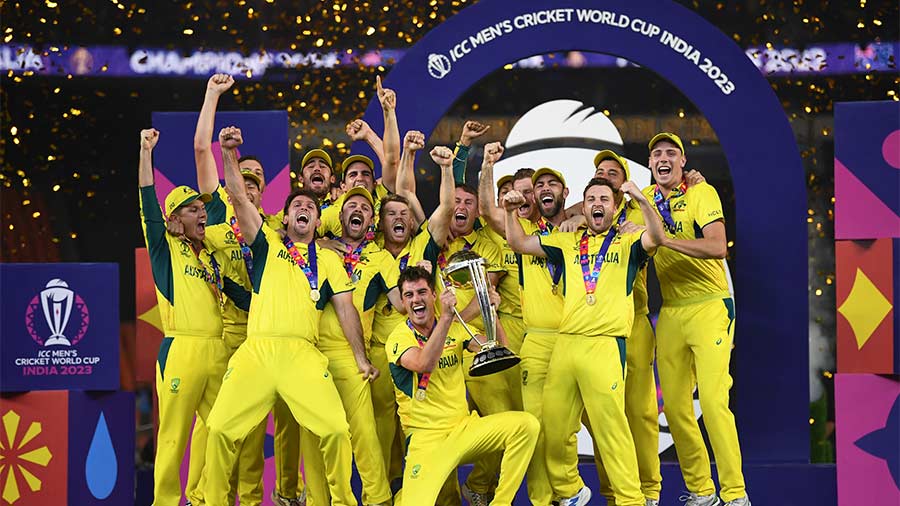
In the wake of men’s cricket world cup fever, there are a lot of memes and reactions flooding the digital spaces. There are allegations that the Board of Control for Cricket in India (BCCI) led by Jay Shah, son of Union Home Minister, had strategically turned this sporting extravaganza into a political instrument to advance the interests of the ruling party. Just like the way G20 was reportedly used for political purposes, the men’s cricket world cup event too was contrived as a strategic component of the political playbook employed by the BJP.
Some reactions
“Oh look, there’s Narendra Modi, in Narendra Modi Stadium, in Narendra Modi Land, with its ambitions for a Narendra Modi world. Oh dear, it’s all spoiled by 11 happy-go-lucky Australians,” wrote Gideon Haigh in The Wire.
Barney Ronay reported in The Guardian, “Jay Shah, the head of the BCCI, has bent the entire sport to his will. He is the most powerful single person in any sport anywhere in the world. The real issue with Shah’s status as unelected world boss is that he appears at first glance to be a prodigy, an administrator of such skill he was able to rise to become head of the BCCI aged just 31…”
Sharda Ugra, a well-known sports journalist, wrote in The India Forum, “This has been the most small-hearted and petty of the World Cups that India has hosted’
Tunku Varadarajan wrote in The Wire, “The BCCI has warped cricket, distorted it, making it so India-centric that other proud nations – some with better pedigrees than India’s – have been reduced to bit-part players, mendicants, petitioners for match-time. Everything is now about India: the crowds, the songs, the scheduling, the pitches, the money. The one element the BCCI cannot control, mercifully, is the outcome of a match. Try as the BJP might – for the BCCI is now the BJP in cricketing form – the result of a match cannot be influenced to suit its needs the way an election can. International umpires are not the Indian judiciary. The ICC is not (yet) the Indian Election Commission.”
“How India took the ‘world’ out of World Cup” wrote Daniel Brettig in Sydney Morning Herald.
These are just a few examples that highlight how this sporting event was deprived of its global, inclusive and diverse character on the one hand and on the other, how it became a vehicle for a nationalist agenda. The opposition players, their family members and the umpires had to endure a lot of abuse from cricket fans cheering for India.
Sportsmanship gives way to nationalism
The absence of the principles of 'vasudhaiva kutumbakam' or 'atithi devobhava' became apparent as the BCCI struggled to secure visas for some competing teams, despite the influential Secretary Jay Shah's direct line to the second-most powerful man in the country, Home Minister Amit Shah!
Many non-resident Indians (NRIs) had gathered to witness the final cricket match and support their countries of origin. While Australia welcomed Indians settled in their country who came to watch and support India, a Pakistani cricket fan faced scrutiny for cheering on his team and exclaiming 'Pakistan Zindabad'!
Sharda Ugra, writing for Al Jazeera, said that “From political influence, to the naming and choice of stadiums, and the demonisation of Pakistan and Muslims, some say the BJP is using the tournament as a launch pad for a third term in office.”
Kapil Dev, the captain of the legendary 1983 World Cup-winning side, wasn't even extended an invitation to the World Cup final. Expressing his disappointment, he stated, "I wasn't invited. They didn't call me, so I did not go." Despite the BCCI norm to invite all past presidents and officials, such courtesies were evidently overlooked by the current BCCI officials.
Several Australians, including Mrs. Vini Raman, the wife of Mr. Glenn Maxwell, have faced online abuse and rape threats. Mrs. Raman has publicly denounced the hateful and vile direct messages she received. Does such reprehensible behaviour align with the standards expected of a nation that refers to itself as Vishwaguru and believes in the ideals of ‘vasudaiva kutumbakam and ‘athithi devobhava’?
Mir Shabbir Ali, a journalist from Pakistan, reported that he and his colleagues received their Indian visas just 48 hours ahead of the India-Pakistan clash in Ahmedabad.
These instances collectively signify the BCCI’s abandonment of the spirit of global camaraderie, and sacrificing it on the altar of pulp nationalism. These have directly or indirectly contributed to the uncivilized and unsportsmanlike behaviour exhibited by the cricket fans particularly in the Modi Stadium, Ahmedabad.
Lessons for India
Following India's loss in the final against Australia, there has been an influx of messages pointing out some silver linings, notably the ‘triumph of sportsmanship over jingoism’ and ‘cricket's victory over nationalism.’ Many observers have also emphasized how the BCCI, which transformed the event into a nationalist narrative, missed a golden opportunity for India to align with the principles of 'vasudaiva kutumbakam' and 'athiti devobhava. There were also other voices that urged Indian fans to reflect on lessons of diversity, inclusiveness, and sportsmanship.
The absence of a pluralistic and diverse culture was evident when religious chants, such as the ‘Hanuman Chalisa’ and ‘Jai Shree Ram’ became part of a sporting event, as witnessed in Ahmedabad during the final between India and Australia. Instead, incorporating popular songs from various film industries would have infused more variety and bestowed the event with an inclusive vibrancy.
Anurag Minus Verma notes in The Print that ‘Construction of genuine sporting culture perhaps is more difficult than the construction of the world’s largest stadium’. What India requires is a genuine sporting culture not just world class stadiums!
Most important lesson should be that our pride as Indians does not come from winning trophies alone but also through the ways in which we welcome the guests, on how we treat the opponents and on how we applaud the teams that played better cricket than us.
Finally, as Deepanshu Mohan wrote in The India Cable ‘In Modi’s New India, there is more to grieve than a sporting loss.’ Rather than turning this defeat into national mourning, political leaders should focus on pressing issues like unemployment, inflation, poverty and notably, delinking sports from politics!
Alas! If only we weren’t small-hearted, petty and abusive towards the competing teams, we would have been truly named ‘vishwaguru’ even if we hadn’t won the trophy!
(The writer is a Researcher at Indian Social Institute, Delhi)
.jpeg)
 A. J. Philip
.jpg)
.png) Jacob Peenikaparambil
Jacob Peenikaparambil
.jpg)
.png) John Dayal
John Dayal
.jpg)
 Pachu Menon
.jpg)

.png)
.png)
.png) Robert Clements
Robert Clements
.jpg)