

.png) Ram Puniyani
Ram Puniyani
 (2).jpg)
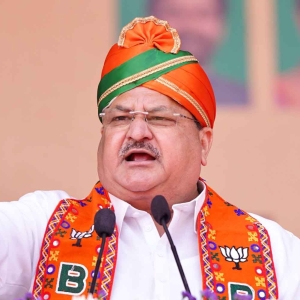
As the election season (April-May 2024) progressed, there were observations that this time, RSS volunteers (swayamsevaks) refrained from helping the BJP with electoral mobilisation. Such a situation has not arisen so far in most elections, barring the one of 1984, in the aftermath of the anti-Sikh pogrom. There are many guesses about the role of the RSS Combine in the polls this time. In this context, in an interview, Mr JP Nadda (Indian Express: May 19, 2024) claimed that the RSS is a cultural and social organisation while the BJP is a political party. Nadda claims that "… the BJP was now self-reliant and was fully capable of running its own affairs. The party has evolved over a period of time and unlike when during Atal Behari Vajpayee's time, it was completely dependent on the RSS, this was not the case anymore."
This is claimed particularly in the light of Narendra Modi's spectacular rise, most of his decisions being made by himself, and the charisma created around him by multiple mechanisms, including what is called Godi media, Controlled by his circle of corporate cronies. Some will tend to believe that the BJP is now a totally autonomous party like any other party. Can this be true?
As we recall, RSS was formed in the context of rising 'Indian consciousness' during the freedom struggle. India's anti-colonial freedom struggle was founded on pluralism and diversity. The triggering point for the formation of RSS was the rising Dalit struggles for social equality. The formation of this Hindu nationalist organisation was also inspired by the nationalism of Mussolini and Hitler. Unlike another organisation devoted to Hindu nationalism, the Hindu Mahasabha, RSS focused on training swayamsevaks and pracharaks (propagators) in the ideology of Hindu nationalism rather than jumping directly into the political arena.
In due course, it started throwing up different organisations, formed mainly by its trained volunteers. Interestingly, the first subordinate organisation was Rashtra Sevika Samiti, which was meant for women. This was guided by KB Hedgewar, the first Sarsanghchalak, and formed by the women close to RSS pracharaks (propagators), as women are not permitted in RSS itself. The pracharaks, in due course, formed Akhil Bharatiya Vidyarthi Parishad, Vanvasi Kalyan Ashram, Bhartiya Majdoor Sangh, Vishwa Hindu Parishad and a bit later, Bajrang Dal. Today, over 60 organisations are working on the agenda of Hindu Rashtra.
The formation of the political wing of RSS came in the wake of the murder of the Father of the Nation, Mahatma Gandhi, by RSS-trained Pracharak Nathuram Godse. RSS felt the need for a political party that could articulate its ideology in the political arena. So far in time, entering the political arena had been an anathema for this organisation. Shyama Prasad Mukherjee of Hindu Mahasabha, helped by Arya Samaj in particular, took the lead in forming BJP predecessor Bhartiya Jansangh. RSS loaned three prominent Pracharaks to Jansangh: Atal Bihari Vajpayee, Lal Krishan Advani and Deendayal Upadhyaya. RSS control over this party became absolute, with Deendayal Upadhyaya becoming the president of Jan Sangh.
At the same time, its shakhas were training young boys in the ideology of Hindu nationalism, based on the glorification of the ancient past and hate for the Muslims. As per Sardar Vallabh Bhai Patel, it was the hate spread by RSS due to which the murder of Gandhi became possible. A statement by the Congress reveals, "Sardar Patel was firmly of the opinion that the communal poison spread by the RSS was responsible for the Mahatma's assassination. …He said, 'As a final result of the poison, the country had to suffer the sacrifice of the invaluable life of Gandhi.'"
Jansangh-RSS eagerly joined the Jayaprakash Narayan movement in 1975. Soon, they came to control the movement and got respectability in public eyes, which was extremely low due to their association with Gandhi's murder. Jansangh also merged into Janata Party, which was inspired by JP. Soon, many components of the Janata Party asked the Janasangh leaders to give up their association with RSS, i.e., dual membership (of Janata Party and RSS). The Jansangh leaders owed their primary loyalty to RSS and left the Janata Party to form the Bhartiya Janata Party in 1980.
While nurtured and trained in the ideology of Hindu Nationalism, the BJP, for electoral purposes, put forward "Gandhian Socialism" as its motto! As it did not get much traction in the electoral arena, it soon shifted gears and took up Babri Mosque-Ram Temple as the central issue. The accompanying anti-Muslim violence led to polarisation, and the BJP's ascent on the political chessboard went up by leaps and bounds.
The significant policies of the RSS Combine, of which BJP is a component, are coordinated through annually held 'Akhil Bhartiya Pratinidhi Sabha' (ABPS, All India Representatives Meeting), presided over by the RSS Sarsanghchalak. As the BJP became more powerful, the RSS was getting more space to work and infiltrate the state apparatus. Since 2014, the number of RSS Shakhas (Branches) has gone up in a big way. As per the ABPS report 22-23, "Over 8,500 new 'shakha' (daily meetings) were started by the RSS in the country during 2022-23. The total number of 'shakha' rose 12 per cent to 68,651 from 60,117 during the previous year. "
This shows how RSS work has expanded during the present BJP rule. What prevails in RSS and BJP is a division of labour, with RSS being the parent organisation and laying the broad contours of the march to Hindu Rashtra.
The present scenario in which Mr Nadda makes this statement needs to be understood in the context of their electoral strategy and relationship to RSS. It is in no way the parting of ways between the parent organisation and its political progeny. Modi's towering image is needed for the agenda of a Hindu nation. Most of the sectarian nationalisms, which are primarily dictatorial, need a towering image to undermine and wipe out democratic freedoms. So projecting Modi as a tall figure in no way contradicts the agenda of RSS Combine; as a matter of fact, it aids their goals in immeasurable ways.
What Mr Nadda states needs to be considered in the proper context and tactical need of the RSS-BJP agenda. It does not suggest any differences in their long-term goal or relationship.
.png) Cedric Prakash
Cedric Prakash
.JPG)
 A. J. Philip
.png) Jacob Peenikaparambil
Jacob Peenikaparambil
.jpg)
.png) John Dayal
John Dayal
.jpg)
 Pachu Menon
.png)
.png)
.png) Robert Clements
Robert Clements