

.jpg) Arockia Rayappan
Arockia Rayappan
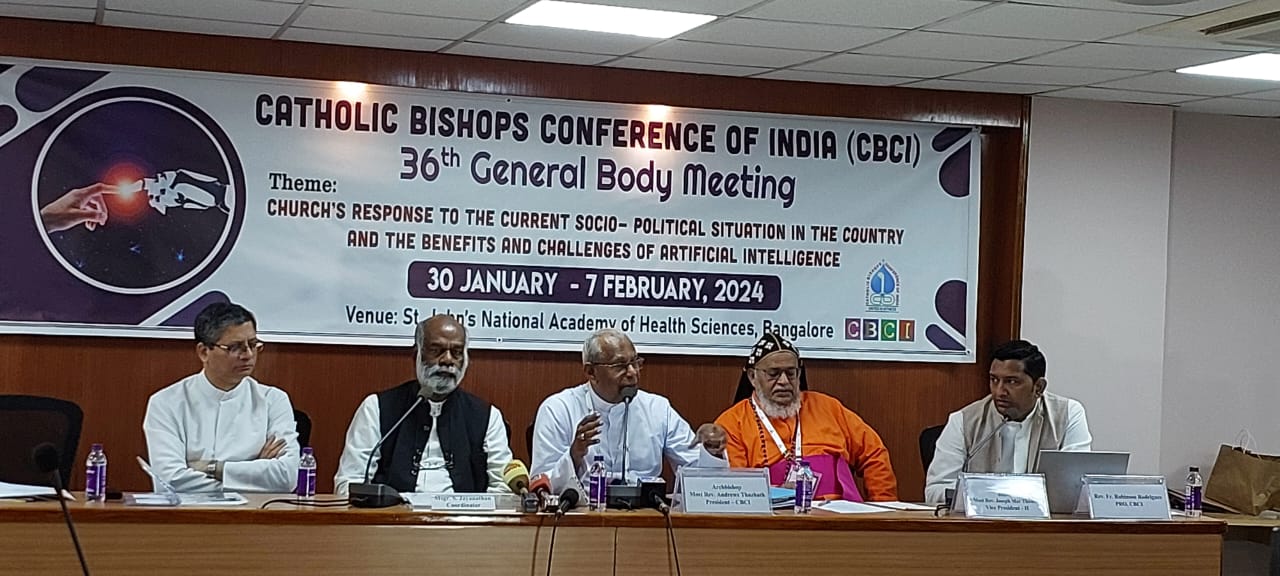
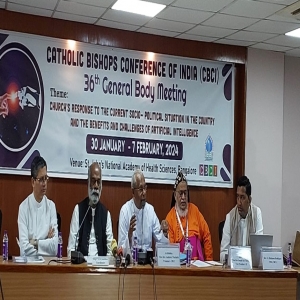
The deep and disturbing observations - recorded in the Final Statement of the Catholic Bishops' Conference of India (CBCI) at their XXXVI Biennial General Body Meeting that was held from January 31 to February 7, 2024, at Bengaluru, India on the current socio-cultural-religious-political-economic-commercial situation in India draws attention. Their observations are a deeper study, discussion, research, and analysis, and they draw up short-term and long-term plans after investigating the causative factors of the current socio-cultural-religious-political-economic situation in India.
The Bishops unequivocally express: "… There is an apprehension that divisive attitudes, hate speeches and fundamentalist movements are eroding the pluralistic, secular ethos which has always characterised our country and its Constitution … Attacks on Christians continue to increase in different parts of India. Destruction of homes and churches and harassment of personnel serving in orphanages, hostels, and educational and healthcare institutions on false allegations of conversion have become common. We are appalled by prolonged violence in Manipur, resulting in the huge loss of life and livelihood … There is an unprecedented religious polarisation which is harming the cherished social harmony in our country and endangering democracy itself."
Bishops in India have observed a weakening of the country's important democratic institutions. They strongly feel that the media—the fourth pillar of democracy—is not fulfilling its role. They are anguished that economic development benefits only a tiny percentage. AJ Philip's finding of the cost of Rs. 1,000 crores for the pre-wedding programme of Anant Ambani, the younger son of Mukesh Ambani, complements the Final Statement of the Bishops.
The Final Statement of the CBCI reiterates that the Church has taken a clear position and option for the poor, namely, the poor farmers, fishermen, indigenous people, and Indigenous Peoples of India (Adivasis/ Moolvasis). As a sign of their solidarity with the suffering people of India, they boldly named Manipur in the document. This will help the generations of Christians in India and elsewhere to take note of the suffering of the people in Manipur for months who are totally neglected and uncared for by the central government. They took note of the prevalent divisive attitudes, hate speeches, the rise of religious fundamentalism, unprecedented polarisation, stress on the federal structure, endangering of constitutional structures, and danger to democracy. For times to come, the future generations of the followers of Christ will re-read the documents when the Church faced challenging times in India. When the going gets tough, the tough gets going.
The Church in India may do well if it explores Basic Ecclesial Communities (BECs) as social healers and reconcilers. BECs and BHCs are people-centred initiatives rooted in the human values propounded by the Holy Bible and other Sacred Scriptures of varied religions. They aim to plant the seeds of social and religious harmony by engaging in inter-religious dialogue initiatives carried out with utmost sensitivity and respect for diversity in India.
While aware of the alarming observations, we also need to recognise that a substantial number of Indians, including youth, women, men, elderly, and senior citizens, envision people-centred initiatives and participate in them to nurture religious and social harmony in India. The writer can vouch for this in his interactions with Hindus in Varanasi, Rohtak, Rewari, Pune, and Delhi. While attending a day-night vigil in solidarity with the persecuted Christians in Kandhamal at Jantar Mantar in New Delhi, the writer came across a Hindu from Varanasi. He was visiting Delhi to spend some time with his newly wedded daughter. He decided to participate in the Dharna after reading about the painful ordeal of Christians in a newspaper.
The global crisis related to climate change, migration, the diaspora's cultural identity, and other issues relating to life could effectively be addressed if human imagination is allowed to run riot. We need to be creative, imaginative, and innovative in our approach to dealing with Hindutva, cultural (religious) nationalism, and the ideologies of fascism and totalitarianism, which are hand in glove with crony capitalism.
Investing sustainably in research studies on the ideologies that influence the current political mainline parties is highly encouraged. We cannot just make observations and sweeping statements and forget about them altogether. Our attempt is to investigate and study the root causes and development of these ideologies that perpetuate an environment of fear and discord and thereby bring about a societal decline. It is amidst this background that the establishment of Research Centres to study Hindutva, Sangh-Parivar, Vishwa Hindu Parishad, the historical development of Hindutva ideology, and the contributive factors of this emerging ideology and its presence in politics, bureaucracy, journalism, and constitutional intuitions is strongly advocated.
Why do we have to study 'Hindutva'? It is incumbent on us to conscientise Christians and practitioners of other faiths and religions, including Hindus, of the spread of harmful ideologies that destroy societal and religious harmony, in particular, the ideology of Hindutva, which is going to influence Indian politics for years to come. We need to study to understand how far they have permeated our society; the study must be supported by concrete findings based on empirical evidence. This way, our response would turn out to be measurable and achievable with well-worked-out short-term and long-term plans.
We wish to research and study ideologies relating to Hindutva—cultural and religious—to understand them from their point of view, not from our self-imposed perspective. We study them neither to label nor to judge them. We study them so that we listen to their genuine points of view with total openness without preconceived ideas and plans. We go to them as learners and listeners, inspired by the Spirituality of the Synod.
The Hindutva Research Institute could be initiated in collaboration with the people of goodwill, the followers of Christ, and other communions and confessions. The earlier we begin to invest our resources in research, the sooner we will be able to offer constructive and redemptive service to society.
We do this not out of fear or discord but because we are affected by the emergence of Hindutva and its permeating influence on the current political regime and its affiliated parties. We discard any superiority complex that has historically been handed on to us in terms of the origin of religion and the tenets of religion that are paramount to us as followers of Christ. We need to have the servant-like and self-emptying attitude of our master. We say no to preconceived ideas, including individual, group, and societal biases.
Bernard Lonergan SJ stands firmly against general bias (intellectual shortsightedness). He advocates for the community and speaks against nationalism's destructive nature. In Lonerganian terms, we undo alienation and ideology. "The road ahead may be fraught with challenges, but it is also paved with hope and possibility. Let us seize this moment to reaffirm our commitment to democracy and rededicate ourselves to the noble pursuit of a more just and equitable society. In the face of adversity, let us stand united, knowing that the true power of democracy lies in the hands of the people."
.jpeg)
 A. J. Philip
.jpg)
.png) Jacob Peenikaparambil
Jacob Peenikaparambil
.jpg)
.png) John Dayal
John Dayal
.jpg)
 Pachu Menon
.jpg)

.png)
.png)
.png) Robert Clements
Robert Clements
.jpg)