

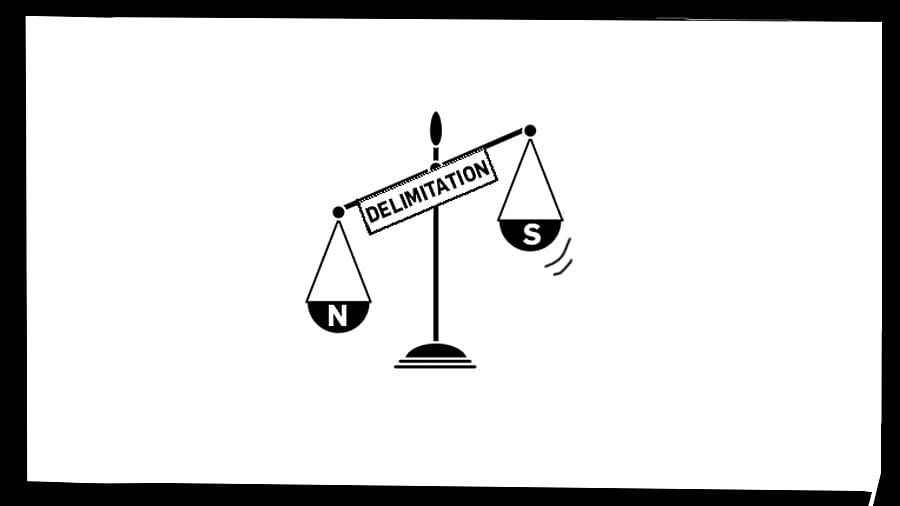
India is approaching a profound constitutional shift. In 2026, the long-standing freeze on the redistribution of Lok Sabha seats—first imposed during the Emergency and later extended—comes to an end. What follows is beyond a mere technical redrawing of boundaries, to a reworking of political power itself.
At one level, delimitation is straightforward: constituencies are redrawn to reflect the current population, so that each vote carries roughly equal weight. But in India, this principle sits uneasily within a federal system marked by deep regional differences. The problem is not whether delimitation should happen—it must—but how its consequences are absorbed across a country where population growth, economic performance, and governance capacity have diverged sharply over the last five decades.
Since seats have remained tied to the 1971 Census, representation has effectively ignored demographic change. India's population has more than doubled in that time, but not evenly. Northern states—Uttar Pradesh, Bihar, Madhya Pradesh, Rajasthan—have seen sustained population growth, while much of the south has stabilised, in some cases falling below replacement fertility levels. The original freeze was meant to protect states that took population control seriously, ensuring they were not punished politically for doing so. Its removal now risks undoing that logic.
Early projections make the direction of change fairly clear. The Lok Sabha is likely to expand significantly—perhaps to 750 or even 800-plus seats—to keep constituencies manageable. But expansion alone does not neutralise redistribution. States with higher population growth will inevitably gain more seats. Uttar Pradesh could cross 100 seats; Bihar may see its tally nearly double. By contrast, Tamil Nadu or Kerala may see only marginal increases, leaving their share of the total House reduced.
This is where the political discomfort begins. Representation in Parliament translates into agenda-setting power, bargaining capacity, and influence over national policy. A shift of even a few percentage points in seat share can alter coalition dynamics, reshape fiscal priorities, and recalibrate what "national interest" looks like in practice.
For the more developed southern states, the concern is structural disadvantage. These states have, over decades, invested in public health, education, and social reform, achieving lower fertility rates and better human development indicators. Yet under a strictly population-based system, those very achievements now translate into reduced relative representation. This is the "success paradox": governance success leads to political dilution.
There is also a fiscal dimension that is harder to ignore. Many of these states are net contributors to the Union's tax pool. If their parliamentary weight declines while their fiscal contribution remains high, it could sharpen existing tensions over resource redistribution. Debates that have so far been contained within Finance Commission formulas may begin to spill more openly into parliamentary politics.
At the other end of the spectrum, the effects on marginalised communities are more complex and potentially troubling. Delimitation also reshapes representation within them. The redrawing of constituency boundaries can dilute or consolidate minority populations, sometimes unintentionally, sometimes otherwise. Even without overt gerrymandering, the process can weaken the electoral voice of smaller communities by merging them into larger, more dominant demographic blocs.
The authority of the Delimitation Commission adds another layer of concern. Its decisions carry the force of law and are not subject to judicial review. This insulation is meant to protect neutrality, but it also means that errors—or perceived biases—cannot be easily corrected. In a politically charged environment, that finality may deepen distrust, particularly among regions and groups that already feel underrepresented.
There is also a subtler risk: the gradual centralisation of political imagination. If parliamentary power shifts decisively toward a few high-population states, national policy may increasingly reflect their priorities. Issues that are regionally concentrated—water stress in peninsular India, ageing populations in Kerala, or urban governance challenges in southern metros—may struggle to gain attention amid the electoral weight of the Hindi-speaking belt. Over time, this can narrow the range of voices that meaningfully shape national decisions.
The planned introduction of 33% reservation for women in the Lok Sabha, tied to delimitation, adds another layer of change. In principle, this is a long-overdue reform. But its linkage to delimitation means that two major structural shifts—gender representation and regional redistribution—will occur simultaneously. That may complicate political negotiations, especially if expanding the House becomes the primary way to accommodate competing interests without visibly taking seats away from any group.
None of this negates the basic democratic argument for delimitation. Today, some MPs represent over three million people while others represent a fraction of that number. Such disparities weaken the idea of equal citizenship. Redrawing constituencies and expanding the House can improve accessibility, accountability, and the everyday functioning of representative democracy.
The difficulty is that equal voting rights do not automatically produce fairness in a federal system. India's states are not interchangeable units; they differ in capacity, contribution, and historical trajectory. A purely arithmetic approach risks flattening those differences in ways that feel politically unjust, even if they are technically correct.
This is why some have argued for a more calibrated approach—perhaps increasing seats across all states by a fixed proportion, or strengthening the Rajya Sabha as a counterweight where states retain equal voice regardless of population. Others have suggested hybrid formulas that incorporate not only population but also indicators such as development or fiscal contributions. None of these solutions is easy, and each comes with its own complications.
What is clear, however, is that the 2026 delimitation is a moment that forces India to confront a basic question: what does fair representation mean in a country where demographic weight and developmental performance do not align?
If handled sensitively, the exercise could restore the legitimacy of India's democratic institutions. If handled narrowly, it risks hardening regional divides and creating a sense—especially in more developed and more vulnerable regions—that the system no longer treats them equitably.
The lines that will be drawn on the map are, in the end, also lines that will shape the future of India's federal charter.
.jpg)
.png) Cedric Prakash
Cedric Prakash
 ICPA
ICPA
 ICPA
ICPA
 ICPA
ICPA
 ICPA
ICPA
 ICPA
ICPA
 ICPA
ICPA
.jpg)
 A. J. Philip
.jpg)
.png) Jacob Peenikaparambil
Jacob Peenikaparambil
.jpg)
.png) John Dayal
John Dayal