

.png) John Dayal
John Dayal
.jpeg)
It would seem that the import of the Adivasi rally at the Red Fort in India, addressed by Union Home Minister and de facto Number 2 in the country after Prime Minister Narendra Modi, has not yet fully sunk in among the community, the media, or the Indian Church.
The May 24, 2026, Sanskritik Samagam held at the Red Fort - the historic site where the Prime Minister unfurls the national flag every Independence Day- was not the cultural festival it claimed to be.
It was a political statement — and for India's Adivasi Christian communities, one of the most consequential made by the ruling establishment in recent years, where it was maddeningly clear that total prevention of conversions to Christianity was now on the national agenda, and for the tribal belt, a top priority.
Organised by the Janjati Suraksha Manch, an affiliate of the RSS-backed Akhil Bharatiya Vanvasi Kalyan Ashram, the rally crystallised decades of ground-level campaigns aimed at creating a tribal identity that stigmatises the Christian faith and penalises Tribals who follow it.
Shah assured the gathering that no provision of the Uniform Civil Code — which essentially targets Muslims presuming all of them have two, if not four wives - would be imposed on tribal communities, citing exemptions in BJP-governed Gujarat and Uttarakhand.
In a strident note, Shah warned against a "conspiracy" claiming the UCC would deprive tribals of their traditions, framing every critic of the government's agenda as an agent of subversion.
He claimed, without ambiguity, that tribal nature worship "connects us with Sanatan Dharma."
His claim, contested by social scientists, places Sarna practitioners, animists, and followers of indigenous traditions inside the circle of acceptable Hindu identity even as it places Adivasi Christians outside it.
This is the language in which violence against Christian Adivasis has long been justified at the village level, as the National Tribunal chaired by former bureaucrat and activist Harsh Mander discovered recently in its tours of Odisha, Madhya Pradesh and Chhattisgarh.
Home Minister Shah, before a crowd of over a lakh and a half at the historic Red Fort, set the seal of authority, sending a signal to Panchayati Raj institutions and the governance machinery.
The demand amplified by the rally — that Christian and Muslim converts be delisted from the Scheduled Tribe roster under Article 342 — has been circulating in RSS-affiliated circles for years, and it has now been given fresh momentum and a national platform.
The stakes for Adivasi Christians, estimated to number two crore, are existential "Delisting" would strip them of Scheduled Tribes reservations in education and employment, remove their land rights under the Forest Rights Act, and sever their access to ancestral community resources.
It would create, in constitutional terms, a religious test for tribal belonging — a development for which there is no precedent in the secular jurisprudence that has governed reservation policy since 1950.
Tribal identity in the North East, the Chotanagpur region of central India, and the southern and west coast states has always been defined by ethnicity, lineage, and community.
The delisting campaign proposes to redefine it by faith, though for Dalit Christians, this blow was struck soon after the Republic was decayed through the Presidential Order 1950, which gave scheduled rights only to Hindus, penalising those who left that faith.
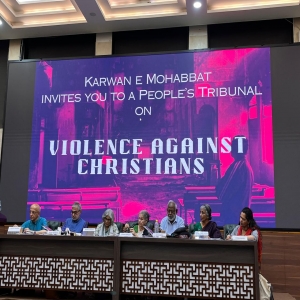
The violence this logic produces is already well documented, now by the National People's Tribunal on Violence Against Christians, and over the years by the Evangelical Fellowship of India and United Christian Forum and independent human rights groups who have recorded sustained and systematic targeting of Adivasi Christians across Chhattisgarh, Jharkhand, and Odisha including church attacks, forced public renunciations, denial of access to markets and common land, and a pattern of police indifference that amounts.
The National People's Tribunal on Violence Against Christians has, on June 2, taken testimony after testimony in which the accusation of "forced conversion" — the precise charge Shah echoed at the Red Fort — served as the justification for dispossession and assault.
Burial rights have become one of the most visceral ex
Village councils refused Christian families access to common graveyards, forcing burials at distances of twenty-five to thirty kilometres, or demanding the exhumation of bodies already interred.
The Supreme Court's intervention, invoking Article 21 — the right to life with dignity, which the Court has interpreted to extend to the dignity of death — has been in vain; the "stay orders" are regularly flouted even as District Collectors and Judges choose not to enforce the directives.
Missionary activity in tribal India has a long and contested record of genuine service in education and healthcare, and of cultural displacement that some Adivasi communities still resent.
The RSS has been adept at weaponising that resentment, presenting every Christian institution in tribal areas as a front for what Shah called conversion by "greed, temptation, or inducement."
His charge erases or collapses the distinction between proselytisation and the provision of schools and hospitals in areas where the state has historically been absent.
Central and state governments have never subjected the ABVKA's own methods of cultural conversion — the systematic replacement of Adivasi cosmologies with Hindu ritual, which Father Stan Swamy spent his life documenting and opposing, and the concept of "Ghar Wapsi" which now has legal protection in the 12 states where the Anti-Conversion laws exist.
Fr Stan Swamy's analysis remains the most penetrating available as he argues that the RSS's "Vanvasi" campaigns served a structural function that went beyond faith - by building cultural conformism and stigmatising dissent, they weakened the capacity of Adivasi communities to assert their rights under the Panchayats (Extension to Scheduled Areas) Act of 1996.
PESA, as the law is called, gives gram sabhas authority over land, forests, and local resources — precisely the authority that mining companies, infrastructure projects, and corporate interests need to circumvent to operate in tribal India.
A community divided against itself along religious lines, with Christian members excluded from village governance and social life, is a community less able to mount the collective resistance that PESA was designed to enable.
The Manipur dimension, largely absent from the national conversation about the Red Fort rally, deserves to be named.
Four Kuki-Zo pastors were killed in Kangpokpi district in the months preceding the event. Their deaths occurred in a conflict that the central government has consistently failed to address with the urgency it demands — a conflict in which Christian tribal communities have borne the overwhelming burden of displacement, destruction, and death.
The silence of the political establishment about those deaths, and the simultaneous spectacle of the Red Fort rally celebrating tribal welfare, is a juxtaposition that Adivasi Christians across the country will not have missed.
The tribal welfare that Shah celebrated is a welfare conditional on conformity — available in full to those who remain within the cultural boundaries the RSS defines, and withheld, incrementally and systematically, from those who do not.
For Church and civil society, the constitutional challenge ahead is formidable. Experts say the delisting campaign will require an amendment to Article 342 or a Presidential order — either route is politically and legally contestable, and the Dalit Christian reservation battle, still unresolved after seven decades, offers some cautionary precedent about how long such struggles can be prolonged.
But the courts are not where this battle will primarily be fought — it will be in villages where council elders decide who may bury their dead and where, in police stations where complaints of church attacks are not registered, and in schools where tribal Christian children are told their faith makes them strangers in their own community.
The Adivasi Christian communities of India are not a marginal constituency, as they were the first to study in schools and then colleges built by Jesuits, Salesians, and Divine Word Fathers, and in hospitals built by Protestant missionaries, where the state had failed.
The Red Fort rally announced that the Narendra Modi government has irrevocably aligned itself with a vision of tribal India in which Christianity has no legitimate place.
.jpg)
.jpg)
.png) Jacob Peenikaparambil
Jacob Peenikaparambil
 John Dayal
.jpeg)
.png) Joseph Maliakan
Joseph Maliakan

.png) Dr Arnald Mahesh SDB
Dr Arnald Mahesh SDB

.jpg) Jose Vattakuzhy
Jose Vattakuzhy
.png)

.jpg) Isaac Gomes
Isaac Gomes
.png)
.png) Robert Clements
Robert Clements