

.png) Jacob Peenikaparambil
Jacob Peenikaparambil
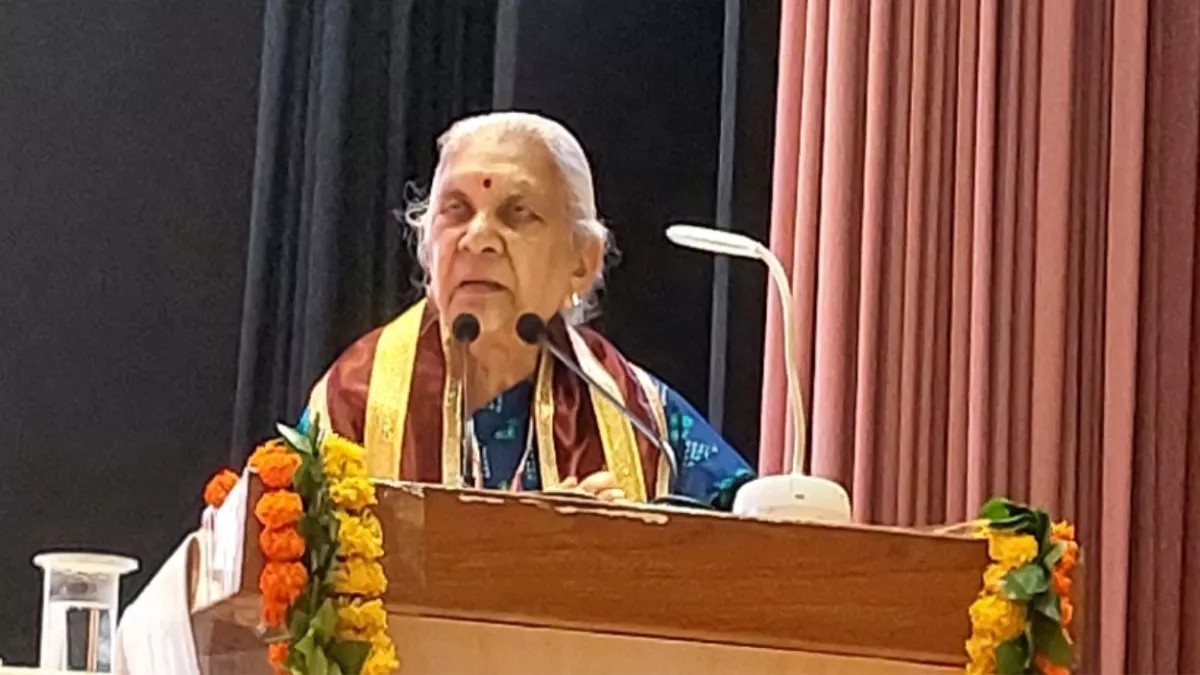
A recent controversial statement by the Governor of Uttar Pradesh, Anandiben Patel, has raised serious questions about the approach of political leaders and parties, particularly the BJP, towards women in India. Do they genuinely seek the empowerment of women, or do they intend to cultivate women merely as a vote bank? Are they committed to sharing social, economic, and political power with women, who constitute nearly fifty per cent of India's population? These questions have arisen in the minds of many people, especially women, following remarks by a powerful woman who has held important political positions for several decades.
Anandiben Patel sparked a major political and social controversy during university convocations when she stated that women should prioritise becoming "expert mothers" and learn how to cook before pursuing careers as IAS officers, teachers, or other professionals.
Addressing the 41st Convocation of Chhatrapati Sahu Ji Maharaj University (CSJMU) in Kanpur, Patel said that professional success should not come at the cost of family responsibilities. "Whether you become a teacher, whether you become an IAS officer, become anyone. Become an expert mother first. That is the need," she said. She further added that women should at least know how to cook the basic meals prepared at home.
A few days earlier, while addressing the 24th Convocation of Dr APJ Abdul Kalam Technical University (AKTU) in Lucknow, she delivered another controversial message, warning young couples against eloping. She said that when families oppose relationships, young couples often elope, leading to unwanted pregnancies. She further remarked that when such children are born, neither the woman's family nor her in-laws accept them, forcing the Government to assume the role of a parent. Referring to such incidents ironically as the youth's "exploits" or "achievements," she advised young people to avoid such actions.
Patel's remarks drew widespread criticism from students, academics, professionals, and social media users, who described them as patriarchal and regressive. Many pointed out that women had won nearly 82 per cent of the medals at the very convocation in CSJMU, Kanpur, making her message particularly discouraging for aspiring female graduates.
Women professionals and educators, writing in The Telegraph, criticised her remarks for reinforcing the phenomenon of the "double shift." They argued that her comments placed an unfair domestic and emotional burden exclusively on working women. At the same time, men are never publicly expected to become "expert fathers" before pursuing careers as IAS officers or corporate executives.
Scholars and students on social media platforms, including Instagram, accused her of perpetuating patriarchal values. Many observed that a woman who herself had risen through the ranks to become Gujarat's first woman Chief Minister was now discouraging the aspirations of younger generations.
Social media users also rejected her assertion that women must learn basic cooking, arguing that cooking is an essential life skill that should be taught equally to both men and women rather than being treated as a gender-specific responsibility linked to motherhood. Indeed, many of the world's finest chefs are men.
Several young women reacted strongly to Anandiben Patel's controversial and patriarchal remarks.
"I am anyway contemplating if I ever want to embrace motherhood. Will that make me any less of a woman? Honestly, this comes from a very patriarchal mindset. Women have to manage homes, cater to their husbands, make babies, before they dream. Why does a dream come with a cost for women?" said Tanaya, 26, who works in Corporate Social Responsibility (CSR).
Political empowerment of women in India presents an equally disappointing picture. All major political parties in India, including the BJP, have failed to empower women adequately in the political sphere. The long and torturous journey of the Women's Reservation Bill illustrates this failure.
The proposal was first introduced in Parliament in 1996 as the Constitution (81st Amendment) Bill by the United Front Government. However, it lapsed following the dissolution of the Lok Sabha. Successive NDA governments reintroduced the Bill in 1998, 1999, 2002, and 2003, but each attempt failed due to a lack of political consensus and repeated disruptions in Parliament.
The UPA Government introduced the Bill in the Rajya Sabha in 2008. It was passed by the Upper House in 2010 but remained stalled in the Lok Sabha. With the dissolution of the 15th Lok Sabha in 2014, it lapsed once again.
The NDA Government introduced a revised version as the Constitution (128th Amendment) Bill in the newly inaugurated Parliament building. It was overwhelmingly passed by both Houses of Parliament and received the President's assent on September 28, 2023, becoming the Constitution (106th Amendment) Act.
In 2026, the Government introduced supplementary legislation to expedite the delimitation process, thereby paving the way for the reservation's implementation. Although the Women's Reservation Act is now part of the Constitution, it has not yet been implemented because its enforcement is linked to the completion of the Census and the delimitation exercise. This linkage has become highly contentious and contributed to the defeat of the Constitution (131st Amendment) Bill in April 2026 due to strong opposition to its federal and regional implications.
Opposition parties and civil society organisations are demanding the immediate and unconditional implementation of the Women's Reservation Act (Nari Shakti Vandan Adhiniyam) by completely delinking it from the Census and delimitation processes. However, the Government continues to insist on retaining this linkage.
While all political parties actively seek women's votes and announce attractive welfare schemes for them during elections, they remain reluctant to allocate even 33 per cent of their election tickets to women. During the 2024 Lok Sabha elections, for example, the Bharatiya Janata Party (BJP) allotted only 16 per cent of its tickets to women, while the Indian National Congress (INC) allotted just 13 per cent.
The views expressed by Anandiben Patel appear to reflect the BJP's broader outlook on the role of women in Indian society. When the Constitution of India was adopted by the Constituent Assembly, Organiser, the mouthpiece of the RSS—the ideological parent of the BJP—published a sharply critical editorial objecting to the newly adopted Constitution for not incorporating the laws of Manu. The editorial stated:
"Manu's Laws were written long before Lycurgus of Sparta or Solon of Persia. To this day his laws as enunciated in the Manu Smriti excite the admiration of the world and elicit spontaneous obedience and conformity. But to our constitutional pundits that means nothing."
The Manu Smriti envisages a caste-based, hierarchical, and deeply patriarchal social order. It contains numerous verses concerning women that have been widely criticised by modern scholars, feminists, and social reformers as derogatory and discriminatory. Historically, these laws imposed strict social restrictions on women, denied them individual autonomy, and assigned them an inferior status in relation to men.
Verse 9.3 explicitly states that a woman should never be independent: "Her father protects her in childhood, her husband protects her in youth, and her sons protect her in old age; a woman is never fit for independence."
Verses 2.213 and 2.214 claim that it is the natural disposition of women to seduce men and caution even wise men against remaining unguarded in their presence.
Verse 9.94 advocates extreme age disparities in marriage, suggesting that a thirty-year-old man should marry a twelve-year-old girl or that an eighteen-year-old man should marry an eight-year-old girl.
Verse 9.78 states that if a wife shows disrespect towards a husband who is abusive, drunk, or diseased, she should be abandoned for three months and deprived of her ornaments. Conversely, Verse 9.80 permits a husband to replace his wife if she is barren, gives birth only to daughters, or speaks "unpleasant things."
Although the leadership of the BJP and the RSS has consistently distanced itself from these texts, maintaining that the Manu Smriti is outdated and no longer relevant, critics—particularly women's organisations—continue to question whether the RSS-BJP combine genuinely believes in equal rights and equal status for women. Statements such as those made by Anandiben Patel only deepen these suspicions.
Meanwhile, Indian women are making remarkable progress in education, skill development, and employment. In 2026, women's overall employability reached 54 per cent, surpassing men's employability (51.5 per cent) for the first time in five years. Women now account for 43 per cent of STEM graduates in India, demonstrating their growing readiness for modern technical and professional careers. Their participation and performance are especially strong in sectors such as Banking, Financial Services and Insurance (BFSI), healthcare, law, and education.
Women's increasing participation in every sphere of national life will undoubtedly contribute significantly to the realisation of the vision of Viksit Bharat. In this context, regressive statements such as those made by Anandiben Patel represent a serious setback to the cause of women's empowerment. The fact that no prominent BJP leader has publicly condemned her controversial remarks further strengthens the suspicion that the party's commitment to women's empowerment may not be as deep as its public rhetoric suggests.
.jpg)
 A. J. Philip
 Jacob Peenikaparambil
.jpg) Renjith Leen
Renjith Leen
.jpg)

.png)
.png) Robert Clements
Robert Clements
.jpg) A. J. Philip
A. J. Philip