

 A. J. Philip
.jpg)
The President
Shri Ram Janmabhoomi Teerth Kshetra
Ayodhya
Most Respected Swami Ji,
May I seek your kind permission to apply for the post of Chief Executive Officer of the Shri Ram Janmabhoomi Teerth Kshetra? Having gone through the eligibility conditions, I have reached the conclusion that I may be one of the eligible candidates, notwithstanding a few apparent shortcomings.
I begin with a full disclosure. I have crossed the age of 70. I hope this will not become an obstacle. I am still younger than Prime Minister Narendra Modi Ji, National Security Adviser Ajit Doval Ji, and Uttar Pradesh Governor Anandiben Patel Ji.
I also understand that the applicant should be a practising Hindu, preferably a Vaishnavite. Here, I plead my case.
Hinduism is unlike any other religion. It accommodates diversity. It speaks of millions of deities while proclaiming the oneness of the Supreme Being. It is the only faith where disbelief itself has a respectable place. The Charvaka school, founded by Brihaspati, rejected the existence of God altogether. Yet Brihaspati continues to be revered.
I heard a prominent Hindu leader remark that Jesus Christ could also be regarded as one among the 33 million manifestations acknowledged by Hindu tradition. It illustrates Hinduism's inclusiveness.
My association with Hindu traditions began in childhood. I remember clutching my father's hand as he led me into the Sri Padmanabhaswamy Temple in Thiruvananthapuram.
The temple symbolises Kerala's unique history. Maharaja Marthanda Varma dedicated the kingdom of Travancore to Lord Padmanabha (Vishnu) and ruled not as an absolute monarch but as the deity's humble servant. Long before tourism officials coined the slogan "God's Own Country," Kerala had earned that distinction.
Some may ask how I qualify as a Vaishnavite. I have an answer.
The first avatar of Lord Vishnu was Matsya, the fish. The earliest symbol of Christianity was not the Cross but the fish. The coincidence has fascinated me. If Lord Vishnu could choose a fish as His first incarnation, perhaps the distance between different faith traditions is not as great as we often imagine.
I do not think Lord Ram Himself would object to my appointment.
The Ramayana presents him not as a victorious king but as the ideal ruler. One of my favourite episodes occurs after his exile begins. Bharat travels to the forest to persuade his elder brother to return to Ayodhya and assume the throne. Ram begins asking questions about the welfare of every section of society. His concern extends to scholars, priests, traders, soldiers, farmers, and even those who questioned conventional religious beliefs.
That is the true meaning of Ram Rajya: a State where justice is impartial, administration is compassionate, and rulers remain accountable to every citizen. It resembles the biblical idea of the Kingdom of God, where righteousness rather than power becomes the guiding principle.
I have no hesitation in describing Lord Ram as Maryada Purushottam, the Supreme Upholder of Righteous Conduct. His greatness lay not in exercising power but in suffering without abandoning principle. The agony he endured and his eventual immersion in the waters of the Sarayu reveal the profound human dimension of his life.
My father inspired my visits to many of India's great temples. I have had the privilege of visiting Rameswaram, Mathura, Kashi, Somnath, Tirupati, Tanjore, Madurai, Chamundy, Chidambaram, Kalady, and many others.
I make no claim to being an expert, but I have approached these places with humility and respect. I shall study every tradition associated with the Sri Ram Temple in greater detail.
Having thus established my theological qualifications, let me come to the practical aspects of the job.
I understand the post carries Cabinet rank and the accompanying privileges. These do not excite me. Titles seldom improve administration.
A taxable salary somewhere between ?50,000 and ?1,00,000 would suffice. I would prefer not to undertake any newspaper assignments, consultancy work, or other professional engagements while holding this office. The temple administration would receive my undivided attention.
I also understand the CEO functions under the authority of the Trust and reports to its Secretary. Every organisation requires a chain of command.
I would respectfully request that important directions be issued in writing. Written communication protects both the Trust and the CEO, minimises misunderstanding, and establishes institutional accountability. My responsibility would be to implement every lawful decision of the Trust with efficiency, honesty, and complete transparency.
The appointment of a CEO, I understand, has become necessary in the wake of alleged financial irregularities. What disturbed me most was not the alleged scam but the fact that six of the eight arrested employees were receiving salaries of only about ?12,000–20,000 a month.
Absolute integrity is difficult to expect from an employee who is expected to support a family on such a meagre income while handling enormous amounts of cash every day. Institutions must remove avoidable temptations.
My first administrative decision would be to ensure that no employee receives less than the minimum wages prescribed by the Central and Uttar Pradesh governments. A proper pay structure would be evolved with annual increments, medical benefits, provident fund, and post-retirement security. Employees should not have to worry about feeding their families.
The counting and accounting of offerings would be entrusted to the State Bank of India or another public sector bank selected by the Trust. Banking professionals are better equipped to handle such large-scale cash management.
I know an organisation that conducts an annual week-long programme. Though the offerings collected there are nowhere near the magnitude of those at Ayodhya, the offertory boxes are installed and managed by a Scheduled Bank. Such arrangements inspire confidence among devotees.
The previous day's collections—including cash, gold, silver, and other valuables—would be uploaded to the temple's official website. All donors would get receipts for their donations. Every quarter, an internal audit report would be published. At the close of each financial year, a fully audited statement of accounts, approved by the Trust, would be placed in the public domain.
Faith and transparency are not enemies. They strengthen each other.
Charitable and religious institutions enjoy tax benefits subject to compliance with the provisions of law relating to the utilisation of income. Those provisions would be observed in both letter and spirit. If the law requires a specified proportion of income (80%) to be spent within the stipulated period, I would comply. Otherwise, we will have to pay tax on the unspent money.
All institutions functioning under the Trust would follow uniform accounting practices. Where the law requires the use of a common Permanent Account Number, that principle would be followed. Such systems make monitoring easier for both the institution and the government.
Modern technology has made financial management remarkably simple. Government authorities should be able to ascertain the balances in the temple's accounts with a few keystrokes whenever legally required. Ambiguity or suspicion should have no place.
Cash transactions would be reduced to the bare minimum. Every payment exceeding ?5,000 would be made through bank transfer, cheque, or other approved digital modes. India has become a global leader in digital payments. Ayodhya would lead by example.
The Trust maintains an account under the Foreign Contribution (Regulation) Act. Compliance should never become a matter of anxiety.
Every foreign donor should clearly indicate the purpose for which the contribution is made. The amount would be utilised only for that purpose and accounted for separately. A qualified chartered accountant would monitor FCRA transactions continuously so that compliance remains absolute.
As the CEO of a non-governmental organisation with an FCRA registration for a few years, I ensured scrupulous adherence to every provision of the law. There was never any question regarding the receipt or utilisation of foreign contributions. We neither encouraged tax evasion nor tolerated financial indiscipline. I would bring the same standards to Ayodhya. My proposals do not mean or imply that you are not following these principles.
I make a personal declaration.
If at any time I or any member of my family is found to have taken even a single rupee belonging to the temple, I shall face any punishment. A prominent political leader declared that he was prepared to be burnt alive if he failed to fulfil a promise. I make no such offer. But I do say this: anyone who steals from a place of worship offends against law and faith.
My responsibilities would never extend to interfering with religious rituals. Those matters belong to the priests and the religious authorities.
I believe priests deserve dignity. They should receive attractive salaries and respectable service conditions so that they need not depend upon unsolicited gifts from devotees. Those wishing to make offerings specifically for the priests may do so through designated hundis. The collections would be counted daily and distributed equitably every month under a transparent system.
I also have a larger dream. India has some of the richest philosophical traditions known to humanity. Yet Hindu theological education lacks an institution comparable to the finest seminaries and theological universities maintained by other faiths.
Why should Hindu society not establish a world-class university devoted to Hindu philosophy, theology, and temple studies?
Ayodhya has both the spiritual stature and the financial resources to create such an institution.
The university could offer undergraduate, postgraduate, and doctoral programmes, with admissions conducted through a transparent national entrance examination better than CUET or NEET. Affiliated colleges could be established across India. Within a decade, the country would have professionally trained priests, Sanskrit scholars, temple administrators, and researchers enjoying both respectable incomes and social status.
Sanskrit would receive the place it deserves. We would produce Sanskrit scholars capable of engaging the finest universities of the world, rather than merely memorising verses. Comparative theology must also form part of the curriculum.
Swami Vivekananda demonstrated how different religious traditions can enrich one another through dialogue. I know a non-Hindu religious leader who earned his doctorate on Sri Narayana Guru. Another wrote his doctoral thesis on the Vishwaroopa Darshan of Lord Krishna. Scholarship knows no religious boundaries.
As the first Director of Nobel Laureate Amartya Sen's Pratichi (India) Trust, I established a school in tsunami-affected Odisha. Over the years, I have managed educational institutions at different levels and handled projects worth crores.
During my visit to the Ayodhya temple in August 2024, I experienced considerable inconvenience because roads had been closed owing to the visit of a Very Important Person. Security considerations must be respected. Nevertheless, ordinary pilgrims should not suffer.
A separate entrance would be provided for constitutional authorities and those requiring special security. The categories entitled to use that entrance would be publicly displayed. Everyone else, however eminent, should patiently join the queue.
Technology can eliminate unnecessary waiting. A queue management system would enable devotees to know precisely when to report for darshan. Tirupati has such a system, which can be improved upon.
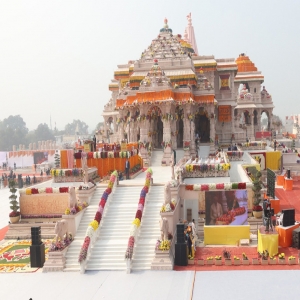
I would also identify a designated location from which visitors may photograph the temple without affecting its sanctity or security. I had carried camera lenses hoping to preserve the memory of this magnificent shrine, but returned disappointed. Properly regulated photography can become a valuable part of the pilgrim experience.
If the Trust is brought within the ambit of the Right to Information Act, I would welcome it. If not, I would still favour voluntary transparency. Honest institutions have nothing to hide.
Finally, I seek neither fame nor power. My ambition is to help make Ayodhya not only the foremost centre of pilgrimage but also a global centre of Hindu philosophy, scholarship, and public service. The temple has sufficient resources to undertake these initiatives.
I run a scholarship programme that benefited 32 students last year by raising nearly ?10 lakh. Under the temple's guidance, similar initiatives could benefit thousands of deserving young people. In my home town, Kayamkulam, the Ramakrishna Mission offers scholarships to hundreds of students. It is financed by àn Infosys founder from Kerala.
These, Swami Ji, are some of the ideas I place before you. If you appoint me, I shall strive to implement them with sincerity. I would also be happy if any future CEO adopts a few of these suggestions for the greater glory of Lord Ram and the welfare of His devotees.
Yours faithfully,
.jpg) A. J. Philip
A. J. Philip

.png) Jacob Peenikaparambil
Jacob Peenikaparambil
.jpg) Renjith Leen
Renjith Leen
.jpg)
.png)
.png) Robert Clements
Robert Clements
.jpg) A. J. Philip
A. J. Philip