


About 30 kilometres from Nagpur, there is a place called Bapu Kuti, the Ashram where Mahatma Gandhi lived during his final years at Sevagram. It is a place of pilgrimage for those seeking to witness Satyagraha (from Sanskrit satya 'truth' + ?graha 'obstinacy'), a life ordered entirely around the pursuit of truth. The cottages remain as they were: sparse, austere, a small room serving as bedroom, office, meeting hall. These mud-walled dwellings are a silent witness to the Gandhian ideal of simplicity of life.
I was at Bapu Kuti with friends who were visiting Nagpur. It was not my first visit to the place. Knowing the campus and having seen everything before, I decided not to join the full tour. Instead, I told my friends I would find a quiet spot outside and work on something I had been meaning to do.
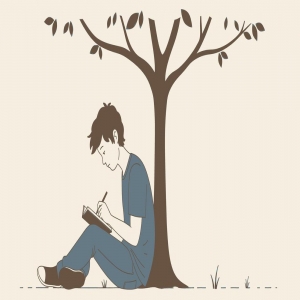
I found a place under one of the huge trees that dot the campus, a shaded, isolated area where I could be undisturbed. I took my notebook and pen and settled down to work. It was one of those rare moments where everything seemed conducive to concentration. The shade was cool, the environment peaceful, the mind ready.
Around me, the campus was alive with the usual activity. People were talking and laughing, capturing their moments on their phones. Amid the constant buzz of voices, I found a rather quiet corner: just me, my notebook, the gentle rustling of leaves above, and the cool winter breeze.
That was when a young man broke through my concentration.
He came up with a look of genuine surprise on his face. For a moment, he just stood there, observing me. Then he pointed at my notebook and pen and asked, "What is that?"
What must have struck him was the strangeness of what he saw: a young man sitting alone, deliberately, with a book and pen, doing something with focused attention, while everyone around him was doing something else entirely, talking, clicking pictures, scrolling, performing for cameras. He was curious about the difference—not about me as a person, but about what I was doing, something so unusual in his experience that he needed to verify it was real.
My first instinct was to dismiss him. I told him tersely: "It is a pen and a notebook." I sought to discourage further conversation and resume my work. But something in his manner—his openness, his genuine curiosity, his friendliness—prevented me from being entirely cold. He persisted, gently. He was not pushy. He simply wanted to know what I was writing.
I hesitated. Initially, I thought I might tell him something simple: "This is a peaceful place, and I was trying to note down some thoughts before I forget them." But as I began to formulate this answer, I realised it would not be fully true. I was not writing about nature, the surroundings, or the chirping of birds in the trees above me. I was not capturing random thoughts or creative inspiration. I was doing something very specific, something I would find difficult to explain to a complete stranger.
"I am Christian," I told him.
He looked at me, puzzled. "What is it?" he asked.
The question hung there, simple and direct. Apparently, he had never heard the word or what it meant. It was as if I had mentioned something completely foreign to his universe.
I explained: "We have our prayers every day during which a text from our holy book is read. The passage that was read this morning particularly touched me, and I was writing my meditation on it."
He seemed genuinely interested. Without hesitation, he asked if he could see my notebook.
I handed it to him, with a warning: "You will not be able to make sense of even a single word in it."
After flipping through a few pages, he said with a humorous smile, "Yes, this indeed looks like a pharmacist's handwriting. We would need another pharmacist to understand it."
There was warmth in that reply. He was not intimidated; he was playful. And that playfulness was the mark of his genuine openness.
But my time was limited. My group members had already left the campus. I had to join them soon. So I took leave of the boy. But not without exchanging our phone numbers. And not without extending an invitation: should he wish to continue our conversation, he could call me or visit me at my residence in Nagpur whenever he desired.
Before parting, I told him (in just a few brief words) about the power of the Name of Jesus. I explained that Jesus was the name of a very powerful person. I told him, "Whenever you are afraid, lost, or confused, use that name. Call upon it."
He had no idea who Jesus was. He had no framework for understanding what I meant. But I could see he was listening. Receiving. Taking it in.
What struck me as I walked away was the strangeness of his unfamiliarity. In a country where Christianity has been present for nearly two millennia, here was a young man with no concept of what it meant. Not hostile to it, but utterly unaware. It revealed something about the spiritual reality of contemporary India, the compartmentalisation of faith, and the invisibility of Christian witness in certain circles.
But more than that, what remained with me was his capacity to notice. In a world where almost everyone around him was distracted, absorbed in their phones and their images, this boy had retained the ability to observe what was different. He had not lost the capacity for wonder. He was not so absorbed by the culture of distraction that he could not recognise an alternative way of being.
I realised, too, how easily I could have turned him away. How readily I might have protected my solitude, maintained my boundary, kept my faith private and unexposed. But something—call it the Spirit, call it grace—prevented that. His openness invited my openness.
What drew him to me was not my religious attire (I had none), not any visible sign of piety or religious commitment. What caught his attention was simply the sight of a man doing something counter-cultural: choosing peace, concentration, inner work in a world that had abandoned all three. He was drawn not to a religious person, but to a human person. To someone living with intention and presence.
What will come of this? Will he contact me? Will he visit? Will we continue our conversation? Will the Name I gave him take root, or will it fade into the background noise of his life? I do not know whether he will ever invoke the Name, or what he will do with it. Only time and grace will tell.
But in that moment, a young man who knew nothing of Christ encountered something that made him curious about transcendence. He discovered that it was possible, even as a young person, to do something other than what everyone else was doing, that interior life and spiritual practice need not be exotic, but could be simply human.
I gave him Christ's Name to carry.
In Jerusalem, Peter once answered the rulers' question, "In whose name?" by confessing that healing and salvation come in the name of Jesus Christ of Nazareth, the only name given under heaven by which we must be saved (Acts 4:10, 12). That unambiguous Name, Jesus, "God saves," a strong tower for those who call upon it (Proverbs 18:10), was all I could offer that afternoon at Sevagram. This being our first meeting, perhaps that was enough: to place in his hands the Name that saves.
The world needs witnesses to the faith, no doubt. But this encounter showed me that the world also hungers for witnesses to what it means to be simply human: to sit alone, to read, enjoy genuine leisure, to attend to something with care. The boy's question came not from seeing religious certainty, but from seeing someone doing what humans are called to do.
.jpg)
.png) Cedric Prakash
Cedric Prakash
 ICPA
ICPA
 ICPA
ICPA
 ICPA
ICPA
 ICPA
ICPA
 ICPA
ICPA
 ICPA
ICPA
.jpg)
 A. J. Philip
.jpg)
.png) Jacob Peenikaparambil
Jacob Peenikaparambil
.jpg)
.png) John Dayal
John Dayal