

.png) Joseph Maliakan
Joseph Maliakan
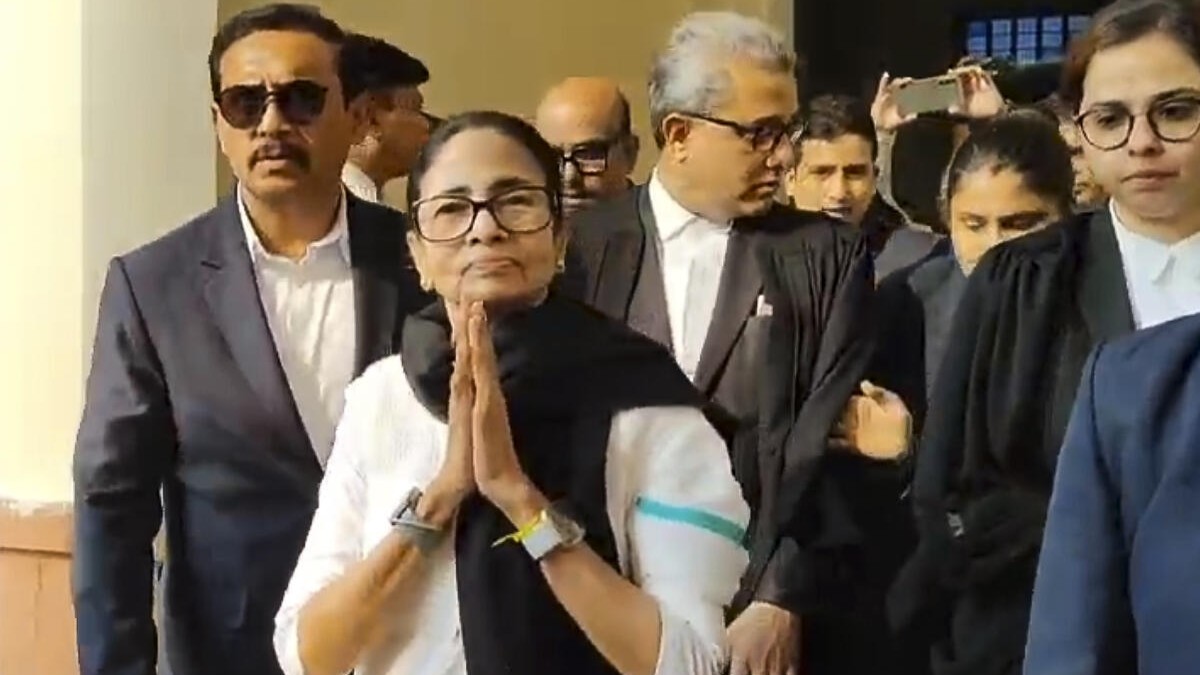
In an unprecedented and extremely consequential move for conducting free and fair elections in the country, the West Bengal Chief Minister and President of the All India Trinamool Congress Mamta Banarjee, on Wenesday, February 4, 2026 appeared before the Supreme Court Bench headed by the Chief Justice of India Surya Kant, challenging the ongoing Special Intensive Revision (SIR) of the electoral rolls in the State.
After hearing the Chief Minister, advocates for the State, and the Election Commission of India, the Bench, also comprising Joymalya Bagchi and VM Pancholi, issued notice to the Election Commission and the Union Government. The Chief Justice also directed the ECI to instruct its officers to be more "sensitive" while issuing show-cause notices to voters.
Chief Minister Mamta Banerjee submitted that the SIR exercise is being done only for the deletion of voters' names, not for their inclusion. She pointed out that women who change surnames after marriage or shift residences were being deleted from the rolls on the grounds of "mismatch."
She further contended that Aadhaar was not being accepted by the ECI as a valid document. This is a clear violation of the Supreme Court's directions issued on September 8, 2025, in the challenge to the Bihar SIR.
Mamta Banerjee said the Election Commission had neither responded to nor acknowledged the six letters she sent. The exercise was being selectively carried out in West Bengal on the eve of the state election. She also questioned the pace at which the SIR was being carried out. "They want to do something in two months which is normally done in two years," she said.
Mamta Banerjee pointed out that micro-observers had been appointed from BJP-ruled states, "superseding" the powers of the Electoral Registration Officers (EROs) and Booth Level Officers (BLOs). In the first phase of the SIR, the names of 58 lakh voters have been arbitrarily deleted, and hundreds of living people have been declared dead!
She alleged that the ECI was issuing instructions informally, thereby turning itself into a "WhatsApp Commission." The Chief Justice responded that the Court would direct the Commission to ensure that all decisions and documents are authorised by the BLOs.
Advocate for the State of West Bengal, Shyam Divan, submitted that despite the Court's order to maintain transparency and to provide adequate opportunity to voters in the Logical Discrepancy (LD) category, the ECI did not follow the directions. Though the Court granted an additional 10 days, only 4 days remain until the deadline.
Devan further pointed out that 1.7 crore voters have been placed in the LD list, while 32 lakh voters have been categorised as unmapped. Hearings are yet to be completed in the case of 62 lakh voters, making it impossible to complete the revision and inclusion process within the stipulated time frame, he said.
Devan further submitted that, even though the Supreme Court had directed disclosure of the reasons for inclusion in the LD list, the Commission had uploaded only names, ages, and genders, while the reasons column contained only cryptic codes.
A significant portion of LD cases arose from minor spelling variations when Bengali names were translated into English. He stated that surnames such as Dutta and Datta, Roy and Ray, and variations in parents' names due to middle names or translation issues had led to notices being issued. He submitted that more than 70 lakh LD cases were attributable to such minor mismatches; therefore, the ECI should withdraw all such notices, which can only be described as unavoidable harassment of the citizens.
One wonders who in the ECI came up with the term "Logical Discrepency" for revision forms. It cannot be the Chief Election Commissioner or the Election Commissioners, because they are all highly educated and wise. Whoever coined the term deserves to be honoured!
CJI Suryakant said that withdrawing the notices under the LD category may not be practical. However, he observed that dialect and spelling variations occur across the country, and by virtue of this, mistakes bona fide persons cannot be excluded from the electoral rolls.
On the admissibility of Aadhaar as a document for voter registration, the Chief Justice observed that the Court could not comment on its evidentiary value, as the judgment on the legality of the SIR process itself had been reserved.
Solicitor General Tushar Mehta submitted that in West Bengal, there was an atmosphere of hostility towards the Election officials, and that a Public Interest Litigation (PIL) pending before the Court seeking protection for ECI officials should be heard along with the present petition.
.jpg)
.png) Cedric Prakash
Cedric Prakash
 ICPA
ICPA
 ICPA
ICPA
 ICPA
ICPA
 ICPA
ICPA
 ICPA
ICPA
 ICPA
ICPA
.jpg)
 A. J. Philip
.jpg)
.png) Jacob Peenikaparambil
Jacob Peenikaparambil
.jpg)
.png) John Dayal
John Dayal