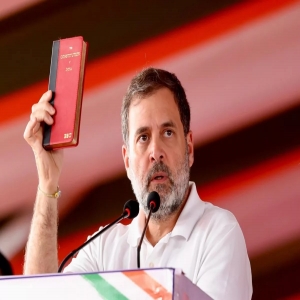


 Jacob Peenikaparambil
.jpeg)
Every year, India observes November 26 as Constitution Day with three main objectives. First, it commemorates the historic milestone of November 26, 1949, when the Constituent Assembly formally adopted the Constitution. Second, it honours the architects of the Constitution, particularly Dr BR Ambedkar, who chaired the Drafting Committee. Third, it promotes the constitutional values and democratic ideals enshrined in the Preamble—justice, liberty, equality and fraternity—and reaffirms India's identity as a sovereign, socialist, secular, democratic republic.
Through activities such as mass readings of the Preamble, quizzes and debates in educational institutions, the day seeks to educate people, especially the youth, about their Fundamental Rights and Fundamental Duties.
The most important objective of celebrating Constitution Day is to educate people about constitutional values and provisions so that they become conscious of their rights, duties and responsibility to safeguard the Constitution, particularly democracy. One reason for the erosion of democracy and constitutional values in India, especially since 2014, is the failure of political parties and educational institutions to educate people about the Indian Constitution.
The Constitution is not a document to be worshipped by bowing before it or singing the entire Vande Mataram. It embodies a broad and inclusive vision for India, the core values that should guide the nation, the Fundamental Rights and Duties of citizens, and the fundamental norms, principles and guidelines for governance. All laws passed by Parliament, state legislatures and local self-governments, as well as all decisions taken by governments, must conform to the provisions of the Constitution.
The BJP has planned to observe November 26, 2026, as Samvidhan Samman Divas (Constitution Respect Day), while the Congress Party has called upon its workers to undertake Samvidhan Raksha (Save the Constitution) marches, highlighting alleged manipulations of electoral rolls through the controversial Special Intensive Revision (SIR) conducted by the Election Commission. So far, SIR has reportedly deleted more than 13 crore names from electoral rolls.
In this context, it is pertinent to refer to an article written by BJP leader Ram Madhav in The Indian Express on November 21, titled "Look Who Is Saving the Constitution." In his article, Ram Madhav highlights Article 51A, which enumerates 11 Fundamental Duties of citizens, including the duty of every citizen "to abide by the Constitution and respect its ideals and institutions, the National Flag and the National Anthem." For him, singing all the stanzas of the national song Vande Mataram amounts to respecting the Constitution. According to him, some Congress leaders' refusal to sing the entire song constitutes disrespect for the Constitution.
It appears that Ram Madhav has forgotten that the Rashtriya Swayamsevak Sangh (RSS) began regularly hoisting the Indian National Flag at its Nagpur headquarters only on January 26, 2002. Between 1950 and 2000, it hoisted the Bhagwa Dhwaj (saffron flag). Was this not disrespect for the Constitution?
In his article, Ram Madhav cites three occasions when the Congress Party misused constitutional provisions: the misuse of Article 356, beginning with the dismissal of the EMS Namboodiripad government in Kerala in 1959; the assault on the Constitution during the Emergency; and the infamous Shah Bano case, which led to an amendment by the Rajiv Gandhi government in 1986.
According to Ram Madhav, respect for the Constitution means upholding the sanctity of the nation, its democratic institutions, and national symbols. However, he says nothing about citizens' Fundamental Rights, the separation of powers, the core values enshrined in the Preamble—justice, liberty, equality and fraternity—or the sanctity of every citizen's right to vote. For him, blatant violations of citizens' Fundamental Rights and discrimination against minorities do not constitute disrespect for the Constitution. Nor does he consider deleting more than 13 crore names from electoral rolls disrespectful to the Constitution.
The BJP's twelve-year rule since 2014 has systematically undermined the spirit of the Indian Constitution. Numerous examples of constitutional violations exist. The Emergency declared by Mrs Indira Gandhi in 1975 violated constitutional principles, and she withdrew it after two years. The Congress Party acknowledges it as a serious mistake. In a conversation hosted by Cornell University in March 2021, Rahul Gandhi, the present Leader of the Opposition, described the Emergency as "wrong" and "absolutely, that was a mistake," adding that his grandmother had acknowledged it. In her memoir, Belonging: A Journey of Love, Sonia Gandhi also describes the 1975–1977 Emergency as a mistake and a temporary measure that went too far.
What India has witnessed since 2014 is an undeclared Emergency. The alleged manipulation of the electoral process by the Election Commission under the influence of the Modi-Shah government is an attack on the Constitution.
Weakening of Federalism: Opposition parties accuse the BJP government at the Centre of centralising political and fiscal power at the expense of the states. The alleged misuse of the Governor's office in non-BJP-ruled states to stall legislation, grievances over declining tax devolution, restrictive borrowing limits imposed on states, and the replacement of the Planning Commission with NITI Aayog are examples of weakening federalism, which is part of the basic structure of the Indian Constitution.
Erosion of Institutional Autonomy: Opposition leaders allege that independent institutions such as the Election Commission of India (ECI), the Enforcement Directorate (ED) and the Central Bureau of Investigation (CBI) have been compromised. Critics point to the sharp increase in investigative agency raids against political opponents, the now-struck-down Electoral Bonds scheme and controversies surrounding the Special Intensive Revision (SIR) of electoral rolls as evidence of the weaponisation of institutions.
According to an investigation by The Indian Express, 95% of prominent politicians investigated, raided, questioned or arrested by India's central investigative agencies—the ED and CBI—between 2014 and 2022 belonged to Opposition parties, while the remaining 5% belonged to the BJP or its allies.
Strain on Secularism and Social Justice: Critics argue that majoritarian policies and rhetoric have blurred the distinction between religion and governance, challenging the Preamble's commitment to secularism and equality. The government's promotion of the majority religion through the expenditure of crores of rupees on the renovation of temples and pilgrim centres, and the Prime Minister assuming the role of chief celebrant at the consecration of the Ram Temple in Ayodhya, amount to a repudiation of secularism. Opposition parties have also accused the government of diluting tribal protections under the Forest Rights Act in favour of corporate mining interests and failing to contain ethnic violence in regions such as Manipur.
Parliamentary Functioning and Dissent: Legal observers and Opposition lawmakers have expressed concern over the declining frequency of parliamentary debates, the mass suspension of Opposition MPs in 2023 and the passage of major bills with limited scrutiny. Critics also contend that the use of sedition and anti-terror laws, such as the UAPA, against journalists, students and activists infringes upon the freedom of speech guaranteed under Article 19.
India ranks 157th out of 180 countries in the 2026 World Press Freedom Index published by Reporters Without Borders (RSF). RSF places India in the "Very Serious" category, the lowest tier of press freedom. India ranks below several neighbouring countries, including Nepal (87th), Sri Lanka (134th), Bhutan (150th), Bangladesh (152nd) and Pakistan (153rd).
Violation of Minority Rights: The ideology of the RSS, the fountainhead of the BJP, is Hindutva, which envisions a majoritarian state in which Muslims and Christians would be treated as second-class citizens. Many BJP policies aim to achieve this goal. Strict anti-conversion and anti-cow-slaughter laws enacted by several BJP-ruled states have become major instruments for harassing minority Muslims and Christians. The Citizenship Amendment Act (CAA), enacted under the initiative of the BJP, is discriminatory against Muslims.
Between 2014 and October 2026, civil society watchdogs in India documented more than 5,600 incidents of violence, intimidation and hostility against Christians. According to the United Christian Forum's (UCF) annual disclosures, 5,625 verified incidents were recorded between January 2014 and October 2026.
Bulldozer justice is another weapon used by BJP-ruled state governments to harass minorities, particularly Muslims. The term refers to the demolition of homes, shops and other properties belonging to people accused of crimes, participating in protests or being involved in communal violence, often without following due process.
In its report titled "If You Speak Up, Your House Will Be Demolished," Amnesty International investigated punitive demolitions in five Indian states following communal violence and protests. The organisation reported that the 128 demolished structures overwhelmingly belonged to Muslims.
Against this backdrop, the BJP's claim that it respects the Constitution rings hollow. The Constitution is respected only when governance is carried out in accordance with its vision, core values and provisions.
Citizens of India have a great responsibility to safeguard the Constitution by raising their voices and protesting against constitutional violations, whether grave or minor, by anyone, particularly those in executive authority. The Supreme Court has a constitutional duty to safeguard the Constitution, which is why it is regarded as the Constitutional Court. Citizens also have a responsibility to internalise constitutional values such as justice, equality, liberty, and fraternity.
 Cedric Prakash
.jpg)
 John Dayal
.jpg)
 A. J. Philip
Jacob Peenikaparambil
.jpg)
 Joseph Maliakan
 Jose Vattakuzhy
.png)
 Robert Clements
.jpg) Cedric Prakash
.jpg) A. J. Philip