

 John Dayal
.jpg)
Archbishop Thomas Menamparampil is no more, but what remains is a long record of his work in northeastern India, far from the mainland, among people often at war with one another over land and the right to be left alone, to their own devices.
He once told me he came from Kerala as a boyish teenager, and the rugged northeastern geography was all he had ever known for the next 75 years or so.
Salesian Thomas Menamparampil and Jesuit Walter Fernandes are rated two of the foremost public intellectuals of the Northeast for their tremendous grassroots knowledge.
Old age kept him from taking on a significant role that would have engaged his remarkable intellect, unprecedented experience, and a scientist's knowledge of the social and cultural anthropology of the northeastern landscape.
Born in Pala, Kerala, in 1936, and ordained a Salesian priest in 1965, young Thomas found the Italian fathers who had reached the Northeast in the 1920s still the Congregation's dominant presence, with schools as their principal instrument.
The newly minted cleric taught in those classrooms and hostels, where he learned the names of boys from the many hill tribes and others from the tea gardens, noting their unique identities.
As Bishop of Dibrugarh from 1981, then as the first Bishop of Guwahati in 1992 and its first Archbishop in 1995, he too added schools, hostels, small hospitals and centres for children who could not walk or speak.
The region is home to many communities that share no single language, origin story, or claim on the land.
The Bodos of the Brahmaputra valley, the Santhal and other Adivasi families brought into the tea gardens by the colonial British tea companies, the Kukis and Paites of the southern hills of Manipur, the Dimasa and Hmar of North Cachar and the Karbi of the eastern hills each keep their own genealogies and their own calendars of grievance.
Thomas Menamparampil never treated them as one tribal mass, meeting their chieftains and leaders separately, and learned which village had lost its fields to a neighbour and which clan still remembered an old raid.
In 1996, the violence between Bodos and Adivasis in Kokrajhar drove more than a quarter of a million people into more than forty relief camps. Thomas Menamparampil, already an Archbishop, began by having a handful of church workers carry rice and medicine into the camps, and only after the hunger eased did they try to bring the two sides into one room.
The relief work lasted several months, and the peace meetings that followed were held at Guwahati, Kokrajhar and Gossaigaon until the hostilities ceased.
The churches formed the Joint Peace Mission Team that year, with him among its promoters.
In 1998, he took the same patience to Churachandpur, in Manipur, where Kukis and Paites had burnt each other's villages, and he sat with the leaders of both groups until they agreed to stop.
In 2003, he did the same for the Dimasa and Hmar near Haflong and for the Kuki and Karbi near Diphu.
The work involved long journeys on bad roads, nights in small houses, and a repeated request that each side state its losses without the other walking out.
Reporter Michael Gleich of "Peace Counts," a German peace-journalism project, wrote a piece "God's Rapid Response Team," which describes the Archbishop's work.
He wrote that the Archbishop brought an interdenominational peace team and rebels to the negotiation table.
He describes the Joint Peace Mission Team as formed in 1996 after the Bodo and Adivasi-Santhal conflict displaced about 250,000 people, with church leaders from several denominations.
These were among the seven peace initiatives the Salesian Bulletin later counted; the list continued with talks between the Dimasa and the Karbi in 2004, the Bodo and Muslim dispute at Udalguri in 2010, and the Rabha and Garo conflict in 2011.
The method changed little from one case to the next, as a team of church leaders from several denominations set aside the loudest voices and party politicians and looked for sober people each community already respected.
When such people appealed for peace, Thomas Menamparampil said, everyone listened.
In a later episode, the team's appeal was followed by a reconciliation ceremony at Tura, where young Garo men gave up their arms.
He kept at these journeys after he retired in January 2012, well past his eightieth year, and in interviews given in his last years he said that most people in the camps wanted the shooting to stop more than they wanted any particular political demand met.
He came out of retirement in February 2014 when Pope Francis made him Apostolic Administrator of Jowai in Meghalaya, a diocese without a bishop since the death of its first bishop, Vincent Kympat, in July 2011, and he held the charge until late 2016.
Recognition came in many forms, including the Ambassador for Peace award from the International Human Rights Council in Delhi and a World Peace Award in 2023.
He accepted them reluctantly and said, as he had when he heard talk of a Nobel Prize in 2011, that the work belonged to his team.
In a paper published in 2015, he set out what he had learned from the camps and the meeting rooms: that ethnicity is what a community holds most precious, because it is the name the community gives to its own continuity.
Every group, he wrote, has a right to take pride in that name and in the stories that go with it, and people grow restless when the name is treated as unimportant, or the land that carries it is taken.
Thomas Menamparampil did not romanticise the unrest and simply noted that it is predictable.
In his widely read essays in Indian Currents and elsewhere, he returned to the point whenever fresh trouble broke out in Manipur or tribal parties in Tripura asked for their own territory.
"Larger communities often assume that smaller ones will eventually accept a lesser place, and the smaller ones rarely do," he had said.
He watched politicians in Delhi and state capitals pit one group against another when it suited them, and he watched church workers arrive with ready-made programmes and leave local people feeling their own ways had been judged and found wanting.
His counsel to younger missionaries was plain. They should learn the families, stay long enough to be known in return, and never ask new Christians to give up the festivals or kinship rules that still hold a village together.
He gave the same warning about industrial projects that displaced whole settlements without consultation, since once the land is gone the identity tied to it begins to fray and the Gospel has little soil left in which to take root.
The Sixth Schedule gave the hill districts of Assam, Meghalaya, Tripura and Mizoram autonomous councils because it accepted that tribal communities held a claim to land and custom that a majority legislature could not be trusted to honour.
Later arrangements followed the same logic, including the special provisions of Article 371 for Manipur's hill areas and the Bodoland Territorial Council created in 2003.
Thomas Menamparampil's mediations took place within this framework, and the leaders he sat with were, in the end, bargaining over how much of the Constitution's promise of self-rule actually reached their villages.
The violence that began in Manipur in May 2023 shows what happens when those promises are left unattended. The Kuki-Zo communities he knew from Churachandpur now ask for an administration separate from Imphal.
Any administration in New Delhi that wants peace in the Northeast has to honour these arrangements as commitments it made to the hill peoples, and a Centre that overrides them for administrative convenience will meet the restlessness he described.
In 2009, Pope Benedict asked him to write the meditations for the Way of the Cross at the Colosseum, which recognised a reputation he had quietly earned outside India.
In 2011, an Italian Salesian magazine proposed him for the Nobel Peace Prize. Neither event changed his routine, and he went on writing short books and longer essays, meeting visiting bishops and travelling whenever a telephone call came from a troubled district.
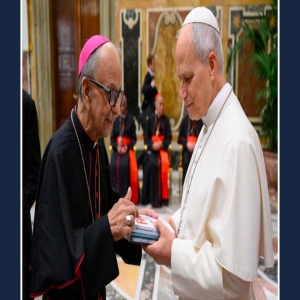
In September this year Pope Leo XIV received him, and he handed over two recent volumes.
Those who saw the photographs noticed that he looked thinner than he had in Guwahati, though he still carried a small stack of papers.
 Cedric Prakash
John Dayal
.jpg)
 A. J. Philip
.jpeg)
 Jacob Peenikaparambil
.jpg)
 Joseph Maliakan
 Jose Vattakuzhy
.png)
 Robert Clements
.jpg) Cedric Prakash
.jpg) A. J. Philip