

 A. J. Philip
.jpg)
It is a privilege to speak before an audience of Christian clergy on a subject that has special significance for both the Church and journalism: the prophetic tradition of journalism and its evolution into the profession we know today.
A journalist, at his best, is a prophet of the modern age. He observes society, identifies its moral failures, exposes injustice, challenges those who wield power and warns people about impending dangers. He may not predict the future, but he reads the signs of the times and alerts society to their implications.
Unfortunately, journalism today is increasingly described as an industry or business, sometimes even an entertainment enterprise. My argument is simple: journalism must never lose its prophetic character. Otherwise, it may remain a successful business but cease to be a meaningful public institution.
Long before newspapers, printing presses and television studios existed, prophets performed functions remarkably similar to those of journalists. They were not merely predictors of the distant future. They were observers and critics of their own times.
Consider the prophet Nathan. When King David arranged the death of Uriah the Hittite and took his wife Bathsheba, Nathan confronted the king with a parable. A rich man, despite owning numerous sheep, took the only lamb belonging to a poor man. When David expressed indignation, Nathan delivered those unforgettable words: "You are that man!"
Imagine the courage required to speak those words to a king. Nathan had no newspaper, television channel or social media platform to support him. He had only his moral conviction. That is the essence of journalism: telling the powerful what they do not wish to hear.
Elijah provides another example. When Naboth was falsely accused and murdered so that King Ahab could appropriate his vineyard, Elijah publicly condemned the rulers. He was not deterred by the consequences of challenging the royal establishment.
The prophet Micaiah displayed similar courage. When 400 prophets assured Ahab of victory in a military campaign, Micaiah alone predicted defeat. He refused to join the chorus of flattering voices. His reward was humiliation and imprisonment. There is a lesson here for journalists. It is easy to repeat what everybody says. It takes courage to report what nobody wants to hear.
Amos, a shepherd from Judah, denounced the exploitation of the poor by the rich. His declaration, "Let justice roll down like waters, and righteousness like an ever-flowing stream," remains one of the most powerful statements of social morality. John the Baptist, too, belonged to this tradition. He rebuked King Herod for his unlawful relationship with Herodias. His courage ultimately cost him his life.
These accounts demonstrate that speaking truth to power is not an invention of modern democracy. How did this prophetic tradition acquire the institutional form we call journalism? An important turning point was the invention of the movable-type printing press by Johannes Gutenberg in the 15th century.
Until then, books were copied by hand and were expensive and inaccessible to most people. Printing transformed the circulation of knowledge. One of its greatest beneficiaries was the Bible. Martin Luther's German translation and William Tyndale's English translation made the Scriptures accessible to ordinary people in their own languages. People could read and interpret the Bible rather than depend entirely on religious authorities.
The printing revolution encouraged literacy and created a growing community of readers. The printed word gradually expanded beyond religious publications to pamphlets, political writings and news sheets. The Reformation and the printing press were closely connected. Printing became an instrument of religious reform and public debate.
The Puritans in England took this further. They regarded the printed word as an instrument of moral and religious reform. Since the monarchy and the established Church controlled the official pulpit and subjected printing to censorship, many Puritan writers resorted to clandestine publications.
The Marprelate tracts of the late 16th century, which satirised the hierarchy of the Church of England, demonstrated the power of printing. The authorities retaliated. William Prynne, John Bastwick and Henry Burton were imprisoned, pilloried and had their ears mutilated for their writings against the ecclesiastical establishment. John Greenwood, Henry Barrowe and John Penry were executed for their religious convictions.
John Bunyan, author of The Pilgrim's Progress, spent twelve years in prison because he refused to stop preaching without a licence. His imprisonment did not extinguish his faith or creativity. These men remind us that the freedom of ex
The Puritans who migrated to North America in the 17th century carried with them a commitment to faith, education and community life. They established churches, schools and eventually newspapers as important institutions. The Church provided spiritual guidance, the school promoted learning, and the newspaper connected communities through information about public affairs. Together, these institutions helped create an informed society.
There is a lesson here for the Church today. It must not confine its concerns to the spiritual lives of its members. It must also care about public life, social conditions and human dignity. A congregation that prays for justice but remains indifferent to injustice outside its doors has not fully understood the prophetic mission of the Church.
The history of Indian journalism also has an important Christian connection. The first printing press in India was established by Jesuit missionaries in Goa in 1556, primarily for religious publications.
In the eighteenth century, the Danish missionary Bartholomaeus Ziegenbalg contributed significantly to Tamil printing and the publication of the New Testament. An even more remarkable contribution came from the Serampore Mission Press, established in 1800 by Baptist missionaries, William Carey, William Ward and Joshua Marshman. Their work extended beyond religious literature. They printed textbooks, dictionaries, grammars and translations in several Indian languages.
In 1818, the Serampore missionaries launched The Friend of India and Samachar Darpan, an early Bengali newspaper carrying news and articles on social subjects. In Karnataka, German Basel missionaries established Mangaluru Samachara in 1843, an important early Kannada newspaper.
In Kerala, Herman Gundert deserves special recognition. A missionary, linguist and lexicographer, he was associated with Rajyasamacharam, published in 1847, which occupies an important place in the history of Malayalam journalism.
These missionaries helped develop printing technology, create typefaces for Indian languages, compile dictionaries and grammars, and make literature accessible to wider sections of society. Their publications also provoked debate about prevailing religious and social practices. Indian scholars, reformers and intellectuals responded by establishing their own publications. Thus, missionary printing helped stimulate a wider culture of public discussion.
India's first newspaper, James Augustus Hicky's Bengal Gazette, appeared in Calcutta in 1780. Hicky himself faced the wrath of the colonial administration for criticising powerful officials. During the freedom struggle, newspapers became indispensable instruments of resistance. Mahatma Gandhi, Bal Gangadhar Tilak, Annie Besant, G. Subramania Iyer and numerous others used journalism to mobilise public opinion against colonial rule.
For them, journalism was not merely a livelihood. It was an instrument of national awakening. Newspapers helped Indians imagine themselves as members of one nation despite differences of language, religion, caste and region.
After Independence, Indian journalism entered a new phase. The press was expected to contribute to nation-building, strengthen democracy, expose corruption and hold public institutions accountable. The economic liberalisation of the 1990s transformed the media landscape. Today, almost anyone with a mobile phone can now become a publisher. Information travels across the world in seconds, and traditional newsrooms no longer enjoy a monopoly over its dissemination.
There is nothing wrong with journalism becoming a profession. It needs professional competence, specialised training, technological skills, fair remuneration and institutional support. But there is a fundamental distinction between a profession and a vocation.
A profession provides a livelihood; a vocation provides a sense of purpose. Journalism needs both. A doctor requires medical knowledge but also compassion. A lawyer must know the law but respect justice. A priest needs theological understanding as well as spiritual commitment. As my vicar in Kayamkulam, Rev. Shaji K. Thomas, puts it succinctly: "For the Church, service begins when worship ends."
Similarly, a journalist must know how to gather information, verify facts, conduct interviews and write clearly. But without courage, integrity and commitment to public welfare, these skills become mechanical. A journalist can be professionally competent and morally bankrupt. That is why the prophetic tradition must remain at the heart of journalism.
The greatest danger confronting journalism is not the absence of technology but the erosion of credibility. Political parties increasingly expect journalists to function as publicity agents. Corporate owners sometimes treat news organisations as instruments to protect commercial interests. Governments, irrespective of their political complexion, are often uncomfortable with inconvenient questions.
The pressure to secure advertising revenue and maximise television ratings has distorted priorities. In some television studios, shouting has replaced discussion, allegations have replaced investigation, and propaganda masquerades as journalism.
Social media has compounded the problem. False information, manipulated photographs and fabricated videos circulate at astonishing speed. Artificial intelligence can assist journalists with research, translation and data analysis, but it can also manufacture convincing falsehoods. In these circumstances, establishing the truth becomes journalism's most important responsibility.
The prophetic tradition offers three essential guidelines. First, journalism must speak truth to power. The powerful must be questioned irrespective of political position, religious affiliation or economic influence. Second, journalism must stand with the vulnerable. The poor, minorities, marginalised communities and victims of discrimination must find a place in the public conversation.
Third, journalism must read the signs of the times. It must go beyond reporting yesterday's events, identify emerging dangers and alert society before it is too late. These responsibilities are particularly important in India, where inequalities remain deeply entrenched and religious, caste and communal divisions are sometimes exploited for political purposes.
What has all this to do with Christian clergy? The prophets in the Bible did not confine themselves to places of worship. They went to the courts of kings, marketplaces and public squares. They confronted injustice wherever they found it. The Church must therefore develop a meaningful relationship with the media. It should not regard journalists merely as people who can publicise its programmes, anniversaries and conventions.
It should encourage independent journalism, promote media literacy and help young people distinguish facts from falsehoods. It must also defend journalists persecuted for exposing wrongdoing.
At the same time, the clergy must be willing to accept scrutiny. Religious institutions are human institutions and are not beyond criticism. Financial impropriety, abuse of authority, discrimination and exploitation can occur within religious organisations as elsewhere. The Church loses its moral authority when it demands accountability from governments but refuses to practise it within its own institutions.
Christian educational institutions should also encourage young people to consider journalism a meaningful vocation. We need journalists who are professionally trained, intellectually independent, morally sensitive and socially committed.
The pulpit and the press need not compete. They can complement each other in the pursuit of truth and justice. Nathan did not ask King David whether his criticism would affect the king's popularity. Elijah did not seek Ahab's approval before condemning the injustice done to Naboth. Amos did not dilute his message because the rich might be offended. Micaiah did not join 400 prophets merely because they represented the majority.
They spoke because truth mattered more than personal safety, popularity or patronage. That is the spirit journalism must recover. The journalist's greatest asset is not the printing press, television camera or smartphone. It is public trust. And trust cannot be purchased through advertisements or manufactured through public relations. It must be earned through honesty, fairness and courage.
There is a famous ex
Perhaps the most appropriate biblical injunction for journalists comes from Isaiah: "Learn to do right; seek justice. Defend the oppressed." Otherwise, we will have newspapers without truth, television without enlightenment and journalists without a conscience. In the final analysis, journalism is not merely about reporting what happens. It is about helping society understand what ought to happen.
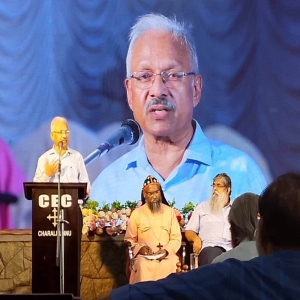
— Based on a lecture the writer delivered at the annual clergy conference of the Mar Thoma Church at Charalkunnu on November 24, 2026.

 Cedric Prakash
.jpg)
 John Dayal
A. J. Philip
.jpeg)
 Jacob Peenikaparambil

.jpg)
 Joseph Maliakan
 Jose Vattakuzhy
.png)
 Robert Clements
.jpg) Cedric Prakash
.jpg) A. J. Philip