

.jpeg)
In the cold, unforgiving silence of the prison cell, Keshav—once defined by his crime—now holds a driver's license, a key to a new life, and a quiet smile. This subtle yet profound transformation is the hallmark of Fr NT Scaria's work. For nearly three decades, this Salesian priest has led a silent revolution in Bengal's prisons, reshaping prison ministry into a prophetic witness of hope, dignity, and reintegration.
What began in 1995 as a solitary visit to the Berhampore Central Correctional Home in Murshidabad district has since grown into the Don Bosco Prison Ministry—a beacon of transformative justice rooted in the Salesian charism and animated by the belief that no life is beyond redemption.
From Consolation to Conviction
"I went in with no plan [to the prison]," Fr Scaria recalls. "But I came out with a conviction—that these men and women, though incarcerated, are still children of God."
Moved by the plight of under-trial prisoners—young, poor, and often legally unrepresented—he began making regular visits. While his early engagement was pastoral—celebrating Mass in the prison and offering counsel—Fr Scaria soon recognised that prayer alone could not heal systemic wounds. A deeper response was needed: one that combined compassion with concrete opportunity.
Changing the Culture Behind Bars
At the core of the Don Bosco Prison Ministry lies a radical premise: education is liberation. Fr Scaria initiated vocational training in mechanics, tailoring, electronics, and digital literacy to equip inmates with life-changing skills. His boldest innovation, he claims — the world's first certified Motor Driving School inside a prison—faced intense scepticism.
"It wasn't easy," he admits. "There were bureaucratic hurdles, safety concerns, and outright resistance. But we persisted. Today, several life convicts have earned licenses and are employed as drivers."
This sentiment is echoed by Abhu Siddiqui, a former inmate and driving school graduate: "Today you see a smile on every prisoner's face, thanks to the teamwork of Fr Scaria, Mr Manoj Pant, and the prison staff. They treated us like human beings, not just inmates."
Mr Manoj Pant is a senior IAS officer whose administrative vision has left a lasting mark on prison reforms in West Bengal. While serving as District Magistrate of Murshidabad, he became closely associated with the Don Bosco Prison Ministry led by Fr Scaria. Pant's support was instrumental in transforming Berhampore Central Correctional Home into a model of rehabilitation, backing initiatives such as vocational training, legal aid, and the pioneering Motor Driving School inside a prison. His administrative encouragement helped shift the prison culture from punishment to dignity and reintegration, with life convicts even trained to drive prison vehicles.
The shift was palpable among correctional officials, with Mr Dipak Sakri, Superintendent of Berhampore Central Correctional Home, observing: "This initiative has changed the atmosphere inside the prison. Inmates are more hopeful, more disciplined. The Don Bosco team has brought not just skills, but a sense of purpose."
Recognition Extended Beyond Prison Walls
In 2006, the National Legal Services Authority (NALSA) awarded Fr Scaria a Certificate of Appreciation for protecting prisoner rights. In 2012, he received the Pascual Chávez Award from the Salesian congregation for his innovative pastoral leadership.
Still, it is the transformations that matter most to him. Stories like the young man who became a computer technician after release, or the woman who now runs a tailoring cooperative in her village, are his truest accolades.
Former District Magistrate Manoj Pant—instrumental in supporting the ministry—affirmed: "Within five years, Fr Scaria and his team succeeded in making this jail prisoner-friendly. Life convicts are now driving prison vehicles after being trained by the Don Bosco team."
Healing Through Wholeness
Beyond training, the ministry emphasises holistic rehabilitation. Through music workshops, football matches, sports and cultural events, and theatre performances, inmates rediscover joy, creativity, and camaraderie. "When prisoners sing or play," says Fr Scaria, "they reclaim fragments of their personhood. It reminds them—and us—that they are still worthy of healing."
Recognising the intergenerational impact of incarceration, the ministry also supports the families of inmates, particularly their children. Education sponsorships, counselling, and mentoring aim to disrupt cycles of stigma and abandonment. As one mother shared in "Joy Behind Bars," the docufilm on Don Bosco Prison Ministry: "I never thought my son would smile again. But after his training and spiritual renewal, he came home with hope in his eyes."
A Witness Captured in Film
In 2022, the Salesian Province of Calcutta released "Joy Behind Bars," a moving short documentary chronicling the remarkable journey of Don Bosco Prison Ministry. More than a record of activities, the film became a testimony to the power of compassion and the possibility of redemption.
The documentary opens with stark images of prison corridors, gradually giving way to scenes of transformation: inmates performing skits on forgiveness, women leading vocational classes for fellow prisoners, and young men discovering dignity through skill training. Their voices, often silenced by stigma, emerge with clarity and conviction. One inmate shares with disarming honesty: "I've found my life's purpose again. The love and care of the Don Bosco team has changed my heart, and I will never return to my old ways."
The film also highlights the role of families, showing mothers and children whose lives have been touched by the ministry's outreach. It captures moments of music, sport, and prayer, reminding viewers that rehabilitation is not merely about discipline but about restoring joy and humanity.
Critics and audiences alike noted the documentary's ability to humanise prisoners, shifting public perception from condemnation to compassion. It became an educational resource for schools and parishes, sparking conversations about justice, mercy, and the Church's mission at the margins.
"This is not just rehabilitation," the narrator reflects in the closing sequence. "It is resurrection."
The documentary's impact was far-reaching, setting the stage for wider recognition of Fr Scaria's ministry. Just three years later, in December 2025, his lifelong commitment to transforming lives behind bars was honoured with the Lifetime Achievement Award for Prison Reforms with Compassion at the International Human Rights Summit in New Delhi. The film had already captured the spirit of his mission; the award confirmed its enduring significance on a global stage.
Global Recognition
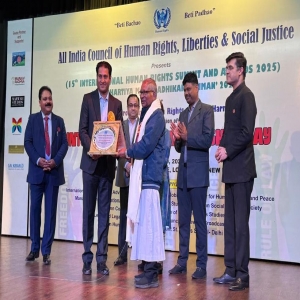
On December 10, 2025, Fr Scaria was conferred the Lifetime Achievement Award for Prison Reforms with Compassion at the 15th International Human Rights Summit & Awards, held at the India Islamic Cultural Centre, New Delhi, on International Human Rights Day.
The Global Board of Jury honoured Fr Scaria for his extraordinary dedication and vision in transforming lives behind bars through faith-driven social action. Beginning with his historic visit to Berhampore Central Correctional Home in 1995, he had pioneered initiatives of reform and rehabilitation across West Bengal, Jharkhand, and Bihar. His ministry introduced vocational training, legal aid, counselling, family support, and the world's first certified motor driving school inside a prison.
Over three decades, the Don Bosco Prison Ministry under his leadership became a beacon of hope, offering release, rehabilitation, and reintegration to thousands of prisoners and their families. His initiatives not only restored dignity to inmates but also inspired correctional officials, volunteers, clergy, and reformers to embrace a more compassionate approach to justice.
The Jury commended Fr Scaria's unwavering compassion and spiritual strength, noting that his life's work embodied the true spirit of mercy, faith, and humanity. The award placed him among eminent global leaders previously honoured at the Summit, underscoring his role as a national symbol of mercy and reform.
A Salesian Heart in the Peripheries
Fr Scaria's work is a living embodiment of the Salesian preventive system—brought not to classrooms alone, but also to correctional cells. He recalls Don Bosco, who famously visited La Generala, the juvenile prison in Turin, saying, "Don Bosco walked the alleys of Turin to rescue boys from crime and poverty. We enter prisons to do the same."
Reflecting on his struggles, colleague Fr KK Sebastian remarked: "This is not the result of a PhD degree but of an authentic SDB degree—a Salesian for the poor and marginalised with love and compassion."
On receiving the award, Fr Scaria told accompanying Salesians: "Prison Ministry should be considered an integral part of the Salesian apostolate. It touches the lives of thousands of needy and problematic youth and offenders. This is what Don Bosco wanted."
Fr Scaria credits his collaborators, including Salesian confreres such as Fr TL Francis, late Br Paul Biko, late Fr CJ Jacob, Fr David Mondol, and lay volunteers, as well as former inmates-turned-mentors. "This is not my work," he insists. "It is God's work, carried out by many hands."
Charting a Way Forward
Fr Scaria's journey from a solitary prison visit in 1995 to receiving the Lifetime Achievement Award for Prison Reforms with Compassion in 2025 is more than a chronicle of milestones; it is a testimony to mercy lived out in action. His ministry has shown that justice without compassion is incomplete, and that even behind bars, dignity and hope can flourish.
Now in his early eighties, he continues to remind the Church and society that the measure of humanity lies not in how we treat the powerful, but in how we embrace the forgotten. Every license earned, every skill acquired, every smile restored is a quiet resurrection, a sign that redemption is possible.
As the Don Bosco Prison Ministry looks to the future, guided by his vision and strengthened by new collaborators, Fr Scaria's life stands as a beacon: that faith, when joined with courage and compassion, can turn cells of despair into classrooms of hope. His legacy is not confined to awards or accolades, but lives on in the countless men and women who, once prisoners, now walk free with dignity, purpose, and trust.
Sidebar: Key Milestones
1995: First visit to Berhampore Central Correctional Home
2000: Launch of vocational training programs
2006: NALSA Certificate of Appreciation
2012: Pascual Chávez Award
2022: Release of Joy Behind Bars documentary
2025: Lifetime Achievement Award for Prison Reforms with Compassion
.jpg)
 A. J. Philip
.png) Cedric Prakash
Cedric Prakash
.jpg)
 P. A. Chacko
.jpg)
.jpg)
.jpg) Thomas Menamparampil
Thomas Menamparampil
.png)
.png)
.png) Robert Clements
Robert Clements
.jpg)
.png)
.png) Chhotebhai
Chhotebhai