

.png) Jacob Peenikaparambil
Jacob Peenikaparambil
.jpg)
A recent statement by Prime Minister Narendra Modi at Somnath and a speech by Ajit Doval, India's National Security Advisor, strongly suggest that the BJP continues to deploy hate and revenge as tools of political mobilisation. These strategies rely on narratives rooted in historical grievances, religious identities, and perceived civilisational humiliations.
Under Prime Minister Modi's leadership, such discourses have been strategically used not only to consolidate the party's core support base but also to divert public attention from pressing socio-economic challenges by intensifying cultural and identity-based fault lines.
While addressing the Viksit Bharat Young Leaders Dialogue on January 10 as the guest of honour, Ajit Doval made a highly controversial statement. "Revenge is not a good word, but it can be a huge force. We have to avenge our history and take this country to the point where it is great again—not just in terms of border security, but economy, social development, every aspect," he said.
In his speech, Doval invoked themes of historical humiliation and urged India's youth to "take revenge" for what he described as painful chapters of India's past, citing pillaged temples, looted villages, and a diminished civilisational role. This framing drew upon a narrative of historical grievance and loss.
Many have questioned the appropriateness of such language from the country's top security official. The crucial question that arises is: against whom is this "revenge" to be taken for events that allegedly occurred a thousand years ago? Does this rhetoric implicitly target the Muslim community? Even though Doval attempted to qualify revenge as a metaphorical force for national rebuilding, the explicit use of the term raised serious concerns among critics.
Mehbooba Mufti, former Chief Minister of Jammu and Kashmir, reacted sharply on X. She wrote: "It is deeply unfortunate that a high-ranking officer like Mr Doval, whose duty is to guard the nation against internal and external nefarious designs, has chosen to join a communal ideology of hate and normalise violence against Muslims." She further stated, "Calling for REVENGE in the 21st century over centuries-old events is merely a dog whistle, inciting poor and uneducated youth to target a minority community already facing an onslaught from all sides."
Observers have also noted how Doval's remarks align with broader nationalist themes promoted by the BJP leadership. His framing of national revival through the lens of historical wrongs resonates with sections of the electorate who view India's past subjugation—whether during colonial rule or earlier periods—as a call to reclaim lost pride and power. Critics argue that this narrative deliberately blurs the line between historical reflection and contemporary prejudice, making it politically expedient but socially dangerous.
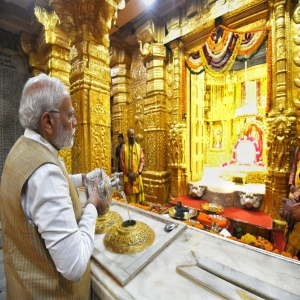
Doval's statement can be viewed in conjunction with Prime Minister Modi's visit to the Somnath Temple in Gujarat on January 10-11, 2026, where he led the Somnath Swabhiman Parv, marking 1,000 years since the first attack on the temple by Mahmud of Ghazni in 1026. The event commemorated the temple's repeated destruction and reconstruction, symbolising resilience and civilisational endurance. This year also marks the 75th anniversary of the temple's modern restoration, completed in 1951.
During the visit, the Prime Minister emphasised that the Somnath Temple stands as a symbol of India's indomitable spirit, faith, and civilisation. He stressed that its history is not one of defeat but of strength, victory, and restoration, explicitly linking the temple's past to contemporary national identity and pride.
In his speech, Modi remarked that while some nations showcase a few centuries of heritage as their global identity, India possesses sacred sites like Somnath that are thousands of years old—symbols of resistance, strength, and tradition. He lamented that after independence, those with a "colonial mindset" allegedly attempted to distance the country from such heritage and even sought to erase this history.
The Prime Minister also indirectly criticised the Congress, stating that when India was freed from colonial rule, and Sardar Vallabhbhai Patel pledged to rebuild Somnath, attempts were made to obstruct him. He referred to objections raised when President Dr Rajendra Prasad attended the temple's inauguration in 1951. According to Modi, forces that opposed the reconstruction of Somnath remain active today and continue to conspire against India through other means.
However, Dr Ram Puniyani, in his article "Somnath Temple: History as a Political Tool, Yet Again," clarifies that neither Jawaharlal Nehru nor the Congress opposed the reconstruction of the Somnath Temple. Nehru, Patel, and Mahatma Gandhi were united in their view that, in a secular state, public funds should not be used for constructing religious structures belonging to any one community. Likewise, Nehru did not object to President Rajendra Prasad attending the inauguration in his personal capacity.
Both Prime Minister Modi and Ajit Doval have thus invoked historical grievances in ways that critics argue polarise the Hindu majority against minorities. Over the past decade, the BJP—bolstered by its ideological alignment with the Rashtriya Swayamsevak Sangh (RSS) and other right-wing organisations—has intensified narratives centred on religion, identity, and history. Instead of focusing primarily on governance outcomes, many BJP leaders' speeches have relied on "us versus them" tropes that foster fear, resentment, and exclusion.
Human Rights Watch, in its detailed review of the 2024 election campaign, observed that speeches by Modi and senior BJP leaders frequently contained rhetoric resembling hate speech directed at Muslims and other minority communities. According to the report, such rhetoric contributed to a climate in which discrimination and violence became increasingly normalised. In several cases, these speeches appeared to violate India's election regulations on communal and religious content, yet the Election Commission took limited action.
Politically, the BJP has benefited significantly from deploying hate and revenge in its discourse. By continuously framing politics around perceived threats to Hindu cultural identity, the party reinforces loyalty among its core supporters—an advantage that becomes particularly evident during election cycles, when communal polarisation can drive voter mobilisation.
When governance failures—such as inflation, unemployment, rural distress, or the lack of access to clean and safe drinking water—become difficult to ignore, shifting public discourse towards history, religion, and national pride offers a convenient diversion. This tactic has been criticised by leaders such as Tamil Nadu Chief Minister MK Stalin, who has accused BJP-ruled states of distracting citizens by "immersing them in religion and hate politics" rather than addressing everyday problems.
The BJP's messaging often reduces political debate to stark binaries: patriots versus anti-nationals, "us" versus "them," majority versus minorities. Such framing leaves little room for nuanced discussion and forces political opponents into defensive postures.
The sustained use of hate and revenge as political tools carries serious consequences for Indian democracy. First, an excessive focus on historical grievances risks deepening social divisions and undermining India's pluralistic and multicultural fabric. Second, when polarising rhetoric intersects with state institutions—such as law enforcement or electoral machinery—to marginalise minorities or political opponents, public trust in democratic institutions is weakened. Third, India's global image as a diverse and plural democracy suffers when international human rights organisations repeatedly raise concerns about hate speech and discrimination.
In this context, an important question arises: how should followers of Jesus respond to the growing culture of hate and revenge, which erodes compassion and empathy in society? A follower of Jesus cannot accept an ideology rooted in hatred and vengeance, as one of the core teachings of Jesus is unconditional forgiveness. Indeed, anyone who actively promotes hate and revenge stands in contradiction to the essence of Christian discipleship.
Followers of Jesus are called to help build a civilisation of love. "Love one another as I have loved you" was the central commandment Jesus gave his disciples. First, Christians must have the courage to unequivocally condemn hate speech and inflammatory statements by political and religious leaders. The Church in India, for instance, should have clearly denounced Ajit Doval's call for "revenge" in the 21st century over centuries-old events. Second, a concerted effort should be launched across Church-run educational institutions to counter the spread of hatred and actively promote harmony among people of different religions, castes, and communities.
.jpg)
.png) Cedric Prakash
Cedric Prakash
 ICPA
ICPA
 ICPA
ICPA
 ICPA
ICPA
 ICPA
ICPA
 ICPA
ICPA
 ICPA
ICPA
.jpg)
 A. J. Philip
.jpg) Jacob Peenikaparambil
Jacob Peenikaparambil
.jpg)
.png) John Dayal
John Dayal