

 A. J. Philip
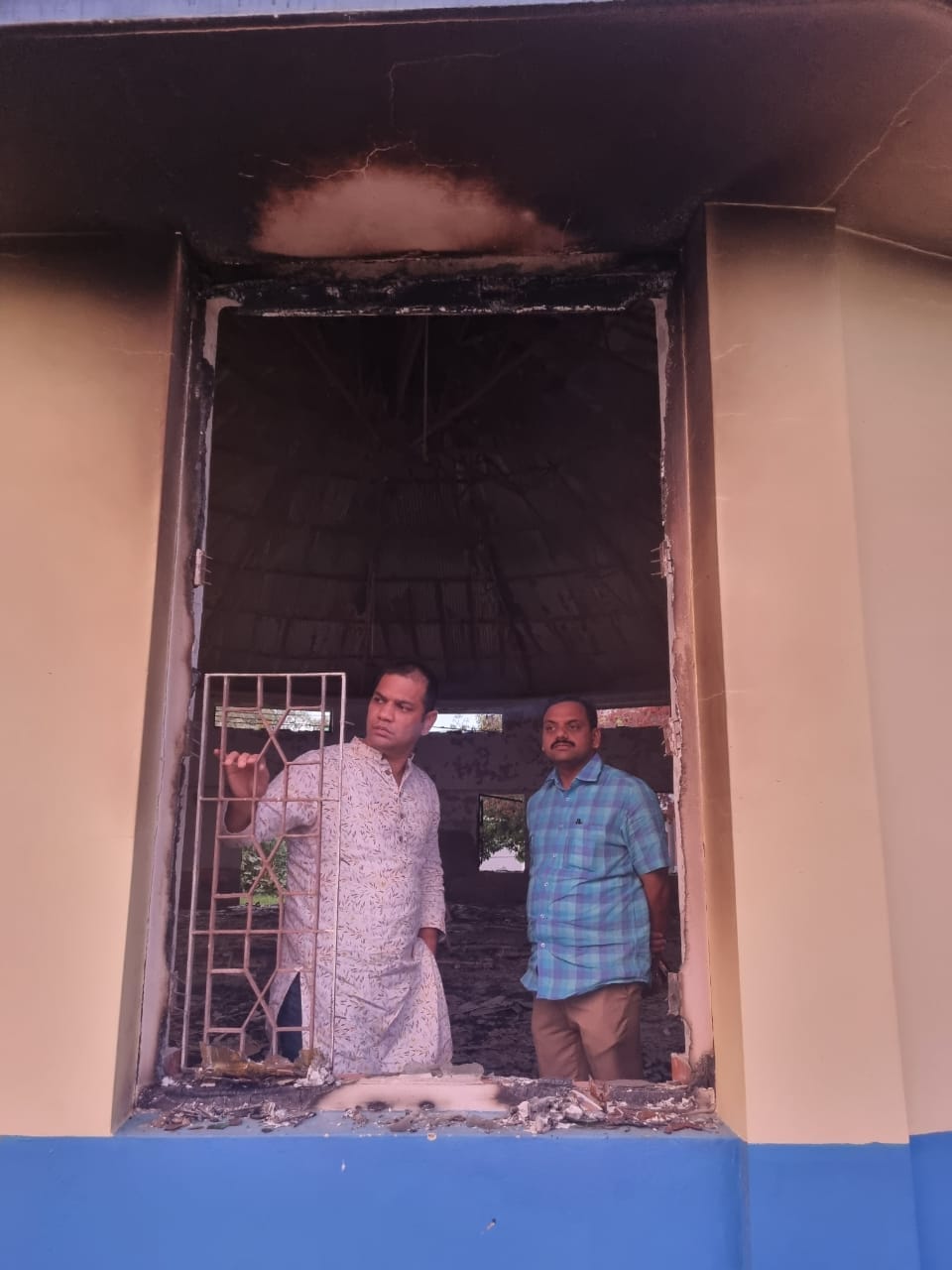
Dean Kuriakose and Hibi Eden are two Congress MPs representing Idukki and Ernakulam constituencies in Kerala. They made a visit to Manipur early this week to study the situation there. They did not inform the Manipur government about their visit. They merely exercised their right as citizens to travel anywhere in the country.
In Manipur, they relied on their personal connections to visit dozens of relief camps and meet the victims of the anti-Christian pogrom.
Senior journalist AJ Philip interviewed Dean Kuriakose, who was the president of the Youth Congress before becoming a Member of Parliament.
Excerpts from the interview:
Question: What prompted you to travel to Manipur?
Answer: It was nearly 40 days since the outbreak of violence in the state on May 3. There was no end to the violence even after Home Minister Amit Shah went to Manipur, stayed there for three days and talked to all the stakeholders. We wanted to see the ground situation and know why violence was not ending.
Q: Was it a secret visit?
A: It is wrong to describe the visit as secret because the Indian Constitution grants permission to every citizen to visit every part of the country. True, we did not inform the state government because it is not mandatory to give such information. We did not want the help of the state machinery to travel in Manipur. Also, we feared that the government might put roadblocks before us.
Q: Where did you go?
A: We visited Imphal, the Capital, and from there we went to adjoining districts and saw dozens of relief camps where people in thousands have been living in miserable conditions for more than a month. The camps are run in government buildings, schools etc. They are given food materials which they themselves cook. Other than that, they do not get any support. For instance, those who need medical care cannot get medicines or medical help.
Q: Is it true that it is an ethnic clash between the majority Meiteis and the minority Kukis?
A: It is difficult to believe so. On the contrary, there are clear indications that it is an anti-Christian pogrom. More than 200 churches have been destroyed. Churches belonging to the Meiteis in Imphal have also been destroyed. Meitei Christians have also been attacked. It is politically convenient to call it an ethnic cleansing but the fact is that it is aimed at destroying, if not eliminating, the Christian community in the state. Let there be no mistake about it. We visited St. Paul’s church where every inch of the structure had been destroyed. They systematically used gas cylinders to destroy churches and homes of Christians.
Q: Why is the violence not ending?
A: That is what has been worrying us. When we were there, the St. Joseph School was attacked. The attackers came at night violating the curfew orders. The law and order authorities were present but they could not prevent the attack. What this implies is that the writ of the state does not run in Manipur. There is reason to believe that the arsonists have the support of the state government.
Q: Do you suggest that the state should be brought under President’s rule?
A: The President's rule should have been introduced weeks ago. We met some MLAs belonging to the BJP. They themselves were saying that they have lost their confidence in the Biren Singh government. Manipur is a classic case of what would happen if the state government supported a large group of anti-social elements fed constantly on hatred for a community. The marauding groups have weapons looted from the police establishments. It is difficult to believe that this happened without the knowledge of the political leadership in the state. That the house of the only woman minister was burnt tells a story of its own. Even senior civil and police officers are suspicious of their security guards. They have all been defanged if they are Christians. What more is required to infer that law and order has totally collapsed.
Q: Do you think a separate state for Kukis is justified?
A: I am not in a position to suggest that because I do not know how the Christians remaining in the valley would feel about it. However, there is no doubt that a majority of the Kukis have been alienated. They feel that the hills where they live should be declared a separate state or at least as an autonomous region as was the case in Ladakh. This needs to be studied.
Q: What do you propose to do now?
A: We will write to the President of India. Droupadi Murmu is the first tribal to become the President. And this is what is happening to the tribal community in Manipur. She has a moral and constitutional obligation to intervene. We will also write to the Prime Minister who has been silent on the issue. We will also try to meet him in order to give a first-hand account of our visit. Of course, we will also inform the Congress leadership about the condition in Manipur.
Q: Do you think Home Minister Amit Shah’s visit to Manipur has yielded any result?
A: On the contrary, many churches and church establishments were destroyed after his visit. It is now 40 days since the Internet was cut. The official death toll has already crossed the 100-mark. Nearly 10,000 houses have been destroyed and tens of thousands of people have become homeless. Thousands of children are being deprived of education. They fear that the strategy is to eliminate them. Let Mr Shah admit that it is not an ethnic clash but a violent campaign against the Christian community and take steps accordingly.
Q: What steps do you suggest?
A: The state should be brought immediately under President’s rule. The Army should be deployed in the state and anyone who takes the law into his own hands should be dealt with severely. Once the message goes that no nonsense would be tolerated, violence will automatically end. The Indian state has the capacity to deal with the situation if it feels strongly about it.
----
.jpg)
.png) Cedric Prakash
Cedric Prakash
 ICPA
ICPA
 ICPA
ICPA
 ICPA
ICPA
 ICPA
ICPA
 ICPA
ICPA
 ICPA
ICPA
.jpg) A. J. Philip
A. J. Philip
.jpg)
.png) Jacob Peenikaparambil
Jacob Peenikaparambil
.jpg)
.png) John Dayal
John Dayal