

.png) Robert Clements
Robert Clements
.png)
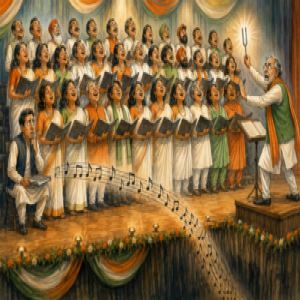
There is a frightening moment in choral singing when the entire choir begins to lose pitch.
Nobody notices it at first.
The sopranos are singing confidently. The altos are following the sopranos. The tenors are following the altos. And basses, being naturally humble people, are following everybody while looking as if everybody is following us.
The strange thing is that we all sound correct to one another.
We are united. We are disciplined. We are singing the same song. We may even be smiling proudly at the audience.
Unfortunately, we are all wrong.
This happens especially when a choir sings without accompaniment. Slowly, almost politely, the pitch begins to slip. One voice moves slightly. Another adjusts to it. A third follows. Soon the whole choir has travelled somewhere the composer never intended it to go.
But because everyone has travelled together, nobody feels lost.
In my soon-to-be-released book, One Note at a Time, I write about this curious problem of losing pitch together. And today, as I look at my country, I realise we are doing exactly that.
Oh yes, millions may repeat the same slogan. Thousands may applaud the same speech. Television anchors may shout the same conclusion. Social media groups may forward the same message. And because so many people are singing it together, we assume it must be true.
But numbers do not determine pitch.
A majority can sing the wrong note.
A crowd can march confidently in the wrong direction.
A nation can applaud while its freedoms quietly disappear backstage.
The problem is that nobody wants to be the lone singer who stops and says, "Excuse me, but have we moved away from the original note?"
He is immediately glared at.
"Everyone else is singing correctly," he is told.
"But we have dropped," he whispers.
"Anti choir!" somebody shouts.
"Enemy of harmony!" cries another.
Soon he is removed from the rehearsal, and the choir continues magnificently towards musical disaster.
The conductor does not ask whether the wrong note is popular. He asks whether it is right. Democracy must learn to ask the same question before applause becomes noise.
A wise choir keeps returning to the tuning note. A wise nation must also keep returning to its Constitution, its conscience, its compassion, and its commitment to truth.
These are the notes that tell us whether we are still singing the song our founders gave us.
Unity is beautiful, but only when united around what is right. Otherwise, unity merely allows everyone to become lost without feeling lonely.
So when the crowd grows louder, listen more carefully.
We may be singing together.
But stop singing, listen carefully, and ask yourself, "am I still in tune?"

.png) Cedric Prakash
Cedric Prakash
.JPG)
 A. J. Philip
.png) Jacob Peenikaparambil
Jacob Peenikaparambil
.jpg)
.png) John Dayal
John Dayal
.jpg)
 Pachu Menon
.png)
.png) Robert Clements
Robert Clements