

.png) Jaswant Kaur
Jaswant Kaur
.jpg)
The new year is around the corner. By the time this piece is read, many of us will be bracing for the first dawn of the new calendar. Some might have already made their way to the hills to witness the annual snowfall, while others, wishing to avoid the extreme cold, may have planned a retreat to warmer places.
But regardless of where we are headed, this moment has a way of compelling almost everyone to pause, to reflect almost instinctively on the hits and misses, the habits we clung to despite better judgment, and the behaviours we promise ourselves we will finally change.
However, if this soft accountability toward ourselves were to become a mandate for larger systems, the story would be clearly different—especially for the Indian judicial system. Ceremonially, the courts close their doors for the routine winter vacation, but there seems to be no practice of reflecting, pondering, and thinking about what could have been done differently.
Unfortunately, the year we are leaving behind has not merely exposed gaps in justice; it has revealed how accustomed we have become to its inefficiencies. The data tells the story when our systems refuse to reflect and correct themselves.
The annual crime report—the much-coveted National Crime Records Bureau (NCRB)—speaks volumes about how justice has evaded women who have been wronged or whose dignity has been violated. The report shows that crimes against women in India crossed 4.45 lakh cases in a single year, amounting to nearly 51 crimes every hour. The number of reported rape cases continues to hover above 30,000 annually—an alarming figure in a country where underreporting is not an aberration but an epidemic.
Ironically, conviction rates for crimes against women remain around 25 per cent, and in several states, they are far lower. These are not abstract numbers. They are lived realities, stacked year after year, with little assurance that reporting violence will lead to justice rather than prolonged suffering.
Against this backdrop, the decision to grant bail to Kuldeep Singh Sengar, convicted of raping a minor and sentenced to life imprisonment, is not a procedural footnote. It is a moral statement. His sentence has been suspended pending appeal.
In India, appeals can take years, sometimes decades. NCRB prison data shows that over 75 per cent of India's prison population consists of undertrials, waiting endlessly for closure. The system seems to accept delay as normal, or perhaps humane. But there is nothing neutral about a time when it works only in favour of the powerful. In most cases, the survivor is permanently punished while the perpetrator remains free.
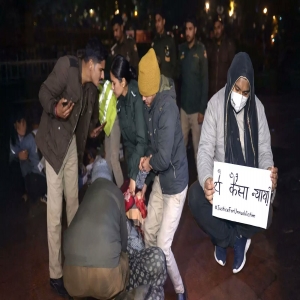
What followed this bail order should have given us a bigger jolt. The parents and the Unnao rape survivor—already stripped of their respect and their dignity—were removed by the police. They were protesting at India Gate, hoping their plea would be heard.
It was a moment that captured the state of our justice system with brutal clarity. When those wronged by the system protest, they are treated as law-and-order problems. When the powerful violate the law, the system bends to accommodate them. What does it say about a democracy when grieving parents are cleared from public spaces while convicted rapists walk free pending appeal?
This is not an isolated failure. It is a pattern that repeats across cases and years. The Hathras case once forced the nation to confront caste violence, sexual brutality, and institutional apathy. Years later, three of the four accused were acquitted. Rape charges quietly vanished without any accountability for investigative lapses. In a country where NCRB data shows that over 90 per cent of sexual assault survivors know their perpetrators, such outcomes do not merely close cases—they reinforce fear and silence.
Even when arrests happen, urgency remains selective. It took hundreds of leaked videos, uncontainable public outrage, and an attempted flight from the country before the law finally stirred in the Prajwal Revanna case. Justice did not act on its own conscience. It was dragged into action. His father remains out on bail. The message is clear: accountability in India is not proactive. It is reactive, reluctant, and often incomplete.
Meanwhile, incarceration itself has become elastic for a certain class of convicts. Gurmeet Ram Rahim and Asaram Bapu have turned prison sentences into revolving arrangements of parole, medical bail, and temporary relief. This is not mercy but a privilege for those who enjoy power and clout.
In stark contrast are overcrowded prisons, operating at 130 to 150 per cent capacity, largely filled with undertrials from marginalised communities accused of minor offences. The law may claim blindness, but its outcomes reveal a disturbingly selective vision.
Then comes the case of Brij Bhushan Sharan Singh, who faces formal charges of sexual harassment yet remains free, politically relevant, and publicly defiant. The women who accused him have been waiting endlessly. Their careers have been destroyed, and their credibility has been put to public scrutiny.
Ironically, the NCRB report does not account for the cost of this long wait—the prolonged trauma and stigma these victims face. Justice delayed is no longer considered justice denied. It has merely become an administrative issue, perhaps not requiring urgent attention.
And this erosion of justice is not confined to crimes against women. It extends to land, air, water, and the future itself. The story of the Aravalli Hills is a case study in environmental injustice. Despite repeated court orders, committee reports, and expert warnings, illegal mining and land misuse continue across the Aravalli region. One of the world's oldest mountain ranges, critical to preventing desertification and protecting groundwater, is being dismantled incrementally, forcing people to conduct mass protests.
And when it comes to air, it has merely been reduced to a "temperature"—as quoted by one of the ministers—an index measured, discussed, and then largely ignored. Small wonder we have become home to 14 of the world's 20 most polluted cities. Delhi's air quality routinely slips into the "severe" category for weeks. Pollution contributes to lakhs of premature deaths annually—but then, who cares?
Groundwater levels across northern India continue to fall. Forest clearances have increased even as climate-related disasters—floods, heatwaves, and droughts—have become more frequent. Environmental laws exist; violations are also documented, but consequences rarely follow. Justice here, too, erodes not through an absence of law, but through an absence of enforcement.
There are, of course, rare moments when the system reminds us of what justice is meant to look like. Justice BV Nagarathna's decision to overturn the remission granted to the Bilkis Bano rapists was one such moment. Eleven convicted men were sent back to prison. The abuse of state power was called out plainly. It reminded us that justice still has some spine. But the fact that such moments feel exceptional should disturb us. Systems are not meant to depend on individual courage to remain ethical and accountable.
As we enter a new year, perhaps the most urgent resolutions are not personal but institutional. Will those in power reflect on how procedure has increasingly eclipsed purpose? Will our elected representatives ask why environmental destruction continues despite judicial warnings? Will lawmakers confront what NCRB data has been telling us for years—that delay, dilution, and selective enforcement are corroding justice from within?
And will those in power ever ask themselves a harder question: Who are they accountable to? What answers do they have for the parents and the rape survivor who were removed from India Gate while seeking justice for their child? How can they look in the eye the hundreds of thousands of survivors who watch their perpetrators walk free pending appeal? And how do they ask for votes from the same citizens who breathe toxic air while laws gather dust?
Justice does not collapse overnight. It erodes quietly. As we step into a new year, the real resolution we need is to ensure that justice is swift and equal in the real sense. Because if we do not demand that now, we may soon find ourselves entering yet another year with laws intact and promises recycled.
.jpg)
 A. J. Philip
.png) Cedric Prakash
Cedric Prakash
.jpg)
 P. A. Chacko
.jpg)
.jpg)
.jpg) Thomas Menamparampil
Thomas Menamparampil
.png)
.png)
.png) Robert Clements
Robert Clements
.jpg)
.png)
.png) Chhotebhai
Chhotebhai