

.jpg)
There is no better illustration of the state of accountability in India today than the absence of a one-line answer to a simple question: who ordered the firing of pellet guns on protesting students?
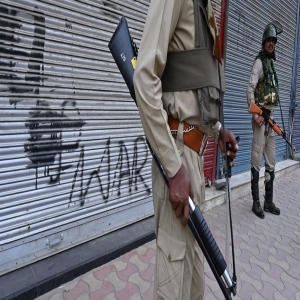
Students protesting in the national capital were fired upon by the Rapid Action Force (RAF) with pellet guns — weapons ordinarily associated with riot control in militancy-affected areas such as Jammu and Kashmir. An RTI response to Rajya Sabha MP Saket Gokhale revealed that at least ten young people were injured by pellets, based on records from only two hospitals, with more data awaited.
This is significant because the Delhi Police had denied that pellet guns were used at all. Union Health Minister JP Nadda repeated that denial in Parliament.
Yet Home Minister Amit Shah did not appear in Parliament to answer the question, nor did the Prime Minister. Instead, well past the eleventh hour, the government offered to discuss the issue only after it had dominated public debate. Students, parents, doctors, the Opposition and the media have had their say. What remains unresolved is responsibility.
The Opposition's objection was never to a discussion; its demand was simpler. Before another discussion, the Home Minister must say who ordered the firing. If the Ministry did not authorise it, he should say so. If it did, he should name who authorised it. If officers on the ground made the call, Parliament should be told who they were and under what authority they acted.
If the government genuinely does not know, that itself is alarming: how can it not know who authorised the use of a potentially blinding weapon against students in the national capital?
The Prime Minister and Home Minister finally appeared on the last day of the session, having missed all preceding days. Critics argued that their appearance was intended, at least in part, to ensure that the session would not go down in parliamentary history as the only one in which neither the Prime Minister nor the Home Minister had attended a single day. Parliament was thereafter adjourned sine die, but the question remained unanswered.
The constitutional principle in all of this is straightforward. Article 75(3) states that "the Council of Ministers shall be collectively responsible to the House of the People." It is the foundation of India's parliamentary system: the executive governs but remains answerable to Parliament. Nor was the Home Minister asked to explain something outside his portfolio: the Union Home Ministry oversees internal security and the central forces under it, including the Rapid Action Force.
The issue also carries weight given Amit Shah's history with state power. As Gujarat's Minister of State for Home, Shah was arrested by the CBI in 2010 over allegations of staged encounter killings — of Sohrabuddin Sheikh, his wife Kausar Bi, and associate Tulsiram Prajapati. The Supreme Court transferred the investigation to the CBI, moved the trial to Mumbai, and barred Shah from Gujarat for the duration of the proceedings.
The death of Justice BH Loya forms part of that history. Loya was presiding over the Sohrabuddin case when he died in Nagpur on December 1, 2014. The official account attributed his death to a heart attack, but the circumstances became the subject of public controversy, examined in journalist Niranjan Takle's book Who Killed Justice Loya?
The Supreme Court considered petitions seeking an independent investigation and rejected them in 2018, finding no basis for one — a conclusion that must be respected. The responsible position is neither to treat the death as proven murder nor to pretend the controversy never happened: Shah was discharged and never convicted, and a special CBI court acquitted the remaining accused in 2018.
When a powerful political figure is connected to a controversial criminal case, scrutiny becomes more important, not less. When that figure later becomes Union Home Minister, questions about the use of force by agencies under his Ministry deserve direct answers.
As the Leader of the Opposition has pointed out, the silence leaves the government with an uncomfortable choice: if the Home Minister knew, why has he not answered; if he did not know, what does that say about the competence of the Ministry he heads?
This culture of evasion is not confined to the Home Ministry. It was visible in 2019, when Finance Minister Nirmala Sitharaman's remark that she did not eat onions came to symbolise the distance between political power and an everyday economic crisis.
The Covid lockdown offered the starkest example. The sudden lockdown triggered an enormous migrant exodus, with workers walking hundreds of kilometres toward their home states amid reports of hunger, exhaustion, accidents, and deaths. When Parliament asked how many migrant workers had died during the lockdown, the Centre replied that no such data existed.
A government imposed an unprecedented national policy affecting hundreds of millions of people, with extraordinary humanitarian consequences — and when Parliament asked for an account, the government said it had none. The absence of data meant that the government could not even be held to account for the human cost of its policy.
The same instinct was evident after the 2023 Balasore railway disaster, when the Opposition demanded Railway Minister Ashwini Vaishnaw's resignation — not because he had personally caused the collision, but because a catastrophic ministry-level failure raises questions of responsibility at that level. No resignation followed.
It is evident in the E20 fuel policy, where Road Transport Minister Nitin Gadkari has been the prominent public face defending the safety and rollout of E20, while clarifying that the formal policy and fuel-blending policies fall under the Petroleum Ministry. When concerns arose over E20, responsibility simply dispersed between the two. For the citizen who owns the vehicle, there is only one question — who is responsible for the consequences? The answer cannot perpetually be "another ministry's decision."
This is where the pellet-gun episode becomes a larger story — a political culture in which responsibility has no fixed address. A ministry fails, and the minister blames officials. An official fails, and the government blames its predecessor. A policy causes hardship, and responsibility migrates to another ministry. An institution collapses, and an inquiry is announced that takes years to complete. Everyone has an explanation, and nobody has responsibility. That is how a democracy can remain formally functional while accountability disappears.
India once had a much stronger conception of ministerial responsibility. Soon after independence, Lal Bahadur Shastri resigned as Railway Minister following a major train accident — the classic example. Shastri had not personally caused the accident, yet he accepted political responsibility for what happened under his Ministry.
More recently, Union Home Minister Shivraj Patil resigned in 2008, taking moral responsibility for the security failures that allowed the 26/11 terror attacks on Mumbai.
A minister need not have personally committed an offence to be politically responsible for a failure within the Ministry he heads. If ministers can evade responsibility simply because they did not personally perform the act in question, ministerial accountability becomes meaningless.
That is why the absence of the Prime Minister and the Home Minister from sustained questioning on a matter involving the use of force is significant. Their physical presence is not constitutionally required at every sitting, but they cannot exercise enormous power collectively and then disclaim collective responsibility when that power produces controversy.
Nor does the problem end at Parliament. The courts remain an important check on executive power, but the last decade has repeatedly raised questions about executive transparency. In the Pegasus episode, the Supreme Court-appointed technical committee did not conclusively find the spyware on the devices examined, but the Court recorded that the government had not cooperated with it.
Accountability is not simply about punishment; it is the mechanism by which governments learn. When the possibility of political consequences disappears, the incentives change: political loyalty becomes more valuable than competence, defending a policy becomes more important than fixing it, and failure becomes something to be managed rather than corrected.
The results are visible in examination scandals and paper leaks, healthcare and infrastructure failures, compromised railway safety, agricultural distress, politicised universities and policing, and institutions losing credibility.
The now all-too-familiar reflex is to defend first and explain later — and, more often than not, not to explain at all. This creates a dangerous asymmetry: loyalty flows upward, but accountability does not. Ministers defend the leadership, officials defend ministers, spokespersons defend the government, a compromised media buttresses it all — and citizens are left asking the most basic democratic question: who is responsible?
The danger, more importantly, is that every government inherits the precedents set by its predecessor. If one establishes that ministers can escape responsibility for serious failures, the next will invoke the same principle. If citizens are told that demanding answers is "politicisation," every government will eventually find that argument useful.
In a democracy, accountability is a fundamental constitutional necessity. Democratic decay occurs not through the abolition of elections or the outright suspension of the Constitution, but through the quiet normalisation of a system in which failure has no owner and power has no consequence — thereby eroding the Constitution from within.
That is the real danger of the Republic of "No One is Accountable" — the present state of affairs. The Constitution says power must answer to the people. A Republic in which nobody is accountable reverses that relationship and cannot be construed as a functioning democracy.
When that happens, the institutions of democracy may still exist — but the principle that makes them democratic has already begun to disappear. It is a drift India cannot afford, and one it must reverse at the root.
.png) Cedric Prakash
Cedric Prakash
.JPG)
 A. J. Philip
.png) Jacob Peenikaparambil
Jacob Peenikaparambil
.jpg)
.png) John Dayal
John Dayal
.jpg)
 Pachu Menon
.png)
.png)
.png) Robert Clements
Robert Clements